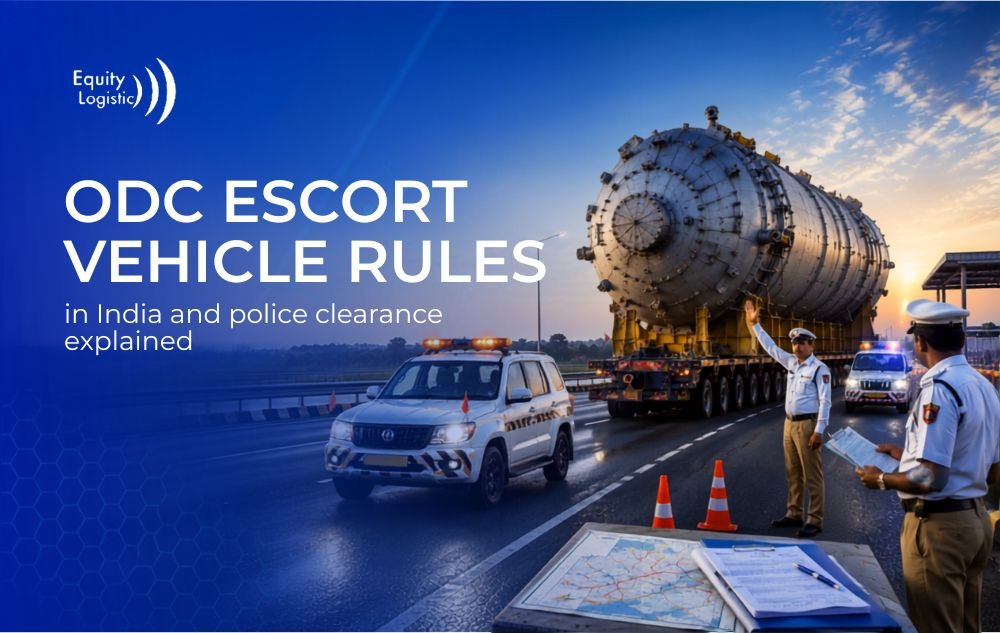
Moving over-dimensional cargo (ODC) across Indian highways is never a simple point-to-point trip. Once a consignment exceeds the legal limits for width, height, or length, it stops being ordinary freight and becomes a regulated movement that requires escort vehicles, route surveys, permits, and, in many corridors, formal police clearance. For EPC contractors, plant procurement teams, and project developers, misunderstanding these rules is one of the most common causes of costly delays, penalties, and stranded cargo. This guide breaks down how escort vehicle rules and police clearance actually work for ODC transportation in India, so your project timelines stay intact.
What Qualifies as Over-Dimensional Cargo (ODC)?
Cargo is classified as over-dimensional when it breaches the standard dimensional envelope permitted for road movement under the Central Motor Vehicles Rules and the relevant state regulations. In practical terms, a load becomes ODC when the vehicle and cargo together exceed the normal legal limits for overall width, height above ground, or total length, or when the combined gross weight demands a multi-axle configuration.
Typical examples handled in project logistics include transformers, boilers, wind turbine blades, refinery columns, pressure vessels, transmission line towers, and large structural steel. Because these units cannot be dismantled, the movement itself must be engineered around the cargo. That engineering begins with correctly identifying the ODC category, since the category directly determines how many escort vehicles you need and whether police clearance is mandatory.
If your consignment overlaps with heavy or awkward units, it is worth reviewing how special cargo handling and project cargo movement are planned end to end before you fix a dispatch date.
Why Escort Vehicles Are Mandatory for ODC Movement
Escort vehicles, often called pilot cars, exist to protect both the cargo and the public. An over-dimensional trailer travelling below highway speed, occupying more than one lane, or carrying a load that overhangs the carriageway creates genuine risk to other road users. Escort vehicles manage that risk by warning oncoming traffic, controlling lane changes, guiding the trailer through junctions, and physically checking clearances at bridges, underpasses, toll plazas, and overhead utilities.
Beyond safety, escorts are a legal condition attached to most ODC permits. State transport authorities frequently make permit validity conditional on the presence of a specified number of escort vehicles. If the movement is stopped and the required escorts are absent, the permit can be treated as violated, exposing the operator to fines and detention of the vehicle. This is why an experienced transporter in India treats escort planning as a core part of the movement, not an afterthought.
Front Escort vs Rear Escort: What Each Does
- Front escort (lead pilot): travels ahead of the trailer, scouts the road, warns of the approaching over-dimensional load, verifies overhead and side clearances, and signals when it is safe to proceed through narrow stretches or turns.
- Rear escort (tail pilot): protects the back of the convoy, manages faster traffic trying to overtake, and prevents vehicles from cutting into the gap around an overhanging or slow-moving load.
- Height pole / clearance escort: for very tall consignments, a vehicle fitted with a flexible height pole runs ahead to physically confirm clearance under bridges, gantries, and power lines before the cargo reaches them.
How Many Escort Vehicles Do You Need?
There is no single national number. The escort requirement scales with the severity of the over-dimension and the conditions of the route. As a working rule, a mildly over-width load on an open national highway may need only a single rear escort, while a load that is simultaneously over-width, over-height, and over-length moving through congested or hilly terrain can require front and rear escorts plus a dedicated height-clearance vehicle.
The final count is usually set by the permitting authority when it issues the movement permit, and it can change at state borders as you move from one jurisdiction to another. Planning for the strictest requirement along the entire route, rather than the most lenient, is the safest approach and avoids a convoy being halted midway because it entered a state with tougher rules.
Permits Behind Every ODC Movement
Escort rules never exist in isolation. They sit on top of a permit framework that legalises the movement in the first place. Before wheels turn, an ODC consignment typically needs several approvals aligned together.
- Special ODC / oversize load permit issued by the state transport department authorising the specific dimensions and weight.
- Route permit that fixes the exact approved path, since ODC movements cannot deviate freely from the sanctioned corridor.
- National Permit or state-specific goods carriage authorisation for the prime mover and trailer.
- Bank guarantees or security deposits where highways, bridges, or structures may need reinforcement or protection.
Because each state issues its own permit, a single cross-country movement can involve a stack of approvals that must all remain valid on the day of travel. Coordinating these alongside PAN India logistics is one of the reasons project cargo is routed through specialists rather than general fleet operators.
When Is Police Clearance Required?
Police clearance becomes necessary when an ODC movement will materially affect public traffic, block a carriageway, require lane closures, or pass through urban areas, sensitive zones, or complex junctions. In these situations, the transport permit alone is not enough; the movement must also be coordinated with the traffic police and, in some cases, local district authorities.
Police clearance serves a coordination function. It allows the authorities to schedule the movement during low-traffic windows, arrange temporary traffic halts at critical crossings, and station personnel where the convoy must occupy multiple lanes. For very large consignments, this can extend to escorting the load through a city at night or briefly stopping traffic at a major intersection while the trailer negotiates a turn.
How the Police Clearance Process Typically Works
- Application: the transporter submits movement details, cargo dimensions, gross weight, the approved route, and the proposed schedule to the relevant police jurisdiction.
- Route assessment: traffic police review the corridor for pinch points, sensitive installations, and timing constraints.
- Conditions: clearance is often granted with conditions such as night-only movement, specified speed limits, and mandatory escort presence.
- Multi-jurisdiction coordination: for interstate movements, clearance may be required from each state or district the convoy passes through, all synchronised to the travel calendar.
Route Survey: The Step That Prevents Most Failures
A physical route survey is the single most valuable exercise before dispatch. Maps and satellite imagery cannot reliably show whether a specific flyover offers enough vertical clearance, whether a village bend can accommodate a long trailer, or whether a bridge is rated for the axle load. A survey team drives the sanctioned route in advance, measures constrained points, identifies obstacles such as low cables, road furniture, and toll canopies, and records where temporary removal or diversion is required.
The survey feeds directly into the escort plan and the police clearance application. It confirms how many escorts are genuinely needed, where the height pole must be active, and which junctions will require police-managed traffic stoppages. Skipping this step is the most frequent reason an ODC movement is halted midway, which is why a disciplined logistics solution always builds the survey into the timeline.
Common Mistakes That Derail ODC Movements
- Treating escort counts as fixed nationally instead of planning for the strictest state on the route.
- Securing the transport permit but overlooking separate police clearance for urban or high-traffic stretches.
- Allowing permits, escorts, and police approvals to fall out of sync so one expires before the movement completes.
- Skipping the physical route survey and discovering a low bridge or unrated culvert only when the trailer arrives.
- Underestimating night-movement conditions, which slow progress and stretch the number of travel days.
Why Partner With a Specialist ODC Transporter
ODC movement is a regulatory and engineering discipline as much as a transport service. The interplay of dimension-based permits, variable escort requirements, state-by-state police clearance, and route feasibility means that a single missed approval can strand high-value project cargo and push back a plant commissioning date. Working with a partner who handles over-dimensional cargo, end-to-end project handling, and coordinated pan-India movement means the permits, escorts, surveys, and clearances are managed as one integrated plan.
If you are planning a transformer, boiler, turbine, or heavy structural movement and need the escort and police-clearance framework mapped to your exact route, our team can scope it for you. Reach out through our contact and quote page to get a compliant movement plan built around your project schedule.
Frequently Asked Questions (FAQ)
- What is the difference between an escort vehicle and a pilot car for ODC movement?
The terms are used interchangeably in India. Both refer to the vehicles that travel ahead of or behind an over-dimensional trailer to warn traffic, verify clearances, and guide the load safely. A front escort scouts the road and checks clearances, while a rear escort protects the back of the convoy from overtaking traffic.
- Is police clearance always required for ODC transportation?
No. Police clearance is required when the movement affects public traffic, needs lane closures, or passes through urban areas, sensitive zones, or complex junctions. Purely rural, open-highway movements of mildly over-dimensional cargo may proceed on the transport permit and escorts alone, but any doubt should be resolved in favour of seeking clearance.
- How many escort vehicles does an ODC consignment need?
It varies with the degree of over-dimension and the route conditions, and it is set by the permitting authority. A mild over-width load may need one rear escort, while a load that is over-width, over-height, and over-length in difficult terrain may need front and rear escorts plus a height-pole vehicle. Always plan for the strictest requirement along the route.
- Can ODC cargo be moved during the day?
Some movements are permitted during daytime on open highways, but large or highly obstructive consignments are frequently restricted to night hours to reduce traffic disruption. The travel window is usually specified as a condition of the permit or police clearance. A specialist transporter plans dispatch timing around these conditions.
- How long does it take to arrange permits and police clearance for an ODC movement?
Lead time depends on the number of states involved, the severity of the over-dimension, and the complexity of the route. Multi-state movements requiring police coordination in several jurisdictions need to be planned well in advance. Building the route survey and approvals into the schedule early is the best way to protect your commissioning date. You can discuss your specific timeline with our team via the quote page.
- Where can I read more about heavy and project cargo movement?
You can explore related guides on our blog, and review our core services for ODC, special cargo handling, and project handling.