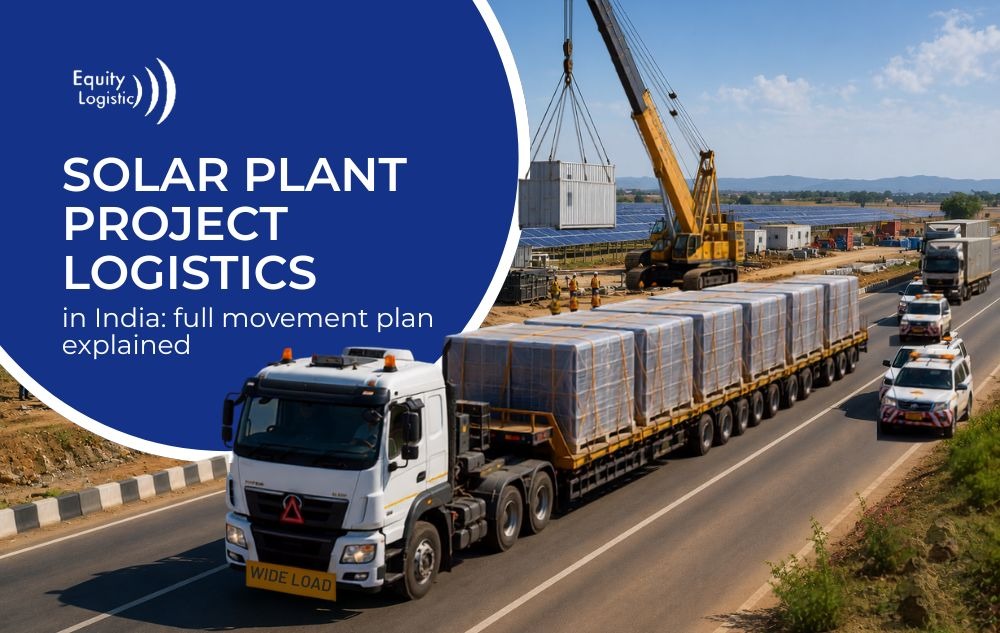
A utility-scale solar plant is only as fast to build as its supply chain. Behind every gigawatt of installed capacity sits a complex logistics operation moving lakhs of modules, inverters, transformers, mounting structures, and balance-of-system components from ports and factories to sites that are often in remote, high-radiation, low-infrastructure regions. For renewable energy developers and EPC contractors, a poorly sequenced logistics plan translates directly into idle crews, storage congestion, and missed commissioning deadlines. This guide lays out the full movement plan for solar module transportation and complete solar plant project logistics in India.
Why Solar Logistics Is Different From General Freight
Solar logistics combines high volume with high fragility and tight sequencing. A single large project can require thousands of pallets of glass modules, each sensitive to micro-cracks, moisture, and mechanical shock, alongside heavy transformers and inverters that fall squarely into over-dimensional and project cargo territory. The components arrive from different origins, on different lead times, and must reach the site in the order the construction schedule demands, not simply whenever they are ready to ship.
This is why solar movement is planned as an integrated project handling exercise rather than a series of disconnected truckloads. The plan has to reconcile factory dispatch, port clearance, inland transport, on-site storage, and installation sequence into one continuous flow.
The Components That Move Into a Solar Plant
Solar Modules (Panels)
Modules are the highest-volume item and the most vulnerable to handling damage. They travel in stacked pallets and must be protected from vibration and point loads throughout transit. Because micro-cracks are invisible yet performance-destroying, module movement demands careful load securing, appropriate stacking limits, and controlled handling at every transfer point. Detailed planning for solar module transportation is the backbone of the whole operation.
Inverters and Transformers
Central inverters and step-up transformers are heavy, sensitive, and often over-dimensional. Large transformers in particular can require multi-axle trailers, route surveys, and escort vehicles, placing them in the ODC and special cargo handling category. Their arrival must be timed to the readiness of the power evacuation infrastructure on site.
Mounting Structures and Trackers
Module mounting structures, tracker assemblies, and piles are bulky, high-tonnage, and shipped in enormous quantities. They are less fragile than modules but dominate the weight and volume profile of the project, making them a major driver of trailer numbers and warehousing footprint.
Cables, Combiner Boxes, and Balance of System
The remaining balance-of-system items such as DC and AC cabling, combiner boxes, earthing material, and monitoring equipment are lower in volume but critical to sequencing. If they arrive late, installed modules and structures cannot be energised, so they are woven into the same delivery schedule.
The Full Movement Plan, Stage by Stage
Stage 1: Origin Dispatch and Consolidation
The plan begins at the factory gate, whether that is a domestic module plant or an overseas manufacturer. Consignments are consolidated and documented, with special attention to how modules are palletised and secured for the journey ahead. For imported modules, this stage also covers booking sea freight and aligning shipment timing with the site construction calendar so that cargo does not arrive months before it can be installed or, worse, after crews are already waiting.
Stage 2: Port Handling and Customs Clearance
Imported solar cargo arrives at an Indian port, where customs clearance, documentation, and careful discharge handling determine whether modules reach the site intact. Delays or rough handling at this stage cascade through the entire project. Coordinating port operations with onward inland transport is a core part of a robust logistics solution, ensuring cargo moves off the port promptly rather than accruing demurrage.
Stage 3: Inland Transport to the Project Region
From the port or factory, cargo moves across the country to the project region, frequently in Rajasthan, Gujarat, Madhya Pradesh, Karnataka, or other high-irradiation states. This long-haul leg is where PAN India logistics capability matters, because it combines large volumes of module trailers with the specialised movement of over-dimensional transformers and inverters, all converging on the same site window.
Stage 4: Regional Warehousing and Staging
Because solar sites rarely have space to receive an entire project at once, cargo is usually routed through a regional warehouse or staging yard near the site. This buffer decouples arrival from installation: modules and structures are stored safely, protected from weather and damage, and released to the site in the exact sequence the construction team requires. Effective staging is what prevents the two classic failures of solar logistics, namely an overwhelmed site with nowhere to unload and an idle site waiting for the next delivery.
Stage 5: Last-Mile Delivery to the Site
The final leg often runs over unpaved approach roads into open land with no formal loading infrastructure. Last-mile delivery has to account for the site’s access limitations, on-site unloading equipment, and the daily installation rate, feeding components to the construction front in a steady, sequenced flow rather than in disruptive bulk dumps.
Sequencing: The Hidden Engine of Solar Logistics
The difference between a smooth solar build and a stalled one is almost always sequencing. Structures must be on site before modules can be mounted; transformers and inverters must arrive as power evacuation nears readiness; cabling must land in step with the energisation plan. A movement plan that delivers the right components in the right order keeps installation crews continuously productive.
This is why solar logistics is planned backwards from the commissioning date. The construction schedule defines the required on-site sequence, the staging plan defines how cargo is held and released, and the transport plan defines how and when cargo leaves origin. Managed as one integrated project, the flow stays predictable even across thousands of shipments.
Hidden Costs and Risks to Plan For
- Demurrage and detention when imported cargo is not cleared and moved off the port quickly enough.
- Module breakage from poor palletising, over-stacking, or rough transfers, which silently erodes plant performance.
- Storage congestion when cargo arrives faster than the site can absorb it, forcing expensive emergency warehousing.
- Idle-crew costs when a single delayed component category stalls an otherwise ready installation front.
- Over-dimensional surprises when transformer movements are treated as ordinary freight and hit escort or permit hurdles late.
Building a Reliable Solar Movement Plan
A dependable solar logistics plan treats modules, over-dimensional equipment, structures, and balance-of-system items as one coordinated flow, aligned from factory and port through to the installation front. It combines careful solar module transportation, specialised ODC and heavy equipment movement, regional warehousing and staging, and disciplined pan-India transport into a single schedule tied to your commissioning date.
If you are developing or building a utility-scale solar plant and want an end-to-end movement plan mapped to your construction sequence, our team can build it around your sites and timelines. Get in touch through our contact and quote page to start scoping your solar logistics plan.
Frequently Asked Questions (FAQ)
- What makes solar module transportation different from ordinary freight?
Solar modules are high in volume and extremely sensitive to micro-cracks, vibration, and mechanical shock, and damage is often invisible yet performance-destroying. They require careful palletising, controlled stacking, and gentle handling at every transfer, which is why dedicated module transportation is planned as a specialised movement rather than general cargo.
- Do solar transformers and inverters count as over-dimensional cargo?
Large central inverters and step-up transformers are heavy and frequently over-dimensional, requiring multi-axle trailers, route surveys, and escort vehicles. These fall into the ODC and special cargo handling category and must be planned separately from the module flow.
- Why is warehousing needed for a solar project?
Solar sites rarely have room to receive an entire project at once, so cargo is buffered through a regional warehouse or staging yard. This lets components be stored safely and released to the site in the exact installation sequence, preventing both site congestion and idle crews waiting on the next delivery.
- How is a solar logistics plan sequenced?
It is planned backwards from the commissioning date. The construction schedule sets the required on-site order, structures arrive before modules, transformers and inverters arrive as power evacuation nears readiness, and cabling lands in step with energisation. This keeps installation crews continuously productive.
- Which regions in India commonly host utility-scale solar projects?
High-irradiation states such as Rajasthan, Gujarat, Madhya Pradesh, and Karnataka are common project regions, often in remote areas with limited road infrastructure. Reaching them reliably requires strong pan-India logistics capability combined with last-mile planning for unpaved site access.
- Where can I learn more about project and heavy cargo logistics?
You can explore more guides on our blog, and review our core services for project handling, solar module transportation, and end-to-end logistics solutions.