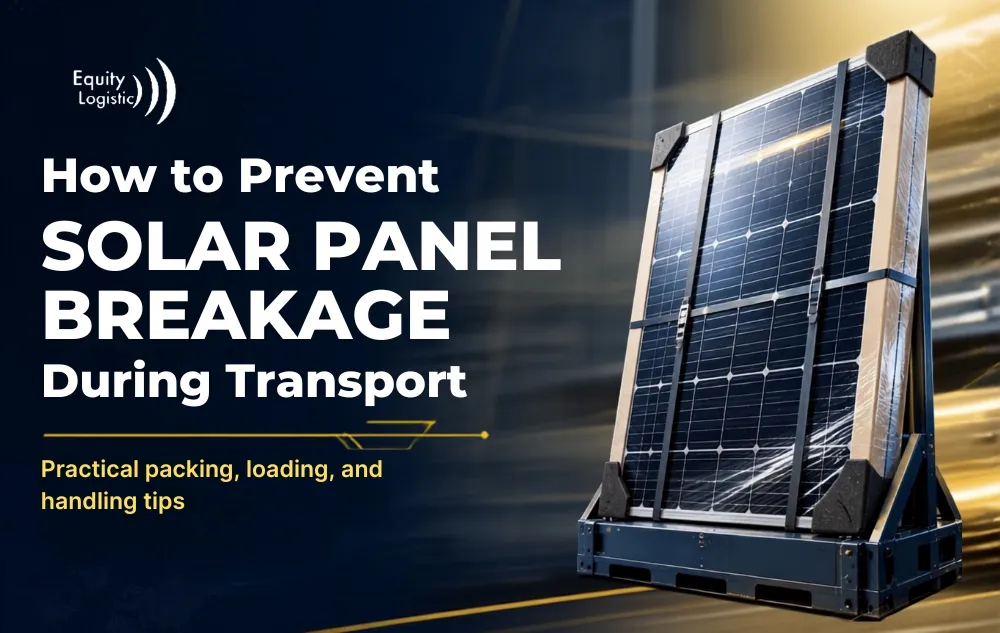
Solar modules are deceptively fragile. A panel that survives decades of hail and wind on a rooftop can be ruined in transit by a single mishandled pallet or an unsupported road shock. For solar EPC contractors and renewable developers moving thousands of modules to a project site, even a small breakage rate translates into real financial loss, warranty disputes, and schedule delays while replacements are sourced. Preventing breakage in transit is therefore not a packing detail — it is a project-critical discipline.
This guide covers the practical, field-proven measures that keep solar modules intact from factory to site, and why specialised handling matters for utility-scale volumes. If you are moving modules across India, Equity Logistics offers dedicated solar module transportation built around cargo integrity.
Why Solar Panels Break in Transit
Understanding the failure modes is the first step to preventing them. Solar module damage in transport falls into a few recurring categories:
- Micro-cracks — invisible fractures in the silicon cells caused by vibration, flexing, or shock. They rarely show at delivery but degrade output over the panel’s life and often void warranties.
- Glass breakage — visible shattering of the front glass from impact, point loading, or crushing under stacked weight.
- Frame and junction-box damage — from rough handling, improper lifting, or poor pallet securing.
- Edge and corner damage — the most vulnerable points, easily chipped when pallets shift or are dropped.
Critically, micro-cracks are the most dangerous because they are invisible at goods-inward inspection. A consignment can look perfect on arrival and still carry a hidden defect rate that only appears as underperformance months later. This is why prevention, not just inspection, is essential.
Packaging: The First Line of Defence
Manufacturer Packaging Standards
Reputable module manufacturers pack panels in engineered cartons and pallets — vertical stacking with foam edge protectors, corner guards, and moisture barriers. The single most important rule is: do not compromise the original packaging. Modules should stay in their factory pallets until they reach the installation staging area.
Vertical vs Horizontal Stacking
Modules are designed to be transported standing on edge (vertically), not stacked flat. Flat stacking concentrates load on the glass and cell surface, dramatically increasing micro-crack risk. Vertical orientation lets the frame bear the load as intended. Any handling plan must preserve this orientation end to end.
Pallet Integrity and Banding
Pallets must be intact, correctly banded, and never over-stacked beyond the manufacturer’s maximum tier count. Compromised or re-used pallets are a common source of in-transit collapse. Where pallets are consolidated for a movement, professional special cargo handling ensures banding and load distribution are checked before departure.
Loading and Handling Best Practices
- Use forklifts with the correct fork length and spacing so pallets are supported across their full base, never on two points.
- Never lift or drag pallets by hand-jacking on uneven ground where they can tip.
- Load modules snugly against each other and against the trailer walls to eliminate movement, but without crushing pressure between pallets.
- Block and brace every pallet so nothing can shift, slide, or topple during transit or sudden braking.
- Keep the vertical orientation consistent — mixing orientations in one load creates uneven load paths and pressure points.
- Train handling crews specifically on modules; general cargo handlers often treat pallets as ordinary freight, which is where damage begins.
Controlling Vibration and Road Shock
Vibration over long road journeys is the primary cause of micro-cracks, and India’s mixed road conditions make it a serious factor. Several measures reduce it:
- Use trailers with air-ride suspension where possible, which absorb far more road shock than leaf-spring suspension.
- Plan routes to favour better road surfaces even at the cost of some extra distance — a smoother longer route can mean fewer cracked modules than a rough short one.
- Secure pallets with anti-vibration dunnage and ensure they cannot resonate against hard surfaces.
- Brief drivers on gentle acceleration and braking, and on avoiding potholes and speed breakers at speed.
For large PAN-India module deliveries, route planning that balances distance against road quality is part of protecting the consignment, not an afterthought.
Route Planning and Environmental Protection
Beyond vibration, the route and environment matter. Modules should be protected from prolonged moisture ingress, so weatherproof covering and sealed containers matter during monsoon movements. Sudden temperature and humidity swings can affect packaging integrity over long transits. For remote or difficult destinations — island projects served through our Andaman & Nicobar logistics or high-altitude sites — additional handling stages (port transfers, transhipment) each add a breakage risk that must be planned for and minimised.
The Real Cost of Breakage for Solar Projects
It is tempting to treat a small breakage rate as an acceptable cost of doing business. For utility-scale projects, the arithmetic says otherwise. A breakage or micro-crack rate of even a few percent across a consignment of thousands of modules means dozens of panels to replace, each carrying not just its own cost but the freight to return it, the wait to source a replacement, and the labour to swap it out during or after installation.
Worse, micro-cracked panels that pass inspection get installed, then underperform across the array’s life, dragging down the plant’s energy yield and complicating warranty claims that the manufacturer may reject if transit handling cannot be proven. Prevention in transit is therefore vastly cheaper than the downstream cost of damage — a point often missed when logistics is chosen on headline freight price alone.
Common Handling Mistakes to Avoid
- Restacking modules flat to ‘save space’ on the trailer — this is the single most damaging shortcut and directly causes micro-cracks.
- Breaking open factory pallets before the module reaches the staging area, exposing panels to mishandling.
- Using general cargo crews without module-specific briefing, who treat pallets as ordinary freight.
- Over-stacking pallets beyond the manufacturer’s maximum tier count, crushing the lower tiers.
- Skipping origin-condition photos, leaving you unable to prove where damage occurred when a claim arises.
- Choosing the cheapest transporter with no module experience, then paying far more in breakage than was saved on freight.
Inspection, Documentation and Claims
Even with best practice, verification protects you commercially:
- Inspect and photograph pallets at loading, so origin condition is documented.
- Record any handling incident immediately rather than at final delivery.
- On arrival, inspect for visible damage before signing off, and note the limits of visual inspection for micro-cracks.
- For high-value consignments, consider electroluminescence (EL) testing of samples to detect hidden micro-cracks.
- Maintain a clear chain-of-custody so any breakage claim can be traced to a stage and party.
Why Specialised Solar Logistics Matters
Solar modules are not general cargo, and treating them as such is where breakage rates climb. A logistics partner experienced in module movement understands vertical orientation, pallet integrity, vibration control and destination-specific handling — and prices for cargo integrity, not just distance. Equity Logistics provides dedicated solar module transportation for utility-scale and commercial solar projects across India. To protect your next consignment, request a quote with your module volume, origin and site details.
Frequently Asked Questions
What causes most solar panel damage during transport?
Vibration-induced micro-cracks are the leading cause, followed by glass breakage from impact or improper stacking. Micro-cracks are especially problematic because they are invisible at delivery but reduce output over the panel’s life. Our solar module transport service is built specifically to minimise these risks.
Should solar panels be transported flat or upright?
Upright (vertically, on edge) as designed. Flat stacking concentrates load on the glass and cells, sharply increasing micro-crack and breakage risk. Orientation must be preserved consistently from factory to site.
What are micro-cracks and why do they matter?
Micro-cracks are tiny fractures in a module’s silicon cells caused by vibration or flexing. They are invisible to the eye, often pass delivery inspection, and then degrade power output over time and can void warranties — which is why prevention in transit is critical.
How can vibration damage be reduced on Indian roads?
Use air-ride suspension trailers, plan routes favouring better road surfaces, secure pallets with anti-vibration dunnage, and brief drivers on gentle driving. Balancing route distance against road quality is part of protecting the load — see our PAN-India logistics.
How do I detect hidden damage after delivery?
Visual inspection catches glass and frame damage but not micro-cracks. For high-value consignments, electroluminescence (EL) testing of sample modules reveals hidden cracks. Always photograph and document condition at both loading and delivery.
Do panels going to islands or remote sites face higher breakage risk?
Yes, because extra handling stages — port transfers and transhipment — each add risk. Specialised planning for destinations such as Andaman & Nicobar minimises the number and impact of these transfers.
Why use a specialised solar logistics provider instead of a general transporter?
General transporters treat module pallets as ordinary freight, which is where damage starts. A specialist understands orientation, pallet integrity, vibration control and destination handling, and prices for cargo integrity. Request a quote to move your modules safely.