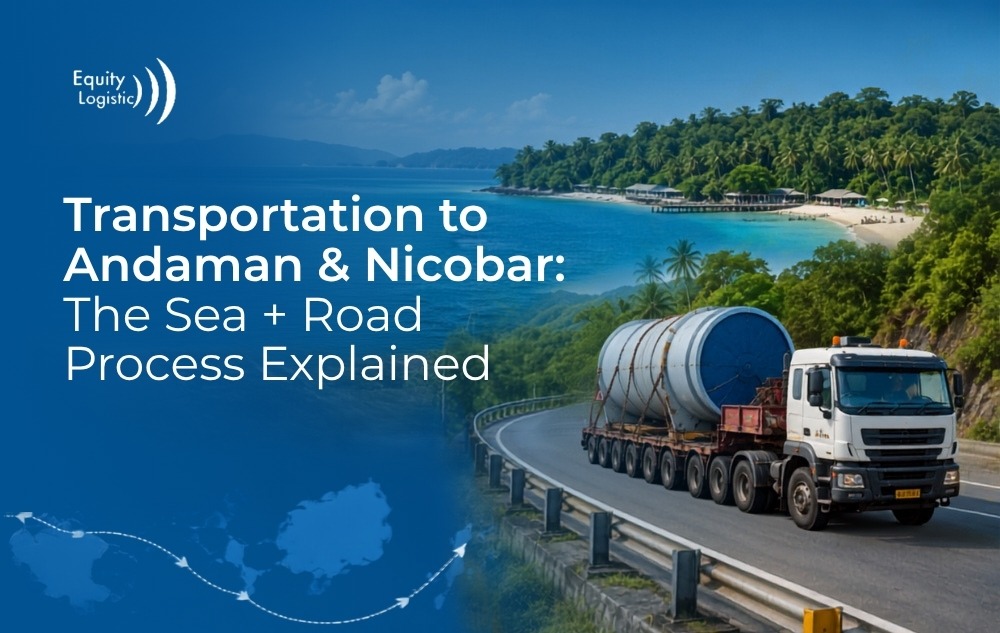
Unlike any mainland destination, the Andaman & Nicobar Islands cannot be reached by a single truck driving door to door. Cargo has to move in two distinct legs — a road leg across the Indian mainland to a designated gateway port, followed by a sea leg across roughly 1,200 kilometres of the Bay of Bengal to Port Blair. Understanding how these two legs connect is the single most useful thing a shipper can learn before booking a consignment. This guide walks through the complete sea-plus-road process end to end, so you know exactly what happens to your cargo, what paperwork is needed, and how to get a move underway.
Why Andaman logistics is a two-leg journey
The islands have no rail link and no road bridge to the mainland. Every industrial carton, machine, vehicle or project component that arrives in Port Blair has travelled by ship. Chennai, Kolkata and Visakhapatnam are the principal mainland gateway ports that operate cargo vessels to the Andamans, with Chennai being the busiest and most frequently used lane. Your cargo first has to reach one of these ports by road, get consolidated and documented, and then sail. Getting either leg wrong — a missed sailing, an incomplete document, an under-specified crate — can add a week or more to transit, because sailings are scheduled rather than continuous.
This is why island cargo is best handled by a single accountable operator rather than a chain of subcontractors. Equity Logistics coordinates both legs under one relationship through its Andaman & Nicobar transportation service, so the road movement, port handling and sea transportation are planned together instead of being handed off blind.
Step 1 — Pickup and the mainland road leg
The journey begins at your factory, warehouse or project yard. Cargo is assessed for weight, dimensions and fragility, then loaded onto the right vehicle — a standard truck for palletised goods, or a multi-axle or low-bed trailer for heavier and oversized items. From there it moves by road to the gateway port. For most shippers based in the north or west, that means a run to Chennai; eastern shippers may route through Kolkata or Visakhapatnam. Proper lashing and weatherproofing matter here, because the cargo is about to face a sea voyage.
Step 2 — Port handling, consolidation and documentation
At the gateway port the cargo is received, weighed and booked onto a specific sailing. This is where documentation is finalised: invoice, packing list, shipper and consignee details, and cargo declarations. Because the islands are a Union Territory rather than a foreign country, movement is domestic — there is no customs clearance in the international sense — but shipping-line booking formalities, e-way bills and vessel manifests still have to be exact. Less-than-container-load cargo is consolidated with other consignments; full loads are stuffed into their own container or booked as break-bulk for outsized items.
Step 3 — The sea voyage to Port Blair
The vessel sails from the mainland to Port Blair’s Haddo Wharf. Sailing time is typically around three to four days at sea, but the total door-to-port timeline depends heavily on how frequently vessels depart on your chosen lane and whether your cargo makes the next available sailing. Realistically, shippers should plan for a two-to-three week total window from pickup to island arrival for general cargo, and longer for oversized or project loads that need a specific vessel. Booking ahead of the sailing schedule — rather than after cargo reaches the port — is the biggest lever you have on transit time.
Step 4 — Island offloading and final delivery
On arrival at Port Blair, cargo is discharged, cleared through port formalities and moved to its final destination on the island by road. If the consignment is heading to a site beyond South Andaman, an additional inter-island leg by ferry or barge may be required. Condition reporting and documented handover close out the movement, giving you a clean record of delivery.
Common mistakes that delay island shipments
Most Andaman delays are self-inflicted and avoidable. The first is treating the move like a mainland courier job — dispatching cargo to the port and assuming it will “just go on the next ship.” Sailings are scheduled and space is finite, so cargo that arrives without a confirmed booking waits. The second is under-declaring dimensions or weight, which means the cargo doesn’t fit the booked slot and gets bumped. The third is incomplete paperwork: a missing e-way bill or an inaccurate packing list can hold a consignment at the wharf while everything else sails. The fourth is inadequate packing for a sea voyage — cargo packed for a short truck run can arrive damaged after days at sea. A specialist plans against all four before your cargo leaves the yard.
What you need to provide to book a move
- Cargo details — type of goods, weight, dimensions and number of packages.
- Origin and destination — exact pickup address and the island delivery point.
- Documents — commercial invoice, packing list and e-way bill where applicable.
- Special handling notes — fragile, hazardous, temperature-sensitive or oversized flags.
- Timeline — your required delivery date, so the move can be planned around the sailing schedule.
For fragile, high-value or technically sensitive items, this feeds naturally into our special cargo handling process. If your consignment forms part of a larger installation, our project handling team sequences multiple shipments around site readiness rather than moving everything at once.
Frequently asked questions
Q1. How is cargo actually transported to the Andaman Islands?
By a combined road-and-sea route. Cargo travels by road to a mainland gateway port — usually Chennai, Kolkata or Visakhapatnam — and is then shipped by sea to Port Blair, before a final road leg to its island destination.
Q2. Which port should my cargo sail from?
Chennai is the busiest and most frequently used lane to Port Blair, but Kolkata and Visakhapatnam also operate cargo vessels. The right choice depends on your origin location and the sailing schedule.
Q3. Do I need customs clearance?
No. The Andaman & Nicobar Islands are a Union Territory of India, so movement is domestic. There is no international customs process, though shipping-line booking formalities and e-way bills still apply.
Q4. How long does the whole journey take?
Plan for roughly two to three weeks door-to-island for general cargo. The sea leg itself is about three to four days, but the total depends on the road distance and how soon your cargo makes an available sailing.
Q5. How do I book a shipment?
Share your cargo details, origin, destination and timeline with the Equity Logistics team through the contact page, and we will build the movement plan and quote around the next suitable sailing.
Related reading: How to Get Around: Transportation in Andaman & Nicobar · Transportation in Andaman & Nicobar Islands · Sea Transportation services.