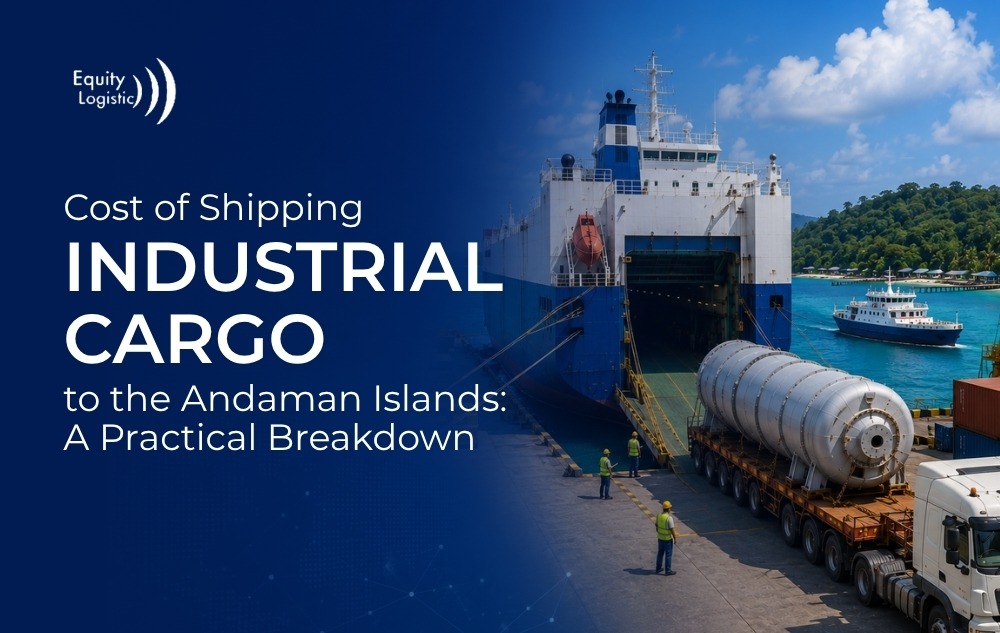
“What will it cost to ship this to the Andamans?” is usually the first question industrial shippers ask — and the honest answer is: it depends on several things that are worth understanding before you compare quotes. Island freight is priced differently from mainland trucking because it combines a road movement, port handling and a scheduled sea voyage into one chain. This article breaks down the real cost components so you can read a quote intelligently, budget accurately and avoid nasty surprises at the port.
The cost is built from stacked legs, not one flat rate
A mainland-to-island quote is the sum of several stages rather than a single per-kilometre rate. Each stage adds cost, and each responds to different variables. Broadly, an industrial Andaman shipment is priced across five buckets: the mainland road leg, port and handling charges, the sea freight itself, insurance, and island-side delivery. Understanding each helps you see where the money goes — and where a well-planned move can save it.
1. The mainland road leg
This is the cost of moving your cargo from origin to the gateway port. It scales with distance, cargo weight and the type of vehicle required. A palletised load on a standard truck is far cheaper per tonne than an oversized component needing a low-bed trailer, permits and escorts. Shippers closer to Chennai, Kolkata or Visakhapatnam naturally pay less on this leg than those dispatching from deep inland.
2. Port and handling charges
Loading, unloading, consolidation, container stuffing and wharf handling all carry charges at the mainland port and again at Port Blair. Break-bulk and oversized cargo cost more to handle than neatly containerised loads because they need cranes, riggers and more labour.
3. The sea freight
This is the core island premium. Sea freight is generally priced by volume or weight — whichever is greater — and by whether you are moving less-than-container-load, a full container, or break-bulk. Vessel availability and sailing frequency on your chosen lane influence the rate too. Because sailings are scheduled, cargo that misses a sailing incurs storage while it waits, which is a hidden cost worth planning against.
4. Insurance
For industrial and high-value cargo, transit insurance is strongly advised given the sea leg. It is typically a small percentage of declared cargo value and is money well spent for machinery, electronics and project components. Equity Logistics builds transit insurance into movements as standard commercial protection.
5. Island-side delivery
Final delivery from Port Blair’s wharf to your site adds a road leg on the island, and an inter-island ferry or barge charge if the destination lies beyond South Andaman.
Factors that make quotes go up or down
- Volume vs weight — light but bulky cargo is often charged on volume, so efficient packing lowers cost.
- Oversized dimensions — anything needing special trailers, cranes or break-bulk shipping costs materially more.
- Consolidation — sharing container space on LCL shipments spreads cost across shippers.
- Timing — booking ahead of the sailing schedule avoids storage and demurrage-type waiting costs.
- Full accountability vs multiple vendors — a single operator avoids the margin-stacking and coordination gaps of a subcontractor chain.
Because exact figures move with fuel, vessel schedules and cargo specifics, a reliable number always comes from a surveyed quote rather than a rate card. For anything oversized, the pricing logic follows our over-dimension consignments approach, where route surveys and equipment selection are priced in from the start. Where cargo needs to wait for the right sailing, our warehousing and staging service holds it securely rather than accruing open storage charges at the port.
Hidden costs that catch shippers out
The headline freight rate is rarely the whole story, and the gaps are where budgets get blown. Storage and waiting charges are the biggest culprit: cargo that reaches the port without a confirmed sailing sits in paid storage until space opens. Re-handling is another — cargo that has to be repacked, re-crated or re-lashed because it was under-prepared adds labour cost at the worst possible moment. Detention on trailers held too long at the port, charges for inaccurate weight declarations discovered at the weighbridge, and inter-island onward legs that weren’t scoped in the original quote all add up. The way to avoid them is not to chase the lowest headline number but to get a fully-scoped quote that names every leg, so there are no line items waiting to appear later.
How planning saves money, not just time
Cost and coordination are the same problem viewed from two angles. Booking ahead of the sailing schedule removes storage cost. Accurate declarations remove weighbridge penalties and bumped-sailing waiting. Consolidating routine material into shared containers spreads the sea-freight premium. Staging heavy items so they hit the right vessel avoids paying for a dedicated break-bulk sailing you didn’t need. In practice, the shippers who pay the least to the Andamans are not the ones who found the cheapest rate — they are the ones who planned the move well enough that no avoidable charge ever landed on the invoice.
How to get an accurate cost estimate
Give the operator the fullest possible picture: precise dimensions and weight, cargo value, origin, exact island destination and your required timeline. The more accurate the inputs, the tighter and more reliable the quote — and the smaller the chance of surprise charges when cargo reaches the port. Vague enquiries produce vague, padded quotes; detailed ones produce sharp, defensible pricing.
Frequently asked questions
Q1. Why is shipping to the Andamans more expensive than mainland transport?
Because the cost stacks a road leg, port handling and a scheduled sea voyage on top of each other, plus island-side delivery. The sea freight and double handling are the main premium over a straight mainland truck run.
Q2. Is sea freight charged by weight or volume?
Generally by whichever is greater. Dense, heavy cargo is charged on weight; light but bulky cargo on volume. Efficient packing therefore directly affects your bill.
Q3. Can I reduce costs by sharing container space?
Yes. Less-than-container-load consolidation lets you share space and cost with other shippers, which is usually the most economical option for smaller industrial consignments.
Q4. Should I insure industrial cargo for the sea leg?
For machinery, electronics and high-value project components, yes. Transit insurance is a small percentage of cargo value and provides commercial protection across the voyage; Equity Logistics includes it as standard.
Q5. How do I get an exact price?
Share full cargo details and timeline via the contact page for a surveyed, itemised quote rather than an indicative rate.
Related reading: Andaman & Nicobar transportation service · Efficient water transport with Equity Logistics · Warehousing services in India.