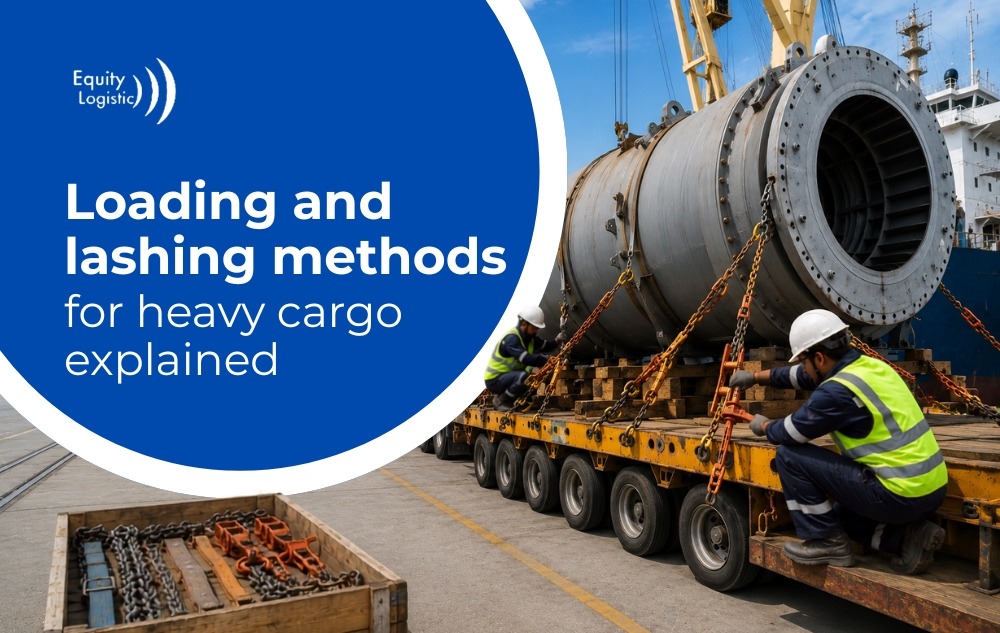
When a transformer, an industrial press or a wind-turbine section shifts even slightly in transit, the consequences range from surface damage to a full rollover. For heavy and over-dimensional cargo, how the load is placed on the trailer and how it is secured is not a formality at the end of the job — it is the core engineering that protects the asset, the crew and everyone else on the road. This guide explains, in practical terms, how professional heavy and special cargo is loaded and lashed for movement across India.
Why Loading and Lashing Deserve Engineering Attention
Heavy cargo generates enormous dynamic forces the moment a vehicle accelerates, brakes, corners or climbs a gradient. A load that feels immovable when static can slide, tip or rotate under those forces. Correct loading positions the mass so the trailer stays balanced and legal; correct lashing restrains it against forward, rearward, sideways and vertical movement for the entire journey. Skimp on either and you invite cargo damage, axle overload, penalties and serious accidents.
- Forward forces during braking are the largest and demand the strongest restraint.
- Cornering and lane changes create sideways forces that can tip a high or narrow load.
- Road shocks and gradients generate vertical and rearward forces, especially on rough or hilly lanes.
- An unbalanced load overloads individual axles, which is both unsafe and non-compliant.
Step One: Correct Loading and Weight Distribution
Securement begins before anything is tied down. The load must be positioned so its weight is distributed correctly across the trailer axles and centred laterally, keeping the centre of gravity as low and central as practical. Getting this right protects the vehicle, keeps axle loads legal and makes the subsequent lashing far more effective.
Placement Principles
- Position the centre of gravity low and over the trailer bed, not overhanging unless the trailer is designed for it.
- Distribute weight so no single axle exceeds its rated capacity.
- Use the full contact area of the bed to spread point loads and prevent deck damage.
- For over-dimensional consignments, match the trailer type — flatbed, low-bed, semi-low-bed or multi-axle hydraulic — to the cargo geometry.
The Role of Cranes and Handling Equipment
Placement itself requires the right lifting method. Cranes, gantries, forklifts and hydraulic jacks are selected by weight and lift geometry, with rated lifting points and spreader beams used to keep the load level and controlled during placement. Poor lifting technique can damage cargo before the journey even begins, so project cargo handling treats loading as an engineered lift, not a rushed step.
Step Two: Lashing and Securement Methods
Once the cargo is correctly placed, it is restrained so it cannot move relative to the trailer. Professional securement combines several methods, chosen by cargo weight, shape and centre of gravity.
Tie-Down (Friction) Lashing
Chains or webbing straps are tensioned over the top of the load, pressing it down onto the deck to increase friction and prevent movement. This is common for compact, stable loads. The number and rating of lashings is calculated against the cargo weight and expected forces — not estimated by eye.
Direct (Angled) Lashing
Chains or straps run from anchor points on the load to anchor points on the trailer at calculated angles, directly restraining the cargo against forward, rearward and sideways movement. This is the standard approach for heavy machinery with proper lashing points and is far stronger than friction alone for dense, tall or irregular loads.
Blocking and Bracing
Physical stops — timber blocking, steel stanchions, wedges and cradles — are placed against the cargo to prevent sliding and rolling. Cylindrical and round items are cradled or chocked so they cannot roll. Blocking absorbs forces that would otherwise be carried entirely by the lashings.
Combination Securement
In practice, a heavy consignment is usually restrained by a combination of all three: correct placement, blocking and bracing to stop movement mechanically, and direct plus friction lashing to hold everything firmly to the deck. The complete securement plan is calculated for the specific cargo and route.
Equipment Used for Heavy-Cargo Lashing
- Load-rated chains and tensioners for high-strength restraint of dense loads.
- Webbing straps and ratchets for cargo that must not be marked by chains.
- Edge protectors to spread load and prevent straps or chains cutting into cargo or corners.
- Anti-slip mats to increase friction between the cargo and the deck.
- Timber, steel stanchions, wedges and cradles for blocking, bracing and chocking.
- Certified lashing points and shackles rated to the calculated loads.
Compliance, Inspection and Documentation
Professional securement is a documented, standards-driven process. As an ISO 9001:2015 certified operator, Equity Logistics treats every heavy movement to a defined method: a securement plan matched to the cargo, correct equipment at rated capacity, and inspection before departure and at halts along the route. Lashings are re-checked and re-tensioned during transit because they can loosen as the load settles and the vehicle works. This discipline is what keeps high-value machinery arriving in the same condition it left.
For sensitive, high-value or special project cargo, securement is planned alongside the route survey so that pass heights, bridge limits and road conditions are all reflected in how the load is placed and tied. It is one integrated plan, not two separate steps.
Moving heavy machinery or over-dimensional cargo that must arrive undamaged? Speak to the Equity Logistics team about an engineered loading and securement plan for your consignment.
Frequently Asked Questions
What is the difference between loading and lashing?
Loading is positioning the cargo correctly on the trailer so weight is distributed across the axles and the centre of gravity is low and central. Lashing is securing that cargo so it cannot move during transit. Both are essential — good lashing cannot compensate for a badly loaded trailer.
What is the difference between tie-down and direct lashing?
Tie-down (friction) lashing presses the load onto the deck to increase friction, suiting compact stable loads. Direct (angled) lashing runs from anchor points on the load to the trailer at calculated angles to restrain movement directly, and is far stronger for heavy, tall or irregular machinery.
How many lashings does a heavy load need?
It is calculated, not guessed. The number and rating of lashings depends on the cargo weight, centre of gravity, shape and the forces expected on the route. A securement plan specifies exactly what is required for that specific consignment.
Why do lashings need to be re-checked during transit?
Loads settle and vehicles flex, vibrate and work over long distances and rough roads, which can loosen lashings. Professional operators inspect and re-tension securement at halts along the route to keep the cargo restrained for the entire journey.
What equipment is used to secure over-dimensional cargo?
A combination of load-rated chains and tensioners, webbing straps and ratchets, edge protectors, anti-slip mats, and blocking materials such as timber, steel stanchions, wedges and cradles, all anchored to certified lashing points rated to the calculated loads.
Does securement planning consider the route as well as the cargo?
Yes. For heavy and ODC movements the securement plan is prepared alongside the route survey, so pass heights, bridge load limits and road conditions all inform how the cargo is placed and tied. It is one integrated plan.