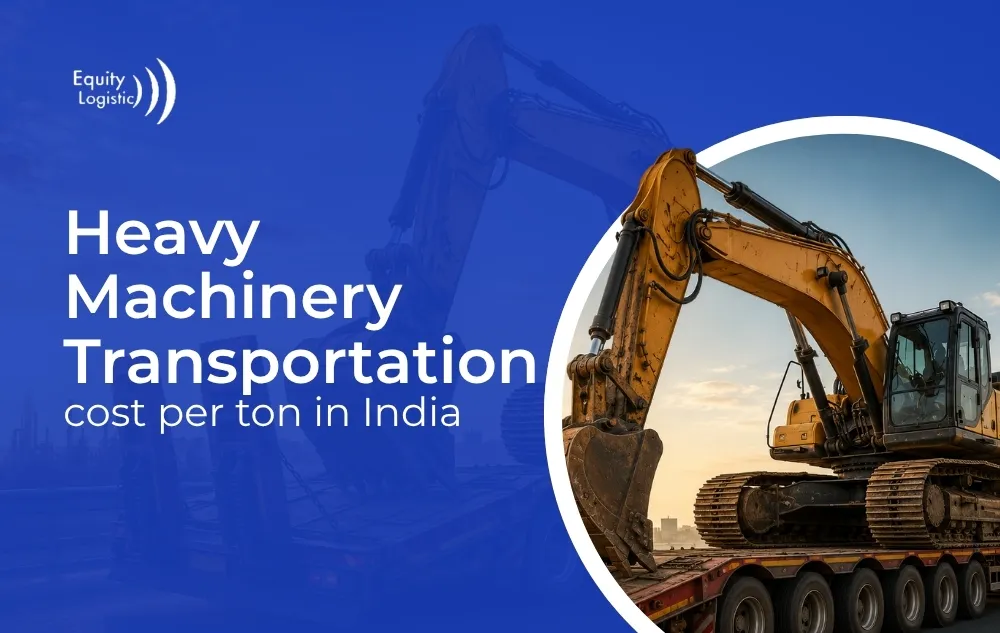
“What does it cost per ton?” is the first question most buyers ask when moving heavy machinery. It is a reasonable question — but for heavy and over-dimensional equipment, the per-ton figure is one of the most misleading numbers in logistics. Two machines of identical weight can cost very different amounts to transport, and understanding why is essential for anyone procuring plant, industrial equipment, or construction machinery in India.
This guide explains what actually determines heavy machinery transport cost, why the simple per-ton rate breaks down, and how to obtain a realistic estimate for your equipment. If you are moving industrial machinery across states, Equity Logistics provides specialised heavy and over-dimensional cargo transport built for exactly this challenge.
Why ‘Cost Per Ton’ Is Only Half the Story
Cost-per-ton works well for bulk commodities — coal, cement, steel coils — where the vehicle fills up predictably by weight. Heavy machinery is different. A compact 40-tonne press may sit neatly on a standard low-bed, while a 25-tonne but oversized crusher structure needs a hydraulic axle trailer, a route survey, and police escort. The lighter machine can easily cost more per tonne to move than the heavier one.
The truth is that heavy machinery transport is priced on the total operation, not on weight in isolation. Weight matters — it dictates trailer axle configuration and permit category — but dimensions, distance, route, and handling requirements often matter more. A meaningful quote reflects all of these, then expresses them as a total, from which a per-ton figure can be derived if you want one.
The Real Cost Drivers for Heavy Machinery Transport
- Weight and Trailer Type
Weight determines the vehicle. Up to around 25–40 tonnes, a semi low-bed or multi-axle trailer usually suffices. Beyond that, hydraulic modular axle trailers are needed, where axle lines are added to spread load and stay within legal per-axle limits. More axle lines means higher trailer cost and often escort requirements. This is the core of professional transporter services in India for heavy plant.
- Dimensions and Over-Dimensional Status
The moment a machine exceeds standard width, height, or length limits, it becomes over-dimensional cargo — and cost changes character entirely. Width triggers route surveys and escorts; height triggers overhead clearance checks and possible power-line lifting; length affects turning radius at every junction. A machine that is heavy but compact is far cheaper to move than one that is light but oversized.
- Distance and Route Difficulty
Distance is obvious; route difficulty is not. A 500 km run on national highways is cheaper per kilometre than a 200 km run through hilly terrain, narrow ghats, or congested industrial belts. Weak bridges force detours that inflate effective distance. Remote and difficult destinations — such as the Himalayan corridors served by our Leh & Ladakh logistics — carry premiums reflecting terrain, altitude and seasonal access windows.
- Loading and Unloading (Handling)
Getting the machine onto and off the trailer is a cost in itself. This may need mobile cranes, gantries, or hydraulic jacking and skidding for pieces too heavy to lift conventionally. If the origin factory or the destination site lacks suitable lifting infrastructure or hard standing, mobilising equipment adds materially to the bill. This handling expertise sits at the heart of special cargo handling.
- Permits, Escorts and Statutory Costs
Overweight and over-dimensional movements need state transport permits, and multi-state routes need clearance from each authority along the way. Pilot vehicles and, in many areas, police escort are mandatory for oversize loads. These costs rise with the number of states crossed and the sensitivity of the route.
- Insurance and Risk
High-value machinery must be insured in transit. Premiums reflect the equipment’s value and the route’s risk profile. For very high-value single pieces, insurer-nominated loading supervision may be required — a small cost that protects a very large asset.
Illustrative Cost Bands (Directional Only)
Because so many factors interact, credible providers avoid publishing flat per-tonne rates. The bands below are directional, to show how category rather than weight drives cost. They are not quotations — always confirm against your specific machine and route.
- Standard heavy machinery within normal dimensions, on national highways: the most economical category, priced close to conventional low-bed freight.
- Over-dimensional machinery requiring escorts and route survey: a significant step up, driven by permits, piloting and slower transit.
- Very heavy pieces needing hydraulic modular trailers and craneage: higher again, dominated by equipment mobilisation and handling.
- Remote or difficult destinations (hills, islands, high altitude): a premium on top of the above, reflecting terrain and seasonal windows.
Notice that the ladder is built on cargo category and route, not on tonnage. This is precisely why a genuine quote starts with your machine’s dimensions and destination, not just its weight.
Common Mistakes That Inflate Heavy Machinery Transport Costs
Many overruns are self-inflicted. Buyers who understand these mistakes negotiate better and budget more accurately:
- Quoting on weight alone — asking vendors only for a per-tonne rate invites either a lowball that excludes handling and permits, or an inflated hedge against unknowns. Provide dimensions and route so the quote reflects reality.
- Ignoring site access — a factory-gate price means nothing if the destination site cannot receive the trailer. Undeclared narrow approaches, weak culverts, or absent lifting equipment force costly last-minute changes.
- Leaving movement to the last minute — permits and route surveys take time. Rushed movements pay premiums for expedited approvals and dedicated equipment that a planned schedule would avoid.
- Splitting one movement across multiple small vendors — no single party owns end-to-end responsibility, and coordination gaps become your cost and your risk.
- Overlooking reverse logistics — returning specialised trailers and modular equipment to base is a real charge that one-way thinking ignores.
Modes of Transport for Heavy Machinery
Road is the default for domestic heavy machinery movement in India because of its door-to-door flexibility, but it is not the only option, and for certain corridors a combination is more economical.
Road Transport
Suitable for the vast majority of movements using low-beds, multi-axle trailers, and hydraulic modular trailers for the heaviest pieces. It offers direct factory-to-site delivery without transhipment, which reduces handling and therefore risk.
Rail and Multimodal
For very long domestic distances, rail can move heavy consignments economically for part of the journey, with road handling the first and last mile. This adds transhipment cost and handling stages, so it makes sense mainly on long, well-served corridors.
Sea and Coastal for Difficult Destinations
Island and coastal destinations require a sea leg, combining road movement to port with vessel transport and handling at both ends. Our logistics solutions cover these multimodal chains end to end, so responsibility does not fragment at each mode change.
How to Get an Accurate Heavy Machinery Transport Quote
- Provide full dimensions — length, width, height — alongside weight. Dimensions often matter more than weight for cost.
- Specify exact origin and destination, including site access conditions and available lifting equipment at both ends.
- State the machine’s value for insurance and any handling constraints (fragile components, centre of gravity, lifting points).
- Share your timeline — urgent or fixed-date movements may need premium routing or dedicated equipment.
- Ask for an itemised quote so you can see freight, handling, permits and escorts separately rather than one opaque figure.
Why Choose Equity Logistics for Heavy Machinery
Equity Logistics moves heavy, over-dimensional and high-value machinery across India for industrial buyers, EPC contractors and plant procurement teams. Rather than quoting a misleading per-tonne rate, we survey your route and equipment and return a transparent, itemised estimate. Explore our full logistics solutions or request a quote with your machine details to get started.
Frequently Asked Questions
What is the average cost per ton to transport heavy machinery in India?
There is no single reliable per-ton figure, because cost depends on dimensions, route, handling and permits — not weight alone. A light but oversized machine can cost more per tonne than a heavier compact one. Reputable providers quote a total based on your specific consignment. Share details via our quote page for an accurate estimate.
Why do two machines of the same weight cost different amounts to move?
Because dimensions and route drive cost as much as weight. An over-dimensional machine needs route surveys, escorts and specialised trailers that a compact machine of equal weight avoids. See our ODC transport services for how this works.
What makes machinery ‘over-dimensional’?
Any machine exceeding standard legal limits for width, height or length becomes over-dimensional cargo, requiring permits, route surveys and often escorts. This category shifts cost from simple freight toward specialised handling.
Does transporting to remote areas cost more?
Yes. Hilly terrain, high-altitude routes such as Leh & Ladakh, and island destinations carry premiums for terrain difficulty, slower transit and seasonal access windows that restrict when movement is possible.
Is insurance included in the transport cost?
Transit insurance is usually quoted separately and is strongly recommended for valuable machinery. Premiums depend on equipment value and route risk. For high-value pieces, insurers may require supervised loading.
How do I get a firm quote for my machine?
Provide dimensions, weight, value, origin, destination and site access details to our team via the quote request page. We survey the requirement and return an itemised estimate rather than a flat per-tonne rate.