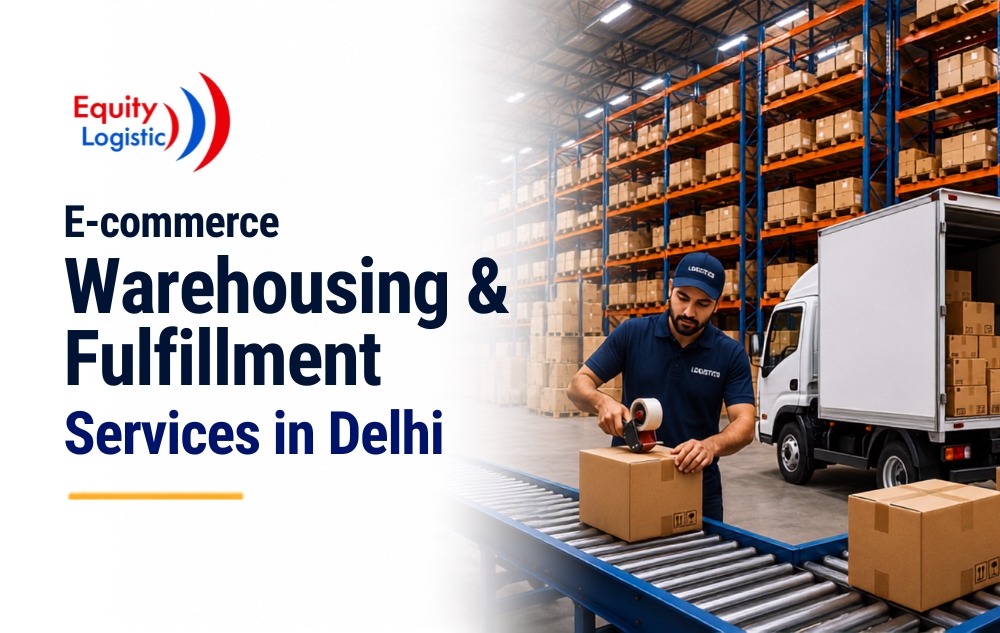
Delhi NCR is the single most valuable warehousing catchment in northern India. It sits at the junction of the Delhi–Mumbai and Eastern Dedicated Freight Corridors, feeds a consumer base of well over 30 million people across the capital region, and puts most of Punjab, Haryana, Uttar Pradesh, Rajasthan and Uttarakhand within a same-day or next-day truck run. For an e-commerce brand, a fulfillment node in Delhi is the difference between two-day delivery to half of North India and a five-day one.
The problem is that warehousing in Delhi covers everything from a 2,000 sq ft godown in a congested industrial pocket to an engineered, racked facility with WMS integration. This guide explains how to tell them apart and how to choose.
Why Delhi NCR works for e-commerce fulfillment
Reach
A well-sited NCR warehouse can serve Delhi, Gurugram, Noida, Ghaziabad and Faridabad within hours, and the wider northern belt within 24 to 48 hours. That radius alone typically converts a meaningful share of a brand’s abandoned carts.
Infrastructure
NH-48, NH-44, the Eastern and Western Peripheral Expressways, and the Delhi–Mumbai Expressway give NCR facilities road access that few Indian clusters match. Add IGI Airport for air cargo and ICD Tughlakabad and ICD Dadri for containerised movement, and both domestic and EXIM flows are covered.
Labour and vendor ecosystem
Packaging suppliers, courier hubs, QC vendors, reverse-logistics processors and skilled warehouse labour are all locally available which matters far more than most brands anticipate during peak season.
The main warehousing clusters to look at
- Bhiwadi and Neemrana (Rajasthan side) — the most cost-efficient large-format space; strong for bulk storage and slower-moving SKUs.
- Gurugram, Manesar and Farukhnagar — Grade A parks, best connectivity to South Delhi and the airport, highest rents.
- Ghaziabad, Dadri and the NH-9 belt — good for eastern UP and Bihar distribution, close to the freight corridor.
- Sonipat, Kundli and NH-44 north — the natural node for Punjab, Haryana and Himachal reach.
- Delhi city (Narela, Bawana, Okhla, Mundka) — small-format urban space for last-mile and dark-store models; heavily constrained on truck entry timings.
The right cluster depends on where your orders actually land. Pull twelve months of pincode-level order data before signing anything brands routinely pick Gurugram for prestige when their volume is concentrated in eastern UP.
What e-commerce fulfillment actually includes
Storage is the least interesting part of the service. A proper fulfillment operation should cover:
- Inbound and GRN — unloading, count verification, QC against purchase order, and putaway with bin-level location mapping.
- Inventory management — real-time stock visibility, batch and expiry tracking, cycle counts and reconciliation.
- Pick, pack and dispatch — order-wise picking, branded packaging, invoice and label generation, courier manifesting.
- Multi-channel integration — direct connections to Shopify, WooCommerce, Amazon, Flipkart, Myntra and marketplace SLAs, each of which has its own packaging and labelling requirements.
- Returns and reverse logistics — for many categories, 20 to 30 per cent of shipments come back. How a provider grades, restocks or scraps returns has a direct effect on your margin.
- Reporting — ageing, fill rate, dispatch SLA adherence, damage and shrinkage.
Equity Logistics operates warehousing services in India built around exactly this stack, with the storage, staging and distribution layers connected rather than sold separately.
Nine things to verify before you sign
- Total versus usable area. Quoted square footage often includes docks, offices and aisles. Ask for usable racked pallet positions.
- Clear height and racking. A 12 m clear height facility with selective racking gives multiples of the storage a 6 m shed offers at the same floor area.
- Dock configuration. Number of docks, dock levellers and truck turning radius determine how fast you can absorb an inbound container during peak.
- Fire and compliance. NBC-compliant fire systems, valid trade licence, pollution clearance, and adequate insurance. Verify the certificates, not the claim.
- WMS and API integration. Ask to see the dashboard. A provider running on spreadsheets will fail you in October.
- Peak capacity. Festive volumes can be three to five times baseline. Ask specifically what they handled last Diwali.
- Commercial model. Fixed rent versus pay-per-use versus a hybrid. Pay-per-use suits volatile volume; fixed suits predictable throughput.
- Security. CCTV coverage and retention, access control, guarding, and a documented shrinkage record.
- Exit terms. Notice period, stock retrieval process and any exit charges — the clauses nobody reads until they need them.
Understanding the cost structure
Fulfillment pricing in NCR typically breaks into four buckets: storage (per pallet or per sq ft per month), inbound handling (per unit or per container), order processing (per order, often slabbed by item count), and value-added services (kitting, labelling, gift wrap, quality checks). Freight out is usually billed at actuals or on a negotiated courier rate card.
Compare providers on a blended cost per order at your actual order profile, not on the storage rate. A facility that is fifteen per cent cheaper on rent but slower on dispatch will cost you more once RTO and SLA penalties are counted. The same logic we set out in how to reduce transportation costs with the right transporter in India applies directly to warehousing.
In-house, marketplace, or 3PL?
Running your own warehouse gives control and makes sense above roughly 3,000 to 5,000 orders a day with stable volume — but it means capex, leases, staffing and compliance. Marketplace fulfillment (FBA and equivalents) is frictionless within that marketplace and restrictive outside it. A third-party logistics partner sits in between: variable cost, multi-channel, scalable up and down with the season. For most growing D2C brands in the 500 to 5,000 orders-a-day band, 3PL is the right answer.
If you are evaluating partners, our guide to choosing the right logistics partner for your business sets out the diligence questions in detail.
Warehousing is only half the job
A fulfillment centre is worth only as much as the transport network around it. Stock has to arrive from your factory or port, move between nodes, and reach customers on time. That means your warehousing partner should also be able to handle inbound line-haul, inter-warehouse transfers and bulk distribution.
Equity Logistics connects NCR warehousing to pan-India logistics and domestic transport across the country, including specialised movement for heavy or oversized inventory through industrial transportation in India. For brands importing stock, sea transportation links port clearance to warehouse putaway in one chain of custody, and our network reaches destinations most fulfillment providers simply do not serve.
Getting started
Begin with your own data: order volume by pincode, SKU count and dimensions, seasonality curve, and current cost per order. Take that to two or three providers, ask for a facility visit rather than a brochure, and insist on a pricing model that maps to your actual order profile.
To discuss e-commerce warehousing and fulfillment in Delhi NCR — storage, staging, order processing and onward distribution under one accountable partner reach the Equity Logistics team through our contact page, or read more about us and the full set of logistics solutions we operate.
FAQs – E-Commerce Warehousing and Fulfillment Services in Delhi
1. What are e-commerce warehousing and fulfillment services?
E-commerce warehousing and fulfillment services cover the storage and handling of online orders, including inventory receiving, storage, picking, packing, order processing, and dispatch.
2. Why do e-commerce businesses need warehousing and fulfillment services in Delhi?
Delhi is a major business and logistics hub with strong connectivity to NCR, North India, highways, airports, and major distribution markets. Using a local fulfillment facility can help businesses manage inventory and streamline order deliveries.
3. What services are included in e-commerce fulfillment?
Depending on the provider, services may include inventory storage, stock management, order processing, picking and packing, labelling, dispatch, returns management, and transportation coordination.
4. Can small businesses use e-commerce fulfillment services?
Yes. E-commerce fulfillment services can be suitable for startups, small businesses, growing D2C brands, and established online retailers. Outsourcing fulfillment can help businesses avoid investing heavily in their own warehouse infrastructure.
5. How does e-commerce warehousing help reduce delivery time?
Strategically located inventory allows orders to be processed and dispatched closer to customers. Efficient inventory management and order processing can also reduce delays between receiving an order and shipping it.
6. What types of products can be stored in an e-commerce warehouse?
Warehouses can handle various products, including consumer goods, packaged products, electronics, apparel, lifestyle products, and other general merchandise, subject to storage requirements and applicable regulations.
7. Do fulfillment services include returns management?
Many fulfillment providers offer reverse logistics and returns management, including receiving returned products, inspection, inventory updates, repacking, and coordinating the next step according to the seller’s return policy.
8. How do I choose the right e-commerce fulfillment company in Delhi?
Compare providers based on warehouse location, storage capacity, inventory management systems, order processing capabilities, scalability, transportation network, technology integration, service coverage, and pricing.