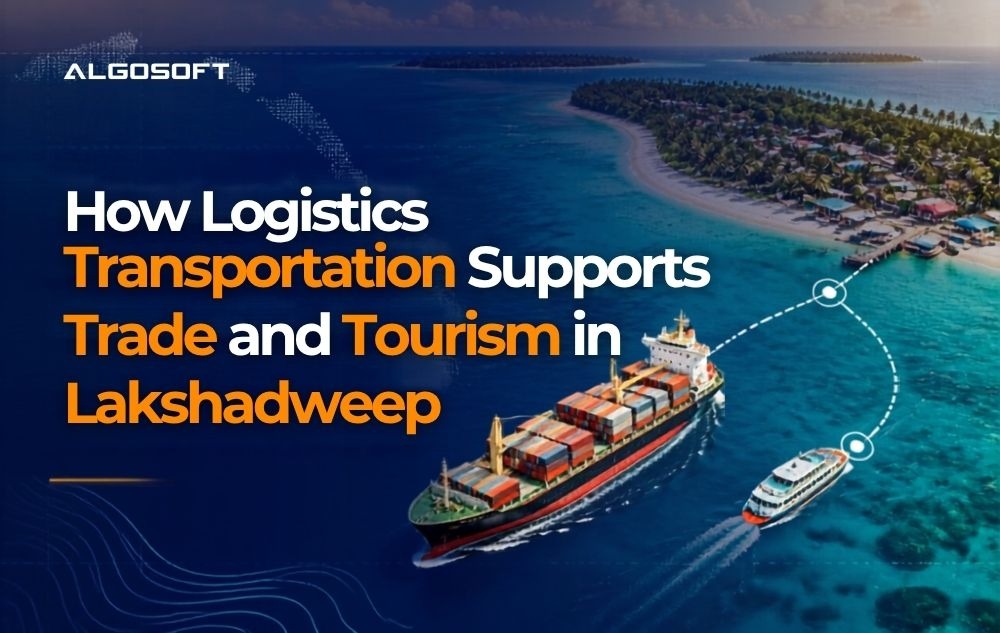
Picture a turquoise lagoon in Kavaratti, a dive resort opening on Agatti, or a new desalination plant coming up on Minicoy. None of it happens without a ship leaving Kochi first. Lakshadweep is India’s smallest Union Territory, but everything from a hairpin to a hotel air-conditioner has to travel roughly 200–400 kilometres of open sea to get there. That single fact is why logistics transportation in Lakshadweep isn’t a background detail of island life it’s the infrastructure that trade and tourism are built on.
In this post, we look at how transportation ties Lakshadweep’s economy together, what makes it so different from mainland logistics, and why choosing the right partner for transportation services in Lakshadweep can make or break a project timeline.
Why Lakshadweep Depends So Heavily on Transportation
Lakshadweep is a coral archipelago of 36 islands, only 10 of which are inhabited, scattered across the Arabian Sea. There’s no local heavy industry and very little manufacturing, so the islands import almost everything they consume construction material, fuel, machinery, packaged food, and retail goods all arrive by sea from the mainland, mostly routed through Kochi.
That dependency creates two realities for anyone moving goods into the territory:
- Sailing schedules dictate timelines. The Lakshadweep Administration runs a fleet of passenger and cargo vessels, and cargo space is limited and shared. Missing a sailing slot can delay a shipment by days, not hours.
- There is no room for guesswork. Cargo has to be packed, permitted, and staged correctly the first time, because there’s no quick re-run to a nearby warehouse if something goes wrong.
This is exactly the kind of environment where dependable cargo transportation to Lakshadweep stops being a convenience and becomes a project-critical service.
The Trade Connection: Keeping the Islands Supplied
Trade in Lakshadweep runs almost entirely on inbound logistics. Local economic activity coconut and coir production, fisheries, tuna canning, small retail depends on a steady inbound supply chain for equipment, packaging material, and consumables, and on reliable outbound transport for whatever the islands produce for mainland and export markets.
Beyond day-to-day commerce, the islands are also seeing renewed government investment in infrastructure: desalination and power projects, telecom upgrades, port and jetty improvements, and renewable energy installations such as solar. Every one of these depends on logistics services in Lakshadweep capable of handling more than boxes think generators, solar modules, telecom tower components, and construction machinery that need specialised handling, permits, and careful sea staging.
This is where a generalist courier or a single-leg shipping line runs into trouble. Moving an oversized transformer or a containerised batch of solar panels from a mainland factory to an island jetty involves road transport, port coordination, vessel booking, and last-mile handling usually across multiple handovers and multiple vendors. Every handover is a point where cargo can be damaged, delayed, or lost in communication.
At Equity Logistics, our transportation services to the Lakshadweep Islands are built specifically to remove those handover gaps one team plans and owns the journey from pickup to island delivery, whether that’s project cargo, special and heavy equipment, or solar module shipments for renewable energy projects.
The Tourism Connection: What Visitors Never See
Lakshadweep’s tourism sector has been growing fast, with renewed national attention positioning the islands as a home-grown alternative to destinations like the Maldives. New resorts, dive centres, and water villas are opening across islands such as Agatti, Kadmat, and Bangaram and every one of them was built using materials that arrived by ship.
Guests booking a beach holiday rarely think about the transportation services in Lakshadweep working behind the scenes, but tourism infrastructure runs on the same fragile supply chain as everything else on the islands:
- Building materials for resort construction and renovation
- Furniture, kitchen equipment, and hospitality supplies
- Diving and watersports gear
- Backup generators and solar power equipment for islands with limited grid capacity
- Packaged food, beverages, and consumables for hotels and homestays
A delayed shipment doesn’t just mean a late invoice — it can mean a resort opening pushed back a season, or a property running short of essentials during peak tourist months. Reliable freight transportation to Lakshadweep is, in a very real sense, part of the tourism product itself.
What Makes Transportation to Lakshadweep Different
Compared to moving freight within mainland India, shipping to Lakshadweep involves a few extra layers of complexity:
- Limited sailing windows — cargo vessels don’t run daily, so shipments need to be planned around the sailing calendar, not the other way around.
- Permits and clearances — entry into the Union Territory involves permits and documentation that need to be in order before cargo (and often personnel) can move.
- Multi-modal coordination — most shipments involve road transport to the port of departure (usually Kochi), sea transit, and then onward island distribution, all of which needs to be sequenced correctly.
- No fallback infrastructure — unlike the mainland, there’s no dense network of alternate carriers or warehouses to fall back on if something goes wrong.
This is why island logistics rewards specialists. A logistics partner who plans the full route pickup, port staging, sea transportation, and island delivery under one accountable team consistently outperforms a patchwork of separate vendors, especially for time-sensitive or high-value cargo. It’s the same principle we apply to our transportation services to the Andaman & Nicobar Islands, another remote archipelago where single-partner accountability makes a measurable difference.
Building a More Connected Lakshadweep
The direction of travel is encouraging. Government plans around port modernisation, improved mainland connectivity, and renewable energy adoption all point toward a Lakshadweep that’s easier though never simple to serve logistically. Until that infrastructure matures, the burden of reliability falls on logistics providers who understand the islands’ constraints and plan around them rather than being surprised by them.
For businesses supplying the tourism sector, contractors executing infrastructure projects, or exporters moving island produce to the mainland, the takeaway is the same: logistics transportation in Lakshadweep has to be planned with the same rigour as the projects it supports. Sailing schedules, permits, cargo type, and last-mile handling all need to be mapped out before the first truck leaves the warehouse.
Partner With a Team That Knows the Route
Equity Logistics has spent years moving heavy, oversized, and project cargo across India’s most demanding routes, including island territories where a single missed sailing can cascade into weeks of delay. Our team manages the full journey road transport to the port, sea coordination, and island-side delivery under one point of accountability, so your project timeline doesn’t depend on how well three different vendors talk to each other.
If you’re planning a shipment to the islands, explore our Lakshadweep transportation services or get in touch with our team to plan your next sailing.
Related reading: Best Logistics Transportation Solutions in Lakshadweep for Seamless Deliveries
FAQs
Q1. Why is transportation so important for Lakshadweep’s economy?
Because Lakshadweep has almost no local manufacturing, nearly everything the islands consume — construction material, fuel, retail goods, and hospitality supplies — has to be imported by sea. Trade and tourism both depend directly on how reliably that cargo moves.
Q2. How does cargo reach Lakshadweep?
Most cargo travels by road to a mainland port, typically Kochi, and then by sea vessel to the islands, followed by last-mile distribution once it arrives. Sailing schedules are limited, so shipments need to be planned in advance.
Q3. What kind of cargo does Lakshadweep’s tourism sector need most?
Construction and renovation material, hospitality equipment, solar and backup power systems, watersports gear, and consumables are among the most common shipments supporting the islands’ growing resort and homestay economy.
Q4. Who should businesses trust for logistics transportation in Lakshadweep?
A partner experienced in multi-modal, island-specific logistics — one who manages road transport, port coordination, and sea transit under a single point of accountability — reduces the handover risks that are common with fragmented shipping arrangements.