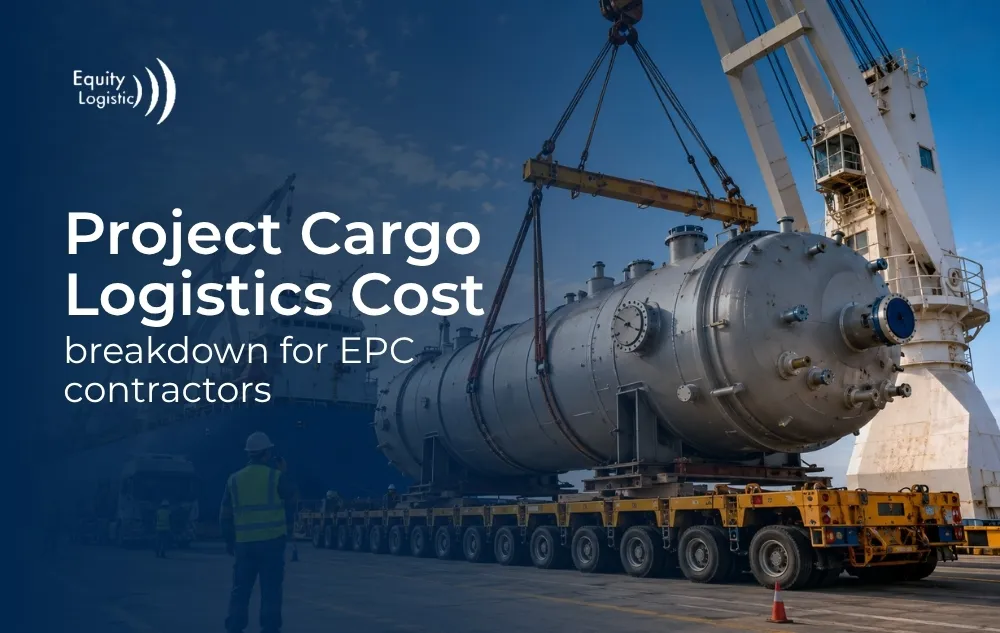
For EPC contractors, logistics is rarely a line item that behaves predictably. A single delayed transformer, a rejected permit, or an underestimated crane charge can erode margins on a contract that took months to win. Yet project cargo logistics is often quoted as a lumpsum figure, leaving procurement and project teams unable to see where the money actually goes. This guide breaks down the true cost structure of moving heavy, over-dimensional and project cargo across India, so you can budget with confidence and challenge inflated quotes intelligently.
Whether you are moving boiler drums to a thermal plant, nacelles to a wind farm, or complete process skids to a refinery, the same cost categories apply. Understanding them line by line is the difference between a bid that holds and one that bleeds. If you need a delivery partner who prices transparently, Equity Logistics offers dedicated project handling services built specifically for EPC and infrastructure timelines.
Why Project Cargo Costs Are Hard to Estimate
Ordinary freight scales with weight and distance. Project cargo does not. A 60-tonne stator may cost less to move than a lightweight but 6-metre-wide structure, because width triggers route surveys, police escorts, and structural clearances that weight alone never would. Cost is driven by the combination of dimensions, weight, route difficulty, and time sensitivity — and each of those interacts with the others.
This is why two vendors can quote wildly different numbers for what looks like the same consignment. One has surveyed the route and priced the real obstacles; the other has guessed. As an EPC contractor, your job is to know which cost heads should appear in a credible quote so you can tell the two apart.
The Core Cost Heads in Project Cargo Logistics
- Base Freight (Line-Haul Transport)
This is the cost of the primary vehicle moving cargo from origin to site. For over-dimensional cargo, this means hydraulic axle trailers, multi-axle low-beds, or modular self-propelled trailers rather than standard flatbeds. Base freight is influenced by trailer type, payload, and the total distance including any detour forced by bridge or road restrictions. Detours on ODC movements can add 15–40% to the nominal point-to-point distance.
- Route Survey and Feasibility Study
Before an over-dimensional load moves, the route must be physically surveyed — bridge load capacities, turning radii at junctions, overhead clearances for cables and gantries, and railway level crossings. For difficult corridors and remote sites, this is non-negotiable. A proper survey costs money upfront but prevents the far larger cost of a stranded consignment. Equity Logistics builds this into its special cargo handling process rather than discovering obstacles en route.
- Permits and Statutory Approvals
Over-dimensional and overweight movements require state-level permits, and cargo crossing multiple states needs approvals from each transport authority along the corridor. Add to this the cost of temporary structural permissions where a load exceeds bridge ratings, forestry or highway authority clearances, and toll surcharges for oversize vehicles. Permit costs and timelines vary significantly by state and should always be confirmed against current rules for your specific route before committing to a delivery date.
- Handling, Lifting and Craneage
Loading and unloading heavy cargo is frequently the most underestimated cost. Depending on the piece weight, you may need mobile cranes, crawler cranes, gantry systems, or jacking-and-skidding arrangements at both origin and site. Crane mobilisation, day rates, and the cost of a suitable hard standing at site all add up. For pieces above typical crane capacity, tandem lifts double the equipment cost.
- Escort, Piloting and Traffic Management
Wide and long loads require pilot vehicles, and in many states police escort for movement through populated areas or at night. Utility teams may be needed to temporarily lift overhead power or telecom lines. These costs scale with the number of states crossed and the number of pinch points on the route.
- Insurance (Marine-cum-Transit)
Given the value of project equipment, transit insurance is essential, not optional. Premiums are calculated on cargo value, mode, and risk profile of the route. For high-value single pieces, insurers may require a nominated surveyor to oversee loading and lashing — an additional but worthwhile cost.
- Site Access and Last-Mile Works
The final kilometre to a project site is often the hardest. Temporary road strengthening, culvert bridging, tree cutting with authority permission, and construction of a turning pad may all be required. On greenfield sites, the access road itself may need building before cargo can arrive.
Hidden and Frequently Missed Costs
The quotes that go wrong are usually the ones missing these:
- Detention and demurrage — when cargo waits at ports, yards, or site because unloading is not ready, daily charges accrue quickly on specialised trailers.
- Idle crane time — a crane mobilised but waiting for cargo or clearance is billed regardless.
- Seasonal and monsoon surcharges — certain routes and remote destinations carry weather-driven premiums or become impassable entirely for months.
- Reverse logistics — returning empty specialised trailers or modular equipment to base is a real cost often left out of one-way quotes.
- Storage between phases — where site is not ready, interim warehousing near the delivery point protects cargo and keeps the schedule alive.
A Sample Cost Structure (Illustrative)
The following shows how a typical project cargo movement distributes cost. Actual proportions vary by consignment, route, and destination difficulty — treat these as a framework, not a quotation.
- Base freight / line-haul: 40–55% of total
- Handling, craneage and lifting: 12–20%
- Permits, escorts and statutory approvals: 8–15%
- Route survey and site access works: 5–12%
- Insurance: 2–5%
- Contingency and hidden charges: 8–15%
Notice that base freight is barely half the picture. An EPC contractor who budgets only for the truck will be short by nearly the same amount again. This is why single-line lumpsum quotes are dangerous — they hide exactly the heads where overruns occur.
How EPC Contractors Can Control Project Cargo Costs
- Involve your logistics partner at the bid stage, not after award. Early route surveys catch cost drivers while you can still price them into the contract.
- Ask for an itemised quote covering every head above. A vendor unwilling to break down costs is a vendor hiding something.
- Consolidate movements where site schedule allows, so escort, permit and mobilisation costs are shared across pieces.
- Plan around monsoon and seasonal restrictions rather than paying premiums to fight them.
- Use a single accountable partner for PAN-India logistics rather than stitching together regional vendors with no end-to-end responsibility.
Partner With a Transparent Project Logistics Provider
Accurate cost estimation begins with a partner who surveys before they quote and itemises before they invoice. Equity Logistics specialises in project and over-dimensional cargo for EPC contractors, power and renewable developers, and plant procurement teams across India. To get a route-specific, itemised estimate for your next consignment, request a quote and share your cargo dimensions, origin and destination site.
Frequently Asked Questions
Why is project cargo more expensive than normal freight?
Because cost is driven by dimensions and route difficulty rather than weight alone. Over-dimensional loads require specialised trailers, route surveys, multi-state permits, escorts, and craneage — cost heads that ordinary freight never incurs. Learn more about our ODC transport capabilities.
What percentage of the total cost is the actual transport?
Line-haul freight is typically only 40–55% of a project cargo movement. The remainder is handling, permits, escorts, surveys, insurance and contingency. Budgeting only for the vehicle is the single most common EPC costing error.
Do I need permits for every state my cargo passes through?
Yes. Over-dimensional and overweight movements require approvals from each state transport authority along the corridor, and permit rules and costs differ by state. These should be confirmed against current regulations for your exact route before fixing a delivery date.
Can logistics costs be estimated at the bid stage?
They can, provided a route survey is done early. Involving your project logistics partner before contract award lets real cost drivers be priced in rather than discovered as overruns later.
What are the most commonly missed costs?
Detention and demurrage, idle crane time, seasonal surcharges, reverse logistics for empty trailers, and interim storage between project phases. A credible quote accounts for all of these.
How do I get an accurate quote for my consignment?
Share your cargo dimensions, weight, value, origin and destination site with our team through the quote request page. We survey the route and return an itemised estimate rather than a single lumpsum figure.