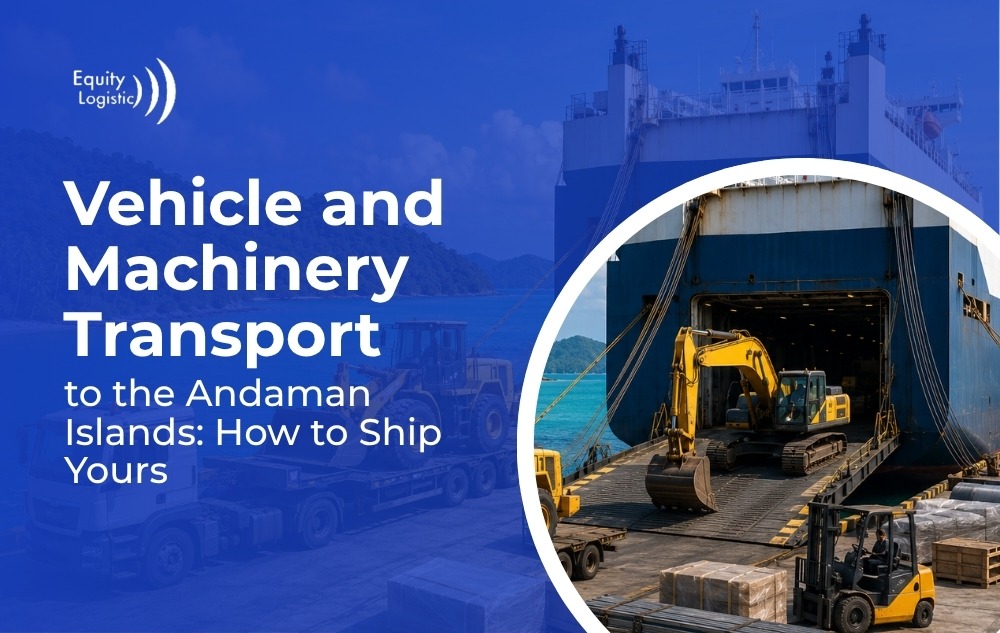
Cars, commercial vehicles, excavators, cranes, tractors, generators and industrial machinery all regularly make the journey to the Andaman Islands — but a vehicle or a machine is not the same as a palletised carton, and shipping one takes specific preparation and the right handling. Whether you are relocating a personal car to Port Blair, sending construction equipment to a site, or moving a machine for a business, this guide walks through exactly how vehicle and machinery transport to the islands works, how to prepare your asset, and how to get it booked.
How vehicle and machinery transport to the Andamans works
The route is the same road-plus-sea chain that all island cargo follows: the vehicle or machine is moved by road to a mainland gateway port — usually Chennai — then shipped across the Bay of Bengal to Port Blair, and finally delivered by road to its island destination. What differs is the handling. Vehicles and machinery are heavy, awkwardly shaped and often self-propelled, so they may be driven or winched onto flat-bed trailers for the road leg and stowed as break-bulk or roll-on cargo for the sea leg. Proper securing at every stage is essential, because an unsecured machine on a sea voyage is a genuine hazard.
This is specialised work that sits within our special cargo handling and over-dimension consignments capabilities, where lifting, lashing and stowage are engineered rather than improvised.
Preparing your vehicle or machine for shipment
For vehicles
- Reduce fuel to a low level — many sea movements require the tank near empty for safety.
- Disable alarms and secure loose parts — prevent battery drain and damage in transit.
- Document existing condition — photograph the vehicle so the handover record is unambiguous.
- Carry registration and ownership papers — these are needed for booking and island-side formalities.
For machinery and equipment
- Drain or secure fluids — as required for safe sea transport of the specific machine.
- Retract and lock moving parts — booms, buckets and arms should be secured to minimise dimensions and movement.
- Identify lifting and lashing points — so riggers can handle the machine safely at the port.
- Provide exact weight and dimensions — these determine the trailer, vessel stowage and quote.
Documentation you’ll need
For vehicles, keep registration certificate, proof of ownership and identification ready. For machinery, have the commercial invoice, specifications and value declaration prepared. As the Andamans are a domestic Union Territory, there is no international customs process, but accurate paperwork keeps booking and island-side handling smooth. Transit insurance is strongly recommended for the value of the asset and is included as standard commercial protection on Equity Logistics movements.
Timelines and what to expect
As with all island cargo, plan for roughly two to three weeks from pickup to island delivery, driven by the road distance and the sailing schedule. Heavy or oversized machinery may require a specific vessel or break-bulk sailing, which can extend lead time, so booking well ahead of the required date is the surest way to protect your timeline. On arrival at Port Blair the asset is discharged, cleared through port formalities and delivered to your site, with a documented condition check at handover.
Choosing the right shipping method for your asset
Not every vehicle or machine ships the same way, and the method affects both cost and safety. Smaller vehicles and compact equipment are often the most economical to consolidate, sharing vessel space efficiently. Larger, self-propelled machinery may move as roll-on cargo where it can be driven aboard, while very heavy or awkward units — long booms, wide plant, high units — travel as break-bulk with crane handling and engineered stowage. The choice depends on the asset’s exact weight, dimensions and running condition, which is why a specialist assesses the machine before committing to a method rather than defaulting to one. Getting this right protects the asset: a machine stowed and lashed correctly for the specific vessel arrives in the condition it left, while an improvised load risks damage across days at sea. For anything genuinely oversized, this is the same engineering discipline our over-dimension consignments service applies to industrial project cargo.
How to book vehicle or machinery transport
Booking is straightforward once you have the details ready. Provide the vehicle or machine type, its exact weight and dimensions, running condition, origin, island destination and required delivery date. The Equity Logistics team — an ISO 9001:2015 certified specialist in Andaman & Nicobar transport — will assess the asset, select the right trailer and sailing, and build a movement plan with insurance and documented handover included. For fleet moves or equipment forming part of a wider project, this connects into our project handling programme.
Frequently asked questions
Q1. Can I ship my car to the Andaman Islands?
Yes. Personal and commercial vehicles are regularly transported to Port Blair by the road-plus-sea route. You’ll need registration and ownership papers, and the vehicle should be prepared with low fuel and secured loose parts.
Q2. How is heavy machinery shipped to the islands?
Machinery moves by road to a mainland port on suitable trailers, then as break-bulk or roll-on cargo by sea to Port Blair. Exact weight, dimensions and lifting points determine the equipment and stowage used.
Q3. Do I need customs clearance for a vehicle?
No. The Andamans are a domestic Union Territory, so there is no international customs. You do need correct registration, ownership and identification documents for booking and island-side formalities.
Q4. How long does vehicle or machinery transport take?
Plan for around two to three weeks from pickup to island delivery. Oversized machinery needing a specific vessel or break-bulk sailing may take longer, so book ahead of your required date.
Q5. Is my vehicle or machine insured during transport?
Transit insurance is strongly recommended and is included as standard on Equity Logistics movements. Share your asset details via the contact page to arrange transport with cover and documented handover.
Related reading: Special Cargo Handling · Over-Dimension Consignments · How to Get Around: Transportation in Andaman & Nicobar.