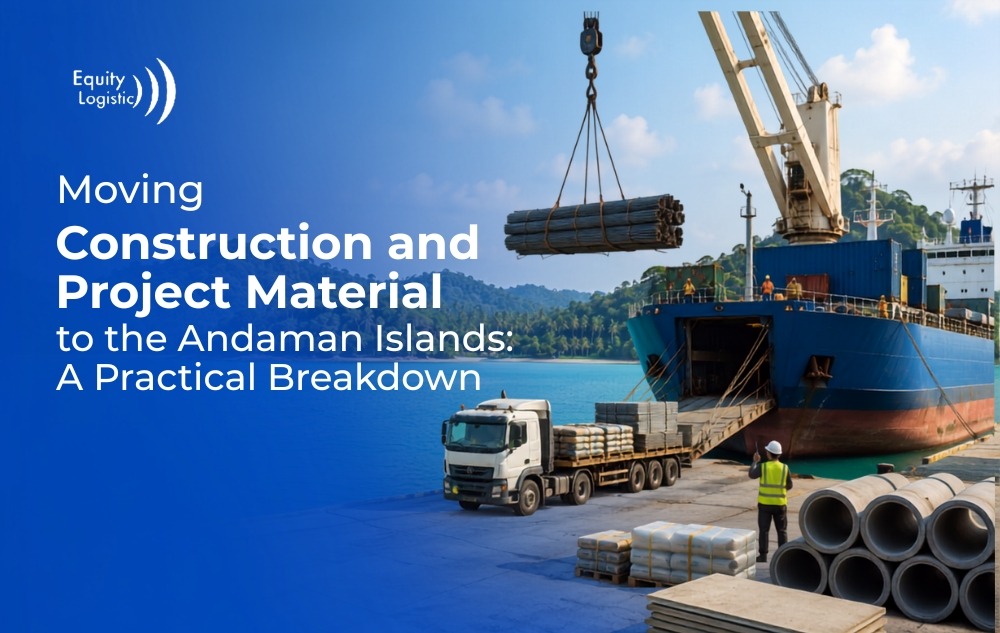
Every infrastructure, resort, telecom or power project in the Andamans faces the same founding question: can we actually get the material out there, reliably and on schedule? Construction and project cargo is heavy, bulky, phased and unforgiving of delay — and the islands sit over a thousand kilometres of open sea from the nearest mainland port. The short answer is that it is entirely feasible, and is done routinely, but only with proper planning. This article examines the feasibility honestly: what moves easily, what needs special handling, and how to keep a project supplied without the sea leg becoming a bottleneck.
The core feasibility question: it’s about sequencing, not possibility
Cement, steel, aggregates, prefabricated structures, generators, transformers, heavy machinery and finishing materials all reach the Andamans by the established road-plus-sea route every day. Feasibility is rarely about whether a given item can physically travel — it almost always can. It is about sequencing supply to a scheduled sea link so that the right material arrives at the right project phase, without the site running dry or the port clogging with material that isn’t needed yet. Get the sequencing right and island construction logistics is very manageable; get it wrong and even simple material becomes a schedule risk.
What moves easily — and what needs special handling
Straightforward cargo
Bagged cement, steel bars, tiles, fixtures, tools and general building material consolidate well into containers and move on routine sailings. This is the bulk of most projects and presents little difficulty beyond ordinary volume planning.
Cargo that needs engineering
Prefabricated structural sections, transformers, generators, cranes, batching plants and long or heavy machinery are over-dimension or break-bulk cargo. These need route surveys on the mainland road leg, the right trailers, and break-bulk shipping or specialised stowage on the vessel. This is squarely the territory of our over-dimension consignments and project handling services, which are built for exactly this class of cargo.
The phased-supply challenge — and how staging solves it
Construction consumes material in waves: foundations first, then structure, then services, then finishes. Shipping everything at once wastes capital, congests limited island storage and risks damage; shipping too slowly starves the site. The professional answer is staged supply — holding material in a mainland warehouse and releasing it to sailings in sync with the project schedule. Equity Logistics supports this directly through warehousing and staging, consolidating and phasing release so cargo arrives when the site is ready for it, not before and not after.
Cost and schedule realities to build into your plan
Feasibility is not only technical — it is financial and temporal. Island project material carries the sea-freight premium and double handling on every consignment, so procurement budgets should be built with island logistics costed in from day one rather than treated as an afterthought. Schedule-wise, the scheduled nature of sailings means lead times are longer and less flexible than mainland supply, so project programmes should carry a realistic buffer for the sea leg and front-load the ordering of long-lead heavy items. Limited storage on the islands themselves is a real constraint too: land is scarce and site space is often tight, which is precisely why buffering material on the mainland and phasing it out to sailings is more efficient than pushing everything across and storing it on-site. Teams that plan with these realities baked in find island projects entirely workable; teams that assume mainland economics and timelines are the ones that struggle.
Planning a feasible project supply chain
- Map material to project phases — know what you need on-site and when, before the first sailing.
- Identify the heavy and oversized items early — these drive vessel choice and lead time, so plan them first.
- Build in the sailing schedule — treat sea departures as fixed milestones your procurement must feed.
- Use mainland staging — buffer material near the port rather than over-shipping to congested island storage.
- Consolidate the routine, engineer the exceptional — containerise general material; survey and handle heavy items individually.
Handled this way, an entire project programme can be run as a coordinated logistics operation rather than a series of anxious one-off shipments. Equity Logistics regularly serves EPC contractors, power and renewable developers and infrastructure teams working in difficult destinations, and its project handling service is designed to sequence multi-consignment programmes around site readiness — the exact discipline island construction demands.
Frequently asked questions
Q1. Is it feasible to build a large project in the Andamans given the logistics?
Yes. Construction and project material reaches the islands routinely by road-plus-sea. Feasibility depends on sequencing supply to the sailing schedule, not on whether the material can physically be moved.
Q2. Can heavy machinery and transformers be shipped to the islands?
Yes, as over-dimension or break-bulk cargo. These need route surveys, the right trailers and specialised vessel stowage, which is handled under over-dimension and project-handling services.
Q3. How do we avoid the site running out of material?
By using mainland warehousing and staging to hold material and release it to sailings in step with your project phases, so cargo arrives when the site needs it rather than all at once.
Q4. What is the biggest risk to island project logistics?
Poor sequencing against the scheduled sea link. Material that misses a sailing, or floods limited island storage too early, is the most common cause of delay and cost overrun.
Q5. Can one company manage the whole project supply chain?
Yes. Equity Logistics coordinates complete programmes from origin to site under one accountable team. Share your project scope via the contact page to plan the supply chain.
Related reading: Project Handling services · Warehousing services in India · How logistics transportation in Andaman streamlines business operations.