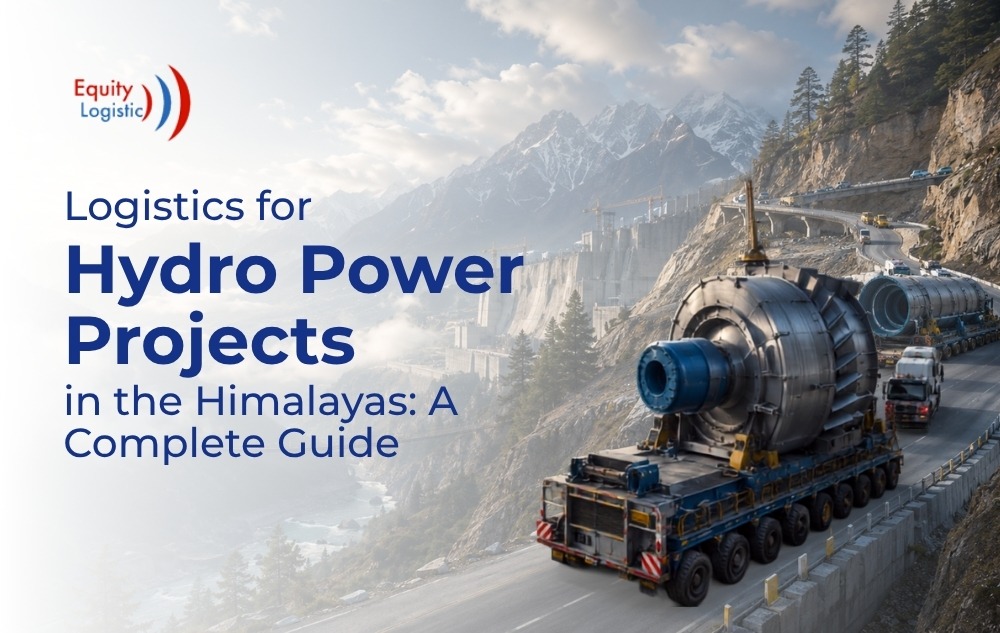
The Himalayas hold the largest share of India’s hydro power potential — and the toughest logistics conditions in the country. Delivering turbines, generators, transformers and penstocks to sites tucked into these mountains demands far more than a truck and a driver. It requires end-to-end project logistics: surveying, planning, permitting, specialised transport and precise on-site delivery, all coordinated across seasons and state borders. This guide walks through how Himalayan hydro logistics actually works, from factory gate to powerhouse floor.
What follows is a stage-by-stage view of the process, the same sequence a professional operator applies whether the destination is a small run-of-river scheme in Himachal or a large storage project deep in the North-East. The terrain changes; the discipline does not.
Understanding the Himalayan challenge
Before the stages, it helps to appreciate why Himalayan movements sit in a class of their own. In the plains, a delayed truck is an inconvenience. In the mountains, a single-lane road means a stalled convoy can halt all traffic for kilometres, a missed weather window can freeze a project for a season, and a wrong turn can leave an over-length trailer wedged on a switchback. Every element of a Himalayan movement is shaped by the terrain:
- Extreme gradients and hairpin bends that limit trailer length and turning radius
- Single-lane roads with limited passing space
- Bridges and culverts with restricted load capacity
- Landslide, snow and monsoon closures creating narrow seasonal windows
- Long distances from ports and factories, crossing several states
These conditions place Himalayan hydro squarely in the domain of hydro power project transportation and heavy project cargo handling.
Stage 1: Route survey and planning
Everything begins with a physical route survey. Specialists drive the proposed route recording bend radii, carriageway widths, gradient, overhead clearances and every bridge’s load rating. The result is a detailed movement plan identifying constraints and the works needed to overcome them. For remote Himalayan destinations this often means coordinating a pan-India logistics route from a coastal port or a plains factory all the way to altitude.
Stage 2: ODC and permit management
Hydro components are almost always over-dimensional or over-weight, so they move as over-dimension consignments. That triggers state-by-state permits, highway authority approvals and, for the heaviest loads, bridge clearances. In a multi-state Himalayan corridor, permit sequencing is a project in itself — get it wrong and the convoy sits idle. Experienced operators build the permit timeline into the master schedule.
Stage 3: Choosing the right equipment
The transport fleet is matched to the cargo and the road:
Hydraulic multi-axle trailers for heavy, steerable loads that must stay level on cross-slopes
Low-bed and semi-low-bed trailers for tall components needing low deck height under bridges
SPMTs for the heaviest indivisible modules and tight on-site manoeuvring
Prime movers sized for altitude, since engine power drops as elevation rises
Stage 4: Seasonal scheduling
In the Himalayas, timing is strategy. Monsoon brings landslides; winter brings snow and ice at higher passes. Movements are scheduled into the safe windows — often spring and early autumn — with contingency for sudden closures. Teams experienced on high-altitude routes such as Leh and Ladakh understand these windows intimately.
Stage 5: Road strengthening and temporary works
Where the route can’t take the load as-is, temporary works make it possible: widening critical bends, plating weak culverts, trimming rock overhangs, or building bypass ramps. These are planned during the survey and executed ahead of the convoy so the movement is never held up mid-mountain.
Stage 6: On-site delivery and offloading
The final metres are often the hardest. Powerhouse sites can have tight, sloping laydown areas. Heavy-lift cranes and skilled rigging crews position each component precisely. Coordinated special cargo handling ensures high-value equipment is offloaded and placed without damage.
Stage 7: Documentation, tracking and reporting
Behind the physical movement runs a paper trail that keeps a Himalayan project auditable and on schedule. Each consignment carries its permits, insurance documents, packing lists and dimensional certificates, and a good operator provides progress updates as the convoy clears each checkpoint and state border. For a project owner sitting far from the mountain, this visibility is what turns a nerve-wracking multi-week haul into a managed, predictable process. Clear reporting also means that if weather or a landslide forces a hold, the delay is communicated immediately and the schedule is re-planned rather than quietly slipping.
Common mistakes in Himalayan hydro logistics
Projects run into trouble in predictable ways. Being aware of them helps you avoid them:
- Skipping or rushing the route survey, then discovering an impassable bend mid-move
- Underestimating permit lead times across multiple states
- Ignoring the seasonal window and dispatching into monsoon or early winter
- Fragmenting scope across several vendors with no single owner
- Choosing a transporter on price alone without checking hill-route references
Each of these is avoidable with an experienced project logistics partner who has run these corridors before.
Why end-to-end coordination matters
Himalayan hydro logistics fails when scope is fragmented — one party for transport, another for permits, a third for craneage, with gaps in between. A single accountable partner managing the whole chain, backed by a nationwide logistics network and warehousing support for staging, removes those gaps and keeps the project on schedule.
Conclusion
Delivering hydro power equipment to the Himalayas is one of the most demanding logistics tasks in India — but a well-run, staged process makes it dependable. From the first route survey to the final crane lift, success depends on planning, the right equipment, disciplined permit management and seasonal timing, all under one accountable partner. If you are building in the mountains, talk to Equity Logistics about a complete, survey-backed logistics plan for your Himalayan hydro project.
Frequently Asked Questions (FAQ)
What is the best time of year for Himalayan hydro transport?
Generally spring and early autumn, avoiding monsoon landslides and winter snow. Exact windows depend on the specific route and altitude and are confirmed during planning.
How are heavy loads moved across weak mountain bridges?
Through a mix of load segmentation, correct axle distribution on multi-axle trailers, and temporary bridge strengthening or bypass ramps identified in the route survey.
Do you handle transport all the way from the port or factory?
Yes. End-to-end project logistics covers the full journey from origin to the powerhouse site, including permits and on-site offloading.
Can you deliver to very remote high-altitude sites?
Yes. With experience on routes like Leh and Ladakh, even remote high-altitude sites can be reached with the right equipment and seasonal planning.