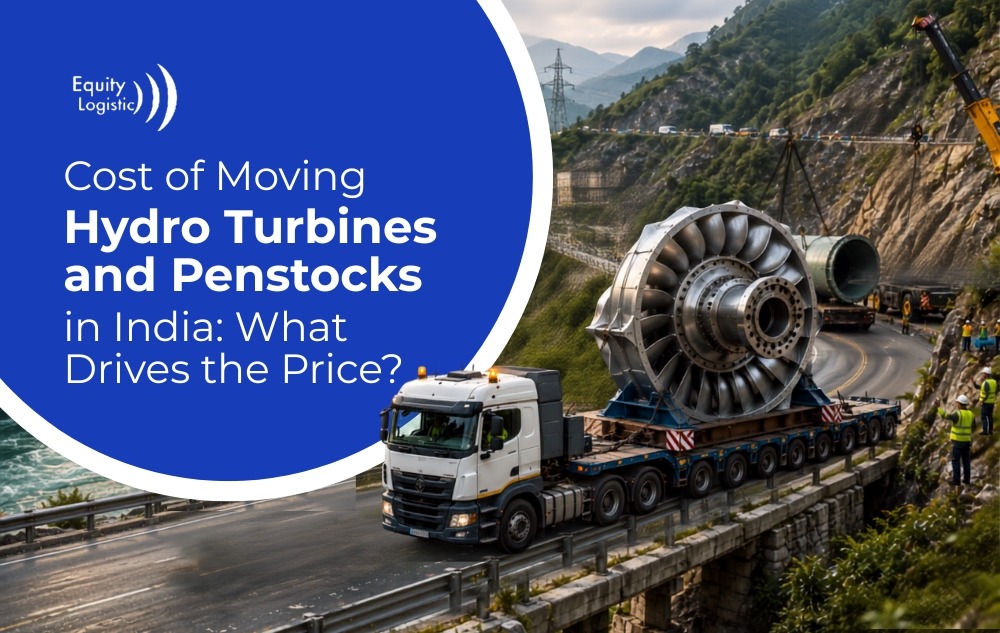
One of the first questions every hydro project owner asks is simple: what will it cost to move the turbines and penstocks to site? The honest answer is that there is no single flat rate — the cost of moving hydro power equipment in India is built up from several variables, and understanding them helps you budget accurately and avoid nasty surprises. This guide explains what actually drives the price of hydro turbine and penstock transportation, so you can read a quotation with confidence.
Why there is no fixed price
Hydro components are heavy, over-dimensional and usually headed somewhere remote. Two projects of similar generation capacity can have very different logistics bills depending on where they sit and what condition the roads are in. Rather than a fixed tariff, pricing is assembled from the cost drivers below. This is standard for over-dimension consignment and project cargo movements.
The main cost drivers
1. Weight and dimensions of the cargo
The heavier and larger a component, the more axles it needs and the more the movement costs. A compact runner is far cheaper to move than a large generator stator that requires a wider trailer, more axle lines and possibly route strengthening. Penstock sections priced by length and diameter add up across many trips.
2. Distance and route condition
Distance matters, but road quality matters more. A long run on good national highways can cost less per kilometre than a short, brutal climb on a damaged hill road. Remote destinations that require pan-India coordination across multiple states carry higher planning and permit overhead.
3. Trailer and equipment type
Standard flatbeds are the cheapest; hydraulic multi-axle trailers, low-beds and self-propelled modular transporters (SPMTs) cost progressively more but are essential for heavy hill hydro loads. The right equipment is a safety requirement, not a place to cut corners.
4. ODC permits and state approvals
Over-dimension and over-weight consignments need permits from every state they pass through, and sometimes special approvals from highway and bridge authorities. Each permit carries a fee and, more importantly, lead time. Delays here are a hidden cost, which is why experienced transporters in India build permit timelines into the plan.
5. Pilot vehicles, escorts and manpower
Over-dimension convoys require pilot escort vehicles front and rear, a movement supervisor, and often police coordination. On long hill hauls, driver relays and rigging crews add to the cost — but they are what keep an expensive cargo safe.
6. Route modification and civil works
This is the swing factor. Widening a bend, strengthening a bridge, laying crossing plates or building a bypass ramp can add substantially to a hill project. A thorough route survey during project handling surfaces these costs early so they are budgeted, not sprung on you mid-move.
7. Loading, unloading and craneage
Heavy-lift cranes for loading at the factory and unloading at site — sometimes on constrained hill pads — are a distinct line item, priced by capacity and duration.
8. Insurance
Given the value of turbines and generators, transit insurance is essential and priced as a percentage of cargo value. It is a small fraction of the equipment cost and non-negotiable for high-value special cargo.
How to get an accurate quote
Because so much depends on specifics, a credible quotation is only possible after the transporter has the following. Providing it up front speeds up pricing:
- Complete packing list with weights and dimensions of each component
- Origin (factory/port) and exact site location
- Delivery timeline and any seasonal constraints
- Site access details — road width, known weak bridges, crane space
With this, a specialist can run a route survey and return a build-up rather than a guess. Vague quotes given without a survey are the ones that balloon later.
A worked example: reading a hydro logistics quote
Imagine you receive a quotation for moving a set of turbines, a generator and penstock sections to a hill site. A credible, itemised quote will typically separate the following heads rather than lumping everything into one number. Understanding the split lets you see where the money actually goes and where you have room to optimise.
Transport charges — the core haulage, priced by trailer type, number of axle lines, distance and route difficulty. Usually the largest single head.
Permits and approvals — state-wise ODC permit fees plus any highway or bridge authority charges along the corridor.
Escorts and manpower — pilot vehicles, movement supervisor, rigging crew and, where required, police coordination.
Route modification works — any bend widening, bridge plating or bypass ramps identified in the survey. On easy routes this may be nil; on hard hill routes it can be significant.
Craneage — loading at origin and offloading at site, priced by crane capacity and hours.
Insurance — transit cover as a percentage of declared cargo value.
When these appear as separate, explained line items, you are dealing with a professional operator. When they are hidden inside a single round figure with no survey behind it, the risk of mid-project cost escalation is high. A transparent build-up is itself a sign of a trustworthy transporter in India.
Ways to control cost without cutting corners
- Plan early. Rushed permits and peak-season craneage cost more.
- Segment loads sensibly to avoid the most expensive route works.
- Consolidate trips where components can share a trailer.
- Choose one accountable partner for end-to-end movement rather than splitting scope, which avoids gaps and double-handling.
Budgeting tip: separate the fixed from the variable
A useful way to frame a hydro logistics budget is to split it into relatively fixed costs — base haulage, craneage and insurance, which you can estimate reasonably early — and variable costs, chiefly route modification works and permit-related delays, which depend on findings from the survey. Building a modest contingency against the variable side, rather than assuming a best case, keeps the project financially resilient if the mountain throws up a surprise. Experienced operators will tell you candidly where that contingency should sit for your specific route, which is another reason a survey-based logistics solution beats a blind quote.
Conclusion
The cost of moving hydro turbines and penstocks in India is driven by weight and dimensions, distance and road condition, equipment type, permits, escorts, route works, craneage and insurance. There is no universal price — but there is a reliable process. Insist on a proper route survey and a transparent, itemised quotation, and you will budget with confidence. To get an accurate, survey-based estimate for your project, reach out to Equity Logistics with your component list and site details.
Frequently Asked Questions (FAQ)
Can you give a rough per-tonne rate for hydro cargo?
Not reliably. Because route condition, permits and civil works vary so much, a per-tonne figure can mislead. An accurate rate needs a route survey and full component list.
What usually makes a hydro move more expensive than expected?
Route modification works — strengthening a bridge or widening a bend — and permit delays. Both are avoidable surprises if surveyed early.
Is insurance included in the transport cost?
Transit insurance is usually a separate line item priced on cargo value. Given the value of turbines, it is essential.
How far in advance should I request a quote?
As early as possible — ideally before finalising the site schedule — so permits, craneage and any route works can be planned economically. See our logistics solutions to start.