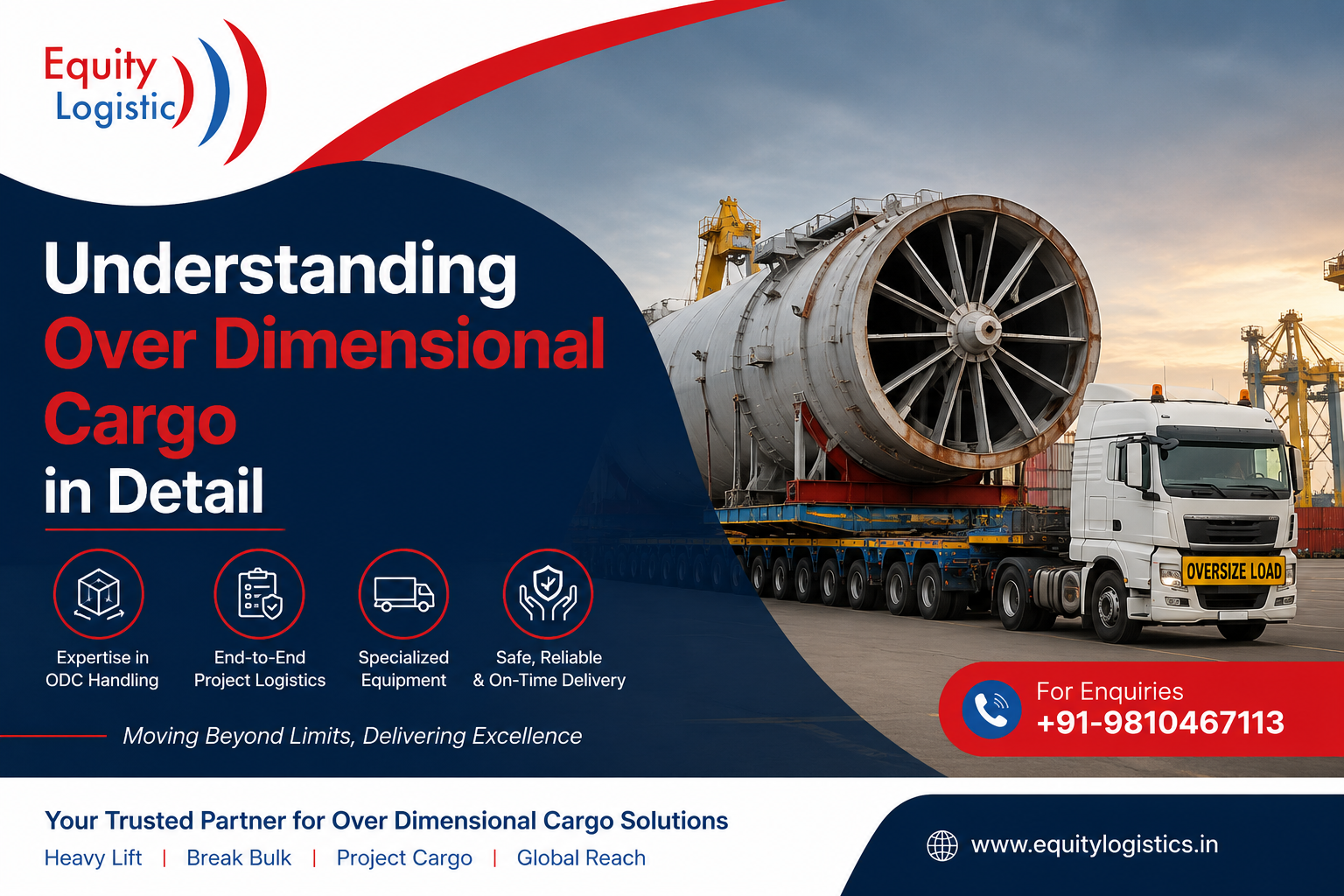
Understanding Over Dimensional Cargo in Detail
When it comes to transporting heavy machinery, industrial equipment, wind turbine components, or construction materials, standard trucking solutions simply won't cut it. This is where Over Dimensional Cargo transportation comes into play — a specialised logistics segment that requires expert planning, specialised equipment, and deep regulatory knowledge to execute successfully.
At Equity Logistics, we've spent years mastering the complexities of moving cargo that simply doesn't fit within conventional shipping parameters. In this comprehensive guide, we're breaking down everything you need to know about Over Dimensional Cargo — what it is, why it matters, and how proper ODC Transportation India wide requires far more expertise than standard freight movement.
What Is Over Dimensional Cargo?
Over Dimensional Cargo (ODC) refers to any shipment that exceeds the standard legal dimensions or weight limits permitted for regular road, rail, or sea transport. These are typically large, heavy, or awkwardly shaped items that cannot be broken down into smaller components without risking damage, functionality loss, or excessive cost.
Common examples of ODC shipments include:
- Wind turbine blades and towers
- Transformers and heavy electrical equipment
- Construction cranes and excavators
- Industrial boilers and pressure vessels
- Pre-fabricated structural steel components
- Aircraft parts and defence equipment
- Large tanks, silos, and reactors
- Bridge girders and heavy machinery for infrastructure projects
Because these items exceed standard dimensional or weight thresholds, they require significantly more planning than a typical freight shipment — including specialised vehicles, route surveys, permits, and often police or highway authority coordination.
How Is Over Dimensional Cargo Defined?
While definitions can vary slightly by country and regulatory body, cargo is generally classified as "over dimensional" when it exceeds one or more of the following standard limits:
- Length: Typically beyond 12–16 metres, depending on vehicle type and local regulations
- Width: Generally beyond 2.5–3 metres
- Height: Often beyond 3.5–4 metres from ground level
- Weight: Exceeding standard gross vehicle weight limits, often starting around 40–50 tonnes depending on axle configuration
Any shipment surpassing these thresholds — in even a single dimension — typically requires special permits, escort vehicles, and carefully planned transportation routes. This is a critical distinction, because even a shipment that's only overweight (but within standard dimensional limits) still qualifies as ODC and requires the same level of specialised handling.
Why Over Dimensional Cargo Requires Specialised Handling
Unlike standard freight, ODC shipments come with a unique set of logistical, regulatory, and safety challenges that make them fundamentally different from everyday cargo movement.
1. Infrastructure Limitations- Roads, bridges, tunnels, and overpasses are all built with specific weight and clearance limits in mind. An oversized shipment might be physically unable to pass under a particular bridge, through a narrow tunnel, or across a weight-restricted road — meaning routes must be carefully surveyed and planned well in advance.
2. Regulatory Permits- Nearly every region requires special permits for oversized or overweight shipments, often issued by multiple authorities depending on the route (state highway departments, municipal corporations, railway authorities, or port authorities). Missing or incorrect permits can result in shipment delays, fines, or even legal action.
3. Specialised Vehicles and Equipment- Standard trucks and trailers simply aren't built to carry ODC shipments safely. Instead, specialised equipment is required, such as:
-
Low-bed trailers for height-restricted cargo
-
Multi-axle trailers to distribute extreme weight loads
-
Hydraulic modular trailers for exceptionally heavy or unusually shaped cargo
-
Extendable trailers for excessively long items like turbine blades or girders
4. Route Surveys and Planning- Before a single wheel turns, a full route survey is typically necessary — checking bridge clearances, road widths, turning radii at intersections, overhead obstructions (like power lines), and weight restrictions along the entire path.
5. Escort and Safety Requirements- Many ODC shipments require pilot or escort vehicles — both in front of and behind the cargo — to warn other road users, manage traffic at tight turns, and ensure safe passage through populated areas. In some cases, police escorts are mandatory, particularly for extremely wide or heavy loads travelling through urban areas.
The Key Stages of Over Dimensional Cargo Transportation
Successfully transporting ODC shipments involves several critical stages, each requiring careful coordination between multiple stakeholders.
Stage 1: Pre-Shipment Assessment- Before any planning begins, a thorough assessment of the cargo's exact dimensions, weight, centre of gravity, and structural fragility is essential. This data forms the foundation for every subsequent decision, from vehicle selection to route planning.
Stage 2: Route Survey and Planning- Logistics teams conduct detailed surveys of potential routes, identifying:
- Bridge and overpass clearances
- Road width and surface conditions
- Sharp turns or roundabouts that may be difficult to navigate
- Overhead obstructions like power lines or signage
- Alternative routes in case of unexpected road closures
Stage 3: Permit Acquisition- Depending on the shipment's origin, destination, and route, multiple permits may be required from different regulatory bodies. This process can take anywhere from a few days to several weeks, depending on the complexity and jurisdictions involved — making early planning essential for any ODC Service India wide businesses rely on.
Stage 4: Equipment and Vehicle Selection- Based on the cargo's specific dimensions and weight, the appropriate specialised trailer or vehicle configuration is selected. This might involve a single low-bed trailer for moderately oversized cargo, or a complex multi-axle hydraulic trailer system for extremely heavy industrial equipment.
Stage 5: Loading and Securing- Proper loading technique is critical to prevent shifting, tipping, or damage during transit. This often involves specialised lifting equipment (cranes, gantries) and rigorous securing methods, including chains, straps, and custom-built cradles for irregularly shaped items.
Stage 6: Transportation and Escort Coordination- During transit, escort vehicles help manage traffic, warn other drivers, and navigate tricky sections of the route. Communication between the transport team, escort vehicles, and sometimes local authorities is maintained throughout the journey to handle any unexpected obstacles.
Stage 7: Delivery and Unloading- Just as with loading, unloading oversized or heavy cargo requires careful planning and often specialised equipment to ensure the cargo is safely positioned at its final destination without damage or safety incidents.
Common Challenges in Over Dimensional Cargo Transportation
Even with careful planning, ODC shipments come with inherent challenges that experienced logistics providers must navigate skilfully.
Infrastructure Constraints- Ageing infrastructure, weight-restricted bridges, and narrow rural roads can significantly complicate route planning, sometimes requiring last-minute route adjustments.
Weather Conditions- Heavy rain, high winds, or extreme temperatures can all affect the safety of ODC transport, particularly for tall or wide loads that are more susceptible to wind resistance.
Traffic and Urban Navigation- Manoeuvring oversized loads through busy urban areas, tight intersections, or congested highways requires significant expertise and often necessitates travelling during off-peak hours, such as overnight.
Multi-State or Multi-Jurisdictional Permits- For shipments crossing state or regional boundaries, coordinating permits across multiple regulatory bodies can be time-consuming and requires experienced logistics coordination to avoid costly delays.
Cost Management- Because of the specialised equipment, permits, and escort requirements involved, ODC transportation is inherently more expensive than standard freight. Working with an experienced provider helps ensure costs remain predictable and justified, rather than escalating due to poor planning or avoidable delays.
Industries That Rely Heavily on Over Dimensional Cargo Transportation
Several industries depend heavily on reliable, expert ODC logistics to keep their operations running smoothly:
Energy and Power- Wind turbine components, transformers, and generators are among the most common ODC shipments, particularly as renewable energy projects continue to expand.
Construction and Infrastructure- Cranes, excavators, prefabricated structural steel, and bridge components regularly require specialised transport to reach construction sites.
Oil and Gas- Large tanks, pressure vessels, and refinery equipment often exceed standard dimensional limits, requiring careful ODC planning for safe delivery.
Manufacturing- Heavy industrial machinery, including presses, moulds, and production line equipment, frequently falls into the ODC category when being transported to or from manufacturing facilities.
Defence and Aerospace- Aircraft components, military vehicles, and specialised defence equipment often require highly controlled, secure ODC transportation solutions.
What to Look for in an Over Dimensional Cargo Logistics Partner
Given the complexity involved, choosing the right logistics partner for ODC transportation is critical. Here's what to prioritise:
1. Proven Experience- Look for a provider with a demonstrated track record of successfully managing ODC shipments similar to yours in size, weight, and industry.
2. Regulatory Knowledge- An experienced ODC provider should have deep familiarity with permit requirements across different states, regions, and authorities, helping avoid costly delays.
3. Specialised Fleet Access- Ensure your logistics partner has access to the right range of specialised vehicles — low-bed trailers, multi-axle trailers, hydraulic modular trailers — rather than trying to force-fit your cargo into inappropriate equipment.
4. Comprehensive Route Planning Capabilities- A thorough route survey process, including clearance checks and contingency planning, is essential for avoiding mid-transit surprises.
5. Strong Safety Record- Given the risks involved in transporting oversized, heavy cargo, a provider's safety track record should be a top consideration — ask about their safety protocols and any relevant certifications.
6. End-to-End Project Management- The best ODC providers manage the entire process — from initial assessment through to final delivery — rather than simply providing a truck and leaving the complex coordination to you.
Why Equity Logistics Is a Trusted ODC Partner
At Equity Logistics, we understand that Over Dimensional Cargo isn't just "big freight" — it's a specialised discipline requiring precision planning, regulatory expertise, and the right equipment for every unique shipment. Here's how we support our clients:
- Comprehensive route surveys to identify potential obstacles before they become costly problems
- Full permit acquisition support, navigating multi-jurisdictional requirements on your behalf
- A specialised fleet including low-bed, multi-axle, and hydraulic modular trailers suited to a wide range of ODC requirements
- Experienced project management, overseeing every stage from initial assessment to final delivery
- Strong safety protocols, ensuring both cargo and public safety throughout transit
- Industry-specific expertise, having supported energy, construction, manufacturing, and infrastructure clients with complex ODC requirements
Whether you're moving a single piece of heavy machinery or coordinating a multi-shipment infrastructure project, our team brings the experience and precision needed to execute even the most complex Over Dimensional Cargo movements successfully.
Frequently Asked Questions
What qualifies as Over Dimensional Cargo?
Cargo is generally classified as ODC when it exceeds standard legal limits for length, width, height, or weight — thresholds that vary depending on regional regulations and vehicle type.
How far in advance should I plan an ODC shipment?
Given the permit acquisition process, route surveys, and specialised equipment coordination involved, it's best to begin planning ODC shipments several weeks in advance, particularly for multi-state or complex routes.
Why is Over Dimensional Cargo transportation more expensive than standard freight?
The additional costs stem from specialised vehicles, permit fees, escort vehicle requirements, and the extensive planning and coordination needed to ensure safe, compliant transport.
Do all ODC shipments require police escorts?
Not always — this typically depends on the cargo's specific dimensions, weight, and the route being travelled, with stricter requirements often applying to extremely wide or heavy loads passing through urban areas.
What industries most commonly require ODC transportation?
Energy, construction, manufacturing, oil and gas, and defence industries are among the most frequent users of specialised ODC logistics services.
Final Thoughts
Over Dimensional Cargo transportation is a highly specialised field that demands far more than simply hooking up a larger trailer. From detailed route surveys and regulatory permits to specialised equipment and experienced project management, successful ODC logistics requires a partner who understands every nuance of the process.
If your business needs reliable, expertly managed Over Dimensional Cargo transportation, Equity Logistics is here to help. With deep industry experience and a comprehensive approach to planning and execution, we make even the most complex oversized shipments feel manageable — so your project stays on schedule, safely and compliantly.