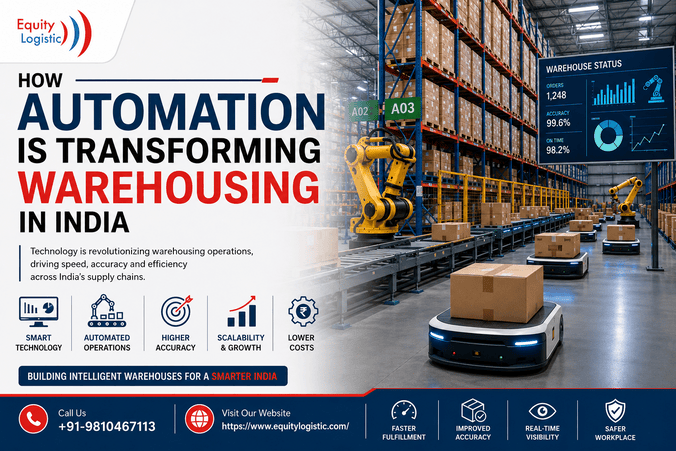
India's warehousing industry is undergoing its most dramatic transformation in decades. What was once a labor-intensive, paper-driven operation—rows of manual pickers navigating large sheds with clipboards and handcarts—is rapidly becoming a technology-driven, data-connected, and partially automated system capable of processing thousands of orders with speed and accuracy that no purely manual operation can match.
This is not a distant future scenario. It is happening right now, across industrial corridors in Maharashtra, Gujarat, Rajasthan, Telangana, and the NCR. And it is reshaping what businesses expect from a warehousing service in India — and what a modern warehousing company in India must be capable of delivering.
The numbers reflect the scale of this shift. India's warehousing and logistics market was valued at USD 35.32 billion in 2026 and is projected to reach USD 79.8 billion by 2030, growing at a CAGR of 14.6% (Mordor Intelligence, 2025). The Indian government's infrastructure push—the PM Gati Shakti program, dedicated freight corridors, and the development of multi-modal logistics parks—is accelerating investment in modern warehousing infrastructure at an unprecedented pace.
At the center of this growth is automation. Businesses across e-commerce, manufacturing, FMCG, pharmaceuticals, automotive, and retail are investing in automated warehousing solutions because the competitive, operational, and economic case has never been stronger.
At Equity Logistics, we have been at the forefront of this transformation—building and operating modern, technology-enabled warehousing facilities across India that deliver the speed, accuracy, and scalability that today's supply chains demand. In this guide, we explain how automation is reshaping Indian warehousing, which technologies are driving the change, and what it means for businesses evaluating their warehousing service options in India.
The State of Warehousing in India Before Automation
To understand how significant the automation wave is, it is important to first acknowledge where India's warehousing sector has come from.
For most of its history, Indian warehousing was characterized by fragmented, unorganized storage facilities—often in older structures with limited infrastructure, managed through manual processes and paper-based records. Key challenges included the following:
Low inventory accuracy: Manual stock counts and paper-based records led to persistent discrepancies between recorded and actual inventory levels—causing stockouts, over-ordering, and fulfillment errors.
Slow order processing: Manual picking and packing processes meant that processing large order volumes—particularly during peak periods—required significant additional labor and still resulted in longer lead times.
High error rates: Human error in picking, packing, and dispatch is an unavoidable reality of manual warehousing. In industries where accuracy is critical—pharmaceuticals, electronics, and luxury goods—this created significant operational and reputational risk.
Scalability constraints: Manual warehousing operations scaled through headcount — adding more workers to handle more volume. This model is expensive, time-consuming to ramp up, and difficult to sustain with India's evolving labor market.
Limited real-time visibility: Without technology systems connecting warehousing operations to the broader supply chain, businesses had little real-time visibility into inventory levels, order status, or operational performance.
The combination of GST implementation (which rationalized India's fragmented warehouse network), e-commerce growth, rising consumer expectations for fast delivery, and increasing investment from private equity into logistics infrastructure has created the conditions for a fundamental upgrade of India's warehousing capabilities.
Key Automation Technologies Transforming Every Warehousing Service India Provides
Warehouse Management Systems — The Digital Foundation of Every Warehousing Company India Operates
Before any physical automation makes sense, the digital foundation must be in place. A Warehouse Management System (WMS) is the software backbone of a modern warehousing operation—managing inventory in real time, directing labor, optimizing storage locations, controlling inbound and outbound processes, and providing the data visibility that every modern supply chain requires.
A WMS transforms warehousing from a physical activity managed through paperwork and memory into a data-driven operation where every movement, every transaction, and every inventory position is tracked in real time.
For any serious warehousing company in India today, a robust WMS is not optional—it is the minimum requirement for competing for business from organized retail, e-commerce, and manufacturing clients who need their supply chains to be data-transparent and reliably accurate.
At Equity Logistics, our facilities are powered by advanced WMS platforms that provide our clients with real-time inventory visibility, order tracking, and performance reporting—accessible from anywhere through web and mobile interfaces.
What a Modern WMS Delivers:
- Real-time inventory tracking across multiple SKUs, locations, and storage zones
- Directed putaway and picking—optimizing every movement for speed and accuracy
- Cycle counting and perpetual inventory management — eliminating periodic manual stock counts
- Integration with client ERP systems (SAP, Oracle, Tally, Microsoft Dynamics)
- Outbound order management with wave planning and priority sequencing
- Performance dashboards—picks per hour, order accuracy, dock utilization, space utilization
Barcode and RFID Technology — Accuracy at the Core of Warehousing Service India
The shift from paper-based records to barcode and RFID-based tracking is one of the most impactful and cost-effective technology transitions in modern warehousing service operations in India.
Barcode scanning — using handheld or wearable scanners — ensures that every goods receipt, putaway, pick, pack, and dispatch is confirmed against the WMS in real time. This eliminates the transcription errors of manual data entry and provides an immediate audit trail for every inventory movement.
RFID (Radio Frequency Identification) takes this further—allowing multiple items to be scanned simultaneously without line-of-sight, enabling passive tracking of goods as they move through the warehouse without requiring manual scan events at each step. RFID is particularly valuable in high-volume, fast-moving operations where the time cost of individual scans adds up, and in industries like apparel, pharmaceuticals, and electronics where item-level tracking is critical.
India's adoption of barcode and RFID technology in warehousing has accelerated significantly, driven by the requirements of large e-commerce platforms, FMCG companies, and automotive manufacturers who mandate technology standards from their logistics partners.
Automated Storage and Retrieval Systems (AS/RS) — The Physical Transformation of Warehousing Company India Infrastructure
Automated storage and retrieval systems represent the most visible physical transformation in modern warehousing. These systems use automated machines — cranes, shuttles, carousels, or robotic systems — to store and retrieve goods from high-density racking systems with minimal human involvement.
Vertical Lift Modules (VLMs) use automated carriers to store and retrieve trays of goods from tall vertical columns—dramatically increasing storage density in a given floor area while delivering items directly to the operator at an ergonomic working height.
Shuttle systems use automated shuttles running on rails within high-bay racking to store and retrieve pallets or totes at speeds no human forklift operator can match—while also optimizing storage density by eliminating the aisle space needed for forklift navigation.
Mini-Load AS/RS systems handle smaller items—electronic components, pharmaceutical products, spare parts—with robotic cranes that retrieve individual totes from high-density storage arrays at extremely high throughput rates.
For India's growing manufacturing sector—automotive components, electronics, and pharmaceuticals—AS/RS installations are increasingly common in the warehousing facilities of leading companies. Any warehousing company in India serving these sectors is under pressure to develop AS/RS capability.
Automated Guided Vehicles and Mobile Robots—Transforming Floor Operations Across Warehousing Services in India
Automated Guided Vehicles (AGVs) and Autonomous Mobile Robots (AMRs) are transforming the movement of goods within warehousing facilities — replacing or augmenting the manual pallet trucks, forklifts, and trolleys that have traditionally dominated warehouse floors.
AGVs follow fixed paths—defined by magnetic tracks, QR codes, or laser navigation—to move pallets and large loads predictably and safely between fixed points in the warehouse. They are particularly suited to repetitive, high-volume movements in manufacturing and distribution facilities.
AMRs are more sophisticated — they navigate autonomously using onboard sensors and mapping technology, finding their own routes around dynamic obstacles, collaborating with human workers, and adapting to changing warehouse layouts. AMRs have seen rapid deployment in e-commerce fulfillment and FMCG distribution warehouses across India.
The economics of warehouse robotics in India are increasingly compelling. While the capital cost of AMR deployment has been a historical barrier, the combination of falling hardware prices, robotics-as-a-service (RaaS) deployment models, and the rising cost and availability challenges of warehouse labor is shifting the calculation in favor of automation for a growing range of Indian warehousing operations.
Automated Picking Technologies — Speed and Accuracy for Every Warehousing Company India Operates
Order picking—selecting individual items from storage to fulfill customer orders—is the most labor-intensive and error-prone activity in most warehousing operations. It is also the activity most directly connected to the order accuracy and fulfillment speed that end customers experience.
Pick-to-light systems use illuminated displays mounted on shelving to guide pickers to the correct location and indicate the quantity to pick—dramatically reducing walking time, eliminating pick errors, and increasing picks per hour.
Voice-directed picking uses a headset and voice-recognition system to give operators spoken instructions, confirming picks verbally—freeing both hands for the pick and eliminating the need to look at a screen or paper list.
Goods-to-person systems bring the items to the picker rather than sending the picker to the items—using AS/RS, AMRs, or conveyor systems to deliver totes or bins to a stationary workstation. This is one of the most significant productivity improvements available, reducing the walking time that can consume 50–60% of a manual picker's working day.
Robotic picking arms—using computer vision and advanced manipulation technology—are beginning to handle a growing range of SKUs autonomously, with particular success in high-volume, repetitive picking environments like e-commerce returns processing and pharmaceutical dispensing.
Conveyor and Sortation Systems — The Backbone of High-Volume Warehousing Service India
For e-commerce distribution, postal and courier hubs, and FMCG distribution centers handling high order volumes, automated conveyor and sortation systems are essential infrastructure.
Modern sortation systems—cross-belt sorters, tilt-tray sorters, and bomb-bay sorters—can process tens of thousands of parcels per hour with near-perfect accuracy, directing each item to the correct dispatch lane, packing station, or loading dock without manual intervention.
India's rapidly growing e-commerce sector—driven by Flipkart, Amazon, Meesho, and a rapidly expanding D2C brand ecosystem—has made sortation automation a standard requirement for the fulfillment centers serving these platforms. Any warehousing service in India operating in the e-commerce supply chain must have sortation capability to remain competitive.
IoT and Smart Sensors — Real-Time Intelligence for Every Warehousing Company India
The Internet of Things (IoT) is embedding intelligence throughout warehousing operations—monitoring conditions, tracking assets, measuring performance, and enabling predictive maintenance in ways that were simply impossible with traditional infrastructure.
Temperature and humidity monitoring is critical for cold chain warehousing—pharmaceuticals, food and beverages, and chemicals. IoT sensors provide continuous, real-time environmental monitoring with automated alerts when conditions deviate from specified parameters—protecting stock integrity and compliance.
Asset tracking uses IoT tags on forklifts, trolleys, containers, and high-value assets to provide real-time location visibility across the facility—reducing the time staff spend searching for equipment and enabling better utilization management.
Predictive maintenance uses sensor data from machinery—conveyor motors, AS/RS systems, forklifts—to identify early signs of mechanical wear or stress before failures occur, enabling planned maintenance that prevents costly operational disruptions.
Energy management IoT systems monitor electricity consumption across lighting, HVAC, and equipment—identifying waste and enabling automated optimization that reduces the energy cost of warehousing operations.
AI and Data Analytics — The Intelligence Layer of Modern Warehousing Service India
Automation generates enormous amounts of operational data. The value of that data depends on the analytical capability applied to it. AI and advanced analytics are increasingly central to how leading warehousing companies in India optimize their operations.
Demand forecasting uses historical order data, seasonal patterns, and market signals to predict future inventory requirements—enabling smarter replenishment planning that reduces both stockouts and excess inventory.
Slotting optimization uses AI to continuously analyze order patterns and determine the optimal storage location for every SKU—placing fast-moving items closest to dispatch areas, grouping frequently co-ordered items near each other, and dynamically updating the slotting plan as demand patterns change.
Labor planning and productivity analytics use real-time and historical operational data to optimize staffing levels, identify high- and low-performing operators, and target training where it is most needed.
Predictive inventory analytics identifies slow-moving and dead stock before it becomes a capital lock-up problem—enabling timely promotional, transfer, or disposal decisions.
Benefits of Automation for Every Warehousing Service India Offers
The business case for automation in Indian warehousing is clear and measurable across multiple dimensions:
Dramatically Improved Order Accuracy: Automated picking and WMS-directed operations consistently achieve order accuracy rates of 99.5–99.9%, compared to 96–98% for well-managed manual operations. In high-volume operations, this difference represents thousands of fewer errors per month.
Faster Order Fulfillment: Automation compresses the time between order receipt and dispatch—enabling same-day and next-day delivery promises that are increasingly expected across e-commerce, FMCG, and healthcare supply chains.
Higher Storage Density: AS/RS and high-bay automated systems can achieve 3–5 times the storage density of conventional racking in the same footprint—dramatically reducing the cost per pallet position and making better use of expensive land in India's major logistics corridors.
Scalability Without Proportional Labor Cost: Automated systems scale with volume without the proportional increase in headcount required by manual operations—providing a more predictable, manageable cost structure as client volumes grow.
Real-Time Supply Chain Visibility: Automation integrated with WMS and ERP systems gives businesses real-time visibility into their inventory and order status — enabling better planning, faster issue resolution, and more confident customer commitment.
Improved Safety: Reducing the interaction between pedestrian workers and moving vehicles—forklifts and AGVs—through automation and designed traffic separation reduces warehouse accidents, which remain a significant safety concern in traditional manual operations.
Challenges in Adopting Automation for Warehousing Service India Operations
Honest guidance requires acknowledging the challenges alongside the benefits. Automation adoption in Indian warehousing faces real hurdles:
Capital Investment: The upfront cost of automation—AS/RS systems, AMR fleets, and conveyor sortation—is significant. For many small and mid-size warehousing operators, the capital requirement has been a genuine barrier. However, Robotics-as-a-Service (RaaS) models, leasing options, and the declining cost of key technologies are progressively lowering this barrier.
Change Management and Workforce Transition: Automation changes job roles and requires workforce reskilling. Managing this transition — retaining experienced staff in new roles, communicating transparently about how automation affects employment — is a critical success factor that is often underestimated.
Integration Complexity: Connecting automated hardware systems with WMS, ERP, and other business systems requires careful integration work. Poor integration is one of the most common causes of automation project underperformance.
Warehouse Infrastructure Readiness: Many existing Indian warehouse facilities — older structures with limited floor load capacity, insufficient ceiling height for AS/RS, or inadequate power infrastructure — require significant modification or replacement before automation can be deployed.
How Equity Logistics Is Leading Automation in Warehousing Company India's Operations
At Equity Logistics, we have made automation and technology investment a strategic priority—because we believe that a modern warehousing company in India cannot serve the needs of today's supply chains without it.
Our facilities are built and operated with a clear vision: to deliver the accuracy, speed, visibility, and scalability that our clients need to compete in fast-moving, demanding markets—backed by technology infrastructure that sets a genuine standard for the Indian warehousing sector.
What We Offer:
Our WMS-powered operations provide real-time inventory visibility and accurate stock management across all client accounts, with seamless integration to SAP, Oracle, Tally, and other ERP systems. Our barcode and RFID-enabled receiving, storage, and dispatch processes deliver consistently high order accuracy. Our IoT-monitored cold chain facilities meet the stringent requirements of pharmaceutical, food, and healthcare clients.
Our scalable infrastructure—designed to flex with seasonal and business-driven volume variations—means our clients never pay for capacity they do not need and never run out of capacity when they do.
And our management team brings deep expertise in warehousing service India operations across e-commerce, FMCG, manufacturing, pharmaceuticals, and retail—so we understand not just the technology but also the supply chain context in which it must perform.
The Future of Warehousing Service India — What Comes Next
The automation wave in Indian warehousing is still in its early stages. The technologies that are transforming leading facilities today will be mainstream across the sector within five years. Looking ahead, several developments will shape the next phase:
Drone-based inventory management using autonomous drones to conduct cycle counts across high-bay warehouses is moving from pilot to production deployment—dramatically reducing the time and labor cost of inventory auditing.
Fully autonomous receiving using computer vision and AI to automatically identify, count, and quality-check incoming goods at the dock—without human inspection—is advancing rapidly.
Digital twin technology is creating a real-time virtual replica of the physical warehouse—enabling simulation of layout changes, process optimizations, and capacity planning before any physical change is made.
Collaborative robots (cobots) working alongside human operators in shared workspaces—handling repetitive, physically demanding tasks like lifting and packing while humans focus on judgment-intensive activities.
Green warehousing with solar power, energy-efficient LED lighting, EV-charging infrastructure for material handling equipment, and rainwater harvesting is becoming not just an ethical choice but a client expectation and regulatory requirement.
Conclusion
Automation is fundamentally reshaping the warehousing industry across India.
Modern businesses require:
- faster fulfillment,
- real-time visibility,
- accurate inventory management,
- and scalable logistics support.
Traditional warehouse operations are no longer sufficient to meet these growing expectations.
Technologies such as:
- Warehouse Management Systems,
- robotics,
- AI-driven analytics,
- RFID tracking,
- IoT monitoring,
- and automated sorting systems
are helping warehouses become smarter, faster, and more efficient than ever before.
For businesses evaluating warehousing service India providers, choosing a technology-driven logistics partner has become critical for long-term operational success.
At Equity Logistics, we are committed to delivering modern warehousing solutions built around automation, operational efficiency, and supply chain excellence.
Whether you need:
- inventory management,
- fulfillment support,
- cold chain warehousing,
- distribution logistics,
- or scalable storage infrastructure,
Our team delivers warehousing solutions designed for the future of Indian logistics.
Frequently Asked Questions (FAQs)
1. What is warehouse automation?
Warehouse automation involves using technologies such as Warehouse Management Systems (WMS), robotics, barcode scanning, RFID, AI, and IoT to streamline inventory management, order fulfillment, and warehouse operations while reducing manual intervention.
2. Why is automation important for warehousing in India?
Automation helps businesses improve inventory accuracy, speed up order processing, reduce operational costs, and enhance supply chain visibility. As eCommerce and retail continue to grow, automation has become essential for efficient warehousing service India operations.
3. How does a Warehouse Management System (WMS) improve warehouse operations?
A Warehouse Management System tracks inventory in real time, manages inbound and outbound shipments, optimizes storage space, improves order accuracy, and provides complete visibility into warehouse performance.
4. What technologies are commonly used in modern warehouses?
Modern warehouses use:
- Warehouse Management Systems (WMS)
- Barcode and RFID tracking
- Automated Guided Vehicles (AGVs)
- Robotics and conveyor systems
- Artificial Intelligence (AI)
- IoT-enabled monitoring systems
- Automated Storage and Retrieval Systems (AS/RS)
5. How does automation improve inventory accuracy?
Automation reduces human errors through barcode scanning, RFID technology, and real-time inventory tracking. This ensures accurate stock levels and minimizes inventory discrepancies.
6. Which industries benefit the most from warehouse automation?
Industries that benefit significantly include:
- eCommerce
- FMCG
- Pharmaceuticals
- Retail
- Automotive
- Manufacturing
- Food and Beverage
- Healthcare Logistics
7. Can small and medium businesses benefit from automated warehousing?
Yes. Many automation solutions such as WMS, barcode systems, and inventory tracking tools are affordable and scalable, making them suitable for small and medium-sized businesses.
8. How do automated warehouses reduce operational costs?
Automation improves efficiency, reduces labor dependency, minimizes errors, optimizes storage utilization, and accelerates order fulfillment, leading to significant long-term cost savings.
9. What should businesses look for when choosing a warehousing company in India?
Businesses should evaluate:
- Technology infrastructure
- Warehouse Management System capabilities
- Inventory accuracy levels
- Security standards
- Scalability
- Industry experience
- Real-time reporting and visibility
- Location and distribution network
10. Why choose Equity Logistics for warehousing services in India?
Equity Logistics offers technology-driven warehousing solutions with advanced WMS integration, real-time inventory tracking, scalable storage infrastructure, efficient distribution support, and industry-specific logistics expertise across India.