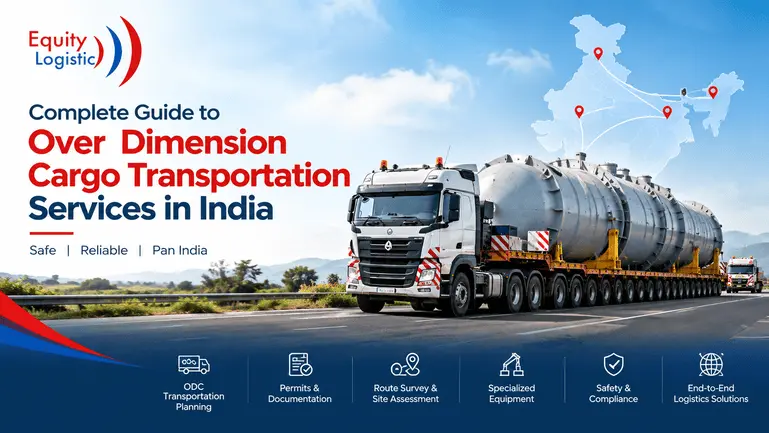
India is building at a scale the country has rarely seen before. Wind farms are rising across Gujarat and Tamil Nadu, new steel plants are coming up across the industrial belts of Odisha and Chhattisgarh, and power infrastructure is expanding into every corner of the map. None of this happens without moving equipment that simply doesn’t fit on standard truck transformers the size of a room, wind turbine blades longer than a cricket pitch, industrial boilers, cranes, and pre-fabricated structures. This is the world of Over Dimension Cargo Transportation, and for any business involved in heavy industry, energy, or infrastructure, understanding how it works isn’t optional, it’s essential to keeping projects on schedule and on budget.
This guide covers everything you need to know about Over Dimensional Cargo Transportation in India what it involves, how it’s regulated, what equipment is used, and how to choose the right partner for your next oversized shipment.
What Is Over Dimension Cargo (ODC)?
Over Dimension Cargo refers to any consignment that exceeds the standard legal limits for length, width, height, or weight permitted on Indian roads. When a shipment is too large or too heavy to be transported using a conventional truck or trailer, it falls into the ODC category and requires specialized vehicles, route planning, permits, and safety protocols to move safely.
This isn’t a small or niche segment of the logistics industry. As India’s manufacturing, energy, and infrastructure sectors continue to expand, demand for reliable ODC Transportation Services in India has grown substantially, and the businesses that get this right consistently outperform those that treat it as an afterthought.
Why Over Dimension Cargo Transportation Matters
For companies in sectors like power generation, renewable energy, steel, oil and gas, and heavy engineering, ODC movement is often the single biggest logistical risk in a project timeline. A delayed transformer can hold up an entire substation. A damaged turbine blade can push a wind farm’s commissioning date back by months, at enormous cost. Getting equipment from the factory gate to the project site safely and on schedule isn’t just a logistics function — it directly determines whether a project stays on budget and on time.
This is why businesses increasingly look for dedicated ODC Transport Services rather than relying on general freight companies that occasionally handle oversized loads as an exception rather than a specialty.
Types of Over Dimension Cargo Movement
ODC transportation isn’t a single, uniform service it covers several distinct categories, each requiring different equipment and planning:
Wide Load Transportation- Cargo that exceeds standard width limits large tanks, industrial vessels, prefabricated modules often requires escort vehicles and careful route clearance through narrow stretches of road.
Long Load Transportation- Wind turbine blades, girders, and long pipe sections fall into this category. These shipments typically use extendable trailers designed to accommodate extra length while maintaining stability during transit.
Heavy Haul Transportation- This covers extremely heavy equipment transformers, generators, industrial presses that require multi-axle or hydraulic modular trailers capable of distributing weight safely across the road surface without damaging bridges or pavement.
Tall Load Transportation- Equipment exceeding standard height limits needs careful route surveys to check for bridges, overhead power lines, and other clearance obstacles along the entire route.
Each of these categories requires a slightly different approach, which is why working with an experienced Over Dimensional Cargo Transport provider rather than a generalist makes such a meaningful difference to project outcomes.
The Regulatory Landscape: Permits and Compliance
One of the most complex aspects of ODC movement in India is the regulatory approval process, largely because road transport regulations are governed at the state level, meaning a single shipment crossing multiple states requires multiple sets of permits and approvals.
Key Permits and Approvals Typically Required
- State Transport Department Permits — Required individually for each state along the route, since dimension and weight limits vary from state to state.
- Route Survey and Approval — A physical inspection of the proposed route to check bridge load capacities, road widths, turning radii at junctions, and overhead obstructions like power lines.
- Police Escort Permissions — Particularly important for very large or heavy loads moving through urban areas, where traffic management becomes a safety necessity.
- National Highway Authority Clearances — Needed for stretches of the route on national highways, especially where weight restrictions or toll considerations apply.
- Municipal Corporation Permissions — Required when routes pass through city limits, especially in areas with infrastructure constraints like low bridges or narrow lanes.
- Railway Crossing and Bridge Authority NOCs — Necessary when the route crosses railway lines or specific bridges with load restrictions.
Because these requirements differ so significantly by state and by the specific characteristics of the cargo, businesses without deep regulatory experience often face costly delays. This is exactly why choosing an experienced ODC Transporter in India one with an established track record navigating these approvals — matters so much.
Equipment Used in ODC Transportation
The equipment fleet behind a successful ODC movement is highly specialized:
- Multi-Axle Trailers — Distribute weight across additional axles to stay within road and bridge load limits.
- Hydraulic Modular Trailers — Used for the heaviest and most oversized loads, with hydraulic suspension systems that allow precise weight distribution and maneuverability.
- Extendable/Telescopic Trailers — Designed to adjust length for unusually long cargo like turbine blades or structural girders.
- Low-Bed Trailers — Lower deck height allows tall equipment to be transported while staying within legal height limits.
- Escort and Pilot Vehicles — Accompany the main convoy to manage traffic, warn oncoming vehicles, and assist with navigation through tight spaces.
An experienced Over Dimension Cargo Transporter maintains a diverse equipment fleet, allowing them to match the right trailer configuration to each specific cargo type rather than forcing a one-size-fits-all approach.
Industries That Depend on ODC Transportation
Power and Energy- Transformers, turbines, generators, and switchgear routinely require oversized transport, often to remote substation and power plant locations with challenging road access.
Renewable Energy- Wind energy, in particular, is one of the largest drivers of ODC demand in India today turbine blades, nacelles, and tower sections are among the most logistically demanding cargo types in the country.
Steel and Heavy Engineering- Industrial presses, rolling mill equipment, and large fabricated structures frequently exceed standard transport dimensions.
Oil and Gas- Refinery equipment, pressure vessels, and pipeline sections often require careful route planning due to their combination of weight and dimension.
Infrastructure and Construction- Bridge girders, precast structures, and large construction equipment like cranes and excavators regularly move via specialized ODC transport.
Heavy Haulage: A Related but Distinct Discipline
Closely related to ODC transport is heavy haulage the movement of extremely heavy, though not necessarily oversized, cargo. Heavy Haulage Transportation Services in India typically involve cargo where weight, rather than dimension, is the primary constraint, requiring reinforced trailers and careful axle load calculations to avoid damaging roads and bridges along the route. In practice, many shipments combine both challenges with a piece of equipment that is both oversized and extremely heavy which is why an integrated approach to planning matters so much.
What a Complete ODC Logistics Solution Looks Like
True ODC Logistics Services in India go well beyond simply providing a truck and driver. A complete solution typically includes:
- Cargo Assessment — Understanding the exact dimensions, weight, fragility, and handling requirements of the equipment being moved.
- Route Survey — Physically verifying the proposed route for bridges, road widths, turning radii, and overhead obstacles.
- Permit and Compliance Management — Securing all necessary state, municipal, and highway authority approvals before the shipment departs.
- Equipment Selection — Matching the cargo to the appropriate trailer type and configuration.
- Execution and Escort Coordination — Managing the actual movement, including pilot vehicles, police escorts where needed, and real-time coordination.
- Insurance and Documentation — Ensuring the shipment is properly insured and all paperwork is in order for audit and compliance purposes.
- On-Site Delivery and Offloading Support — Coordinating the final leg of delivery, including any specialized offloading equipment required at the destination.
This is the essence of true Over Dimensional Cargo Logistics — an integrated, end-to-end service rather than a fragmented series of separately managed steps.
Common Challenges in ODC Transportation
Multi-State Permit Coordination- Shipments crossing several states require separate permits from each jurisdiction, and timelines can vary significantly, making coordination a genuine logistical challenge.
Infrastructure Constraints- Low bridges, narrow village roads, and overhead power lines can force significant route detours, sometimes adding days to a shipment’s timeline.
Seasonal and Weather Disruptions- Monsoon season, in particular, can affect road conditions and visibility, requiring careful scheduling around weather patterns.
Last-Mile Access- Remote project sites particularly for renewable energy and infrastructure projects often have the most challenging final stretch of road, requiring specialized local knowledge.
Cost Unpredictability- Without proper planning, permit delays, route detours, and equipment mismatches can significantly inflate costs beyond initial estimates.
Working with an experienced provider substantially reduces exposure to each of these risks, since route surveys, permit timelines, and seasonal planning are built into the process from the outset rather than discovered as problems along the way.
How to Choose the Right ODC Transportation Partner
When evaluating a provider for your next oversized shipment, consider the following:
- Track Record with Similar Cargo — Has the provider handled equipment of similar size, weight, and industry type before?
- Fleet Diversity — Do they have access to the specific trailer types your cargo requires, rather than a limited, generic fleet?
- Regulatory Expertise — Can they demonstrate a strong history of managing multi-state permits and approvals smoothly?
- Route Planning Capability — Do they conduct genuine physical route surveys, rather than relying on outdated maps or assumptions?
- Transparent Communication — Will you receive proactive updates throughout the shipment, especially if delays or route changes occur?
- Insurance and Documentation Practices — Is the provider thorough about insurance coverage and compliance documentation for audit purposes?
Why Businesses Choose Equity Logistic
Equity Logistic has built a strong reputation as a dependable partner for over dimension cargo movement across India, combining deep regulatory expertise, a diverse specialized fleet, and end-to-end project management for even the most complex shipments. From wind turbine components and transformers to industrial machinery and infrastructure equipment, Equity Logistic manages every stage of the process route survey, permits, equipment selection, execution, and delivery under one accountable team.
Final Thoughts
Over dimension cargo transportation is one of the most technically demanding areas of Indian logistics, requiring specialized equipment, deep regulatory knowledge, and careful route planning to execute safely and on schedule. As India’s energy, infrastructure, and manufacturing sectors continue to grow, the businesses that treat ODC movement as a strategic priority rather than an operational afterthought will consistently see fewer delays, lower costs, and safer outcomes for their most critical shipments.
If your business needs a reliable partner for oversized or heavy cargo movement anywhere in India, connect with Equity Logistic’s team to plan your next shipment.