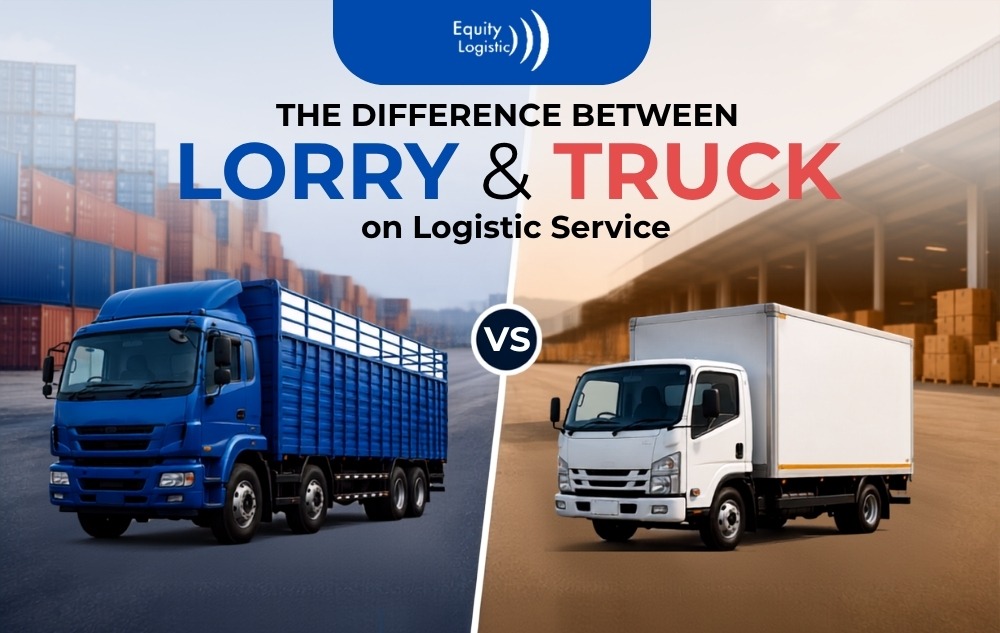
Walk on to any loading dock in India and you will hear the same vehicle called three different things within five minutes. The transporter calls it a truck, the site supervisor calls it a lorry, and the paperwork calls it a goods carriage. Most of the time nobody minds. But when you are moving a 40-tonne transformer, a batch of solar modules, or a consignment that has to clear three state borders on schedule, that loose language starts to cost money because the wrong vehicle class means the wrong permit, the wrong axle configuration and the wrong quotation.
This guide sorts out the difference between a lorry and a truck as the terms are actually used in logistics service, and then goes a step further: it explains how vehicles are really classified in Indian freight movement, and how to pick the right one for your cargo.
Lorry vs Truck: the short answer
There is no engineering difference. Lorry and truck describe the same category of vehicle — a motorised road vehicle built to carry goods rather than passengers. The split is linguistic, not mechanical.
- Lorry is British English. It travelled into Indian usage through the colonial-era railway and road administration, and it stuck. In most of India especially in the south and in spoken Hindi as lāri — a lorry is the everyday word for a heavy goods vehicle.
- Truck is American English, and it is now the dominant term in formal Indian logistics, in RTO documentation, in manufacturer catalogues and in international trade paperwork.
So when a customer asks for lorry transport and a logistics provider quotes truck transport, they are talking about the same thing.
Where the usage actually diverges
That said, three shades of difference have hardened in practice, and understanding them prevents genuine confusion on the ground.
1. Size and duty class
In Indian conversational usage, “lorry” tends to imply a large, heavy, multi-axle vehicle the classic long-haul goods carrier. “Truck” is the broader umbrella. A small commercial vehicle doing last-mile city delivery is a mini truck; almost nobody calls it a mini lorry. So the practical rule is: every lorry is a truck, but not every truck gets called a lorry.
2. Rigid body versus articulated units
Where the terms genuinely stop overlapping is at the articulated end. A tractor unit pulling a semi-trailer is a trailer or a truck-trailer combination, never a lorry. The same applies to the specialised equipment used for oversized freight: low-bed trailers, hydraulic axle trailers and modular platforms. If you are comparing configurations before you book, our breakdown of trailer and transportation options in India covers what each body type is designed to carry, and our guide to the best trailer types for ODC cargo transportation goes deeper into the oversized end of the range.
3. Documentation and regulation
Regulatory language does not use either word loosely. Under the Motor Vehicles Act, the operative terms are *goods carriage*, *heavy goods vehicle (HGV)*, *medium goods vehicle (MGV)* and *light goods vehicle (LGV)*, defined by gross vehicle weight. Permits, driver licence endorsements, road tax and toll classification all key off those definitions — not off whether the invoice says lorry or truck. This is why a serious logistics solution company will always confirm the vehicle in GVW and axle terms before dispatch.
The classification that actually matters
Instead of arguing over vocabulary, freight buyers get more value from understanding the practical vehicle classes used across Indian goods transport.
Light commercial vehicles (LCV)
Payloads roughly up to 3.5 tonnes. Used for urban distribution, spare parts movement and feeder runs from a warehouse to retail points. Manoeuvrable, cheap to run, restricted in what they can legally carry.
Medium and heavy commercial vehicles (MCV / HCV)
Rigid-body trucks in 9-tonne, 16-tonne and 25-tonne classes with two to four axles. These are the workhorses of intercity freight and the vehicles most people picture when they say lorry. Ideal for palletised general cargo, packaged goods and bulk consignments that fit standard dimensions. Most domestic transport movements across the country run on this class.
Multi-axle trailers and semi-trailers
A tractor unit with a detachable trailer flatbed, container chassis, low-bed or extendable. This is where capacity jumps from tens of tonnes into hundreds, and where load planning becomes an engineering exercise rather than a booking exercise.
Specialised and modular equipment
Hydraulic modular trailers, girder bridges, steerable axle lines and pullers. These are used for consignments that exceed legal dimensional limits turbines, boiler drums, reactors, generator stators, tower sections. Movements of this kind fall under over dimension consignments, and if you want the fundamentals, our explainer on understanding over dimensional cargo is a good starting point.
How to choose the right vehicle for your consignment
Terminology aside, five questions determine which vehicle you should be booking.
- What are the dimensions? Length, width and height decide whether you are in standard freight or ODC territory. Anything beyond roughly 2.6 m wide, 4.2 m high or the permissible length triggers route surveys and state-level permissions.
- What is the weight, and how is it distributed? Gross weight sets the axle count. Concentrated point loads common with machinery may need a low-bed or a modular platform even when total weight looks modest.
- What is the route? Bridge capacities, overhead clearances, ghat sections, urban restrictions and border checkpoints frequently rule out the vehicle that looked cheapest on paper. This matters even more for terrain-heavy movements such as hydro power project transportation or freight into the North East.
- How fragile or sensitive is the cargo? Solar panels, electronic assemblies and precision equipment need controlled handling and lashing regimes, not just capacity. Our note on common challenges in solar module transportation explains why the vehicle is only half the answer.
- What is the delivery window? A cheaper vehicle that needs three permits and a night-only travel restriction is not cheaper. Cost per tonne only makes sense alongside transit time a point we unpack in how to reduce transportation costs with the right transporter.
Why the distinction matters commercially
Vehicle selection is the single largest controllable cost in road freight. Under-specify and you risk detention, damage, re-handling or an outright rejection at a check post. Over-specify and you are paying for axles you never needed. Both outcomes come from a booking made in vague language “send a lorry” rather than a specification.
A capable transporter in India will ask for cargo drawings, weights and delivery constraints before quoting, then propose a vehicle class and a route plan together. For plant and machinery movements, that discipline is not optional: industrial transportation and project handling both depend on the equipment matching the engineering, not the vocabulary.
The bottom line
Lorry and truck mean the same thing. One is British, one is American, and Indian logistics uses both interchangeably. What is not interchangeable is the vehicle class behind the word LCV, HCV, trailer or modular platform and that is what determines your permits, your transit time and your final freight bill.
At Equity Logistics, every movement starts with the specification rather than the label. Whether it is routine pan-India logistics or an over-dimension consignment that needs a route survey and a police escort, we match the equipment to the cargo. Talk to our team about your next movement through the contact page, or explore the full range of logistics solutions we operate across India.
FAQs – The Difference Between Lorry and Truck in Logistics Services
1. What is the difference between a lorry and a truck?
The terms lorry and truck generally refer to motor vehicles designed to carry goods. “Lorry” is more commonly used in British English and countries influenced by it, while “truck” is widely used in American English and many other regions. The exact terminology can vary by country.
2. Is a lorry the same as a truck?
In many contexts, yes. Both are commercial vehicles used for transporting goods and cargo. However, the terms may have different meanings depending on the country, vehicle type, and local transportation regulations.
3. Which is better for logistics, a lorry or a truck?
It depends on the type, size, weight, and dimensions of the cargo. Different trucks and lorries are designed for different transportation requirements, such as general cargo, heavy equipment, oversized goods, or long-distance freight.
4. What are lorries and trucks used for?
Lorries and trucks are commonly used to transport industrial goods, machinery, construction materials, commercial products, agricultural goods, and other cargo between warehouses, distribution centres, factories, ports, and project locations.
5. What types of trucks are used in logistics?
Common types include flatbed trucks, container trucks, tipper trucks, trailer trucks, refrigerated trucks, tanker trucks, and heavy-duty trucks. The appropriate vehicle depends on the cargo and transportation requirements.
6. How do I choose the right truck for cargo transportation?
Consider the cargo weight, dimensions, volume, loading requirements, transportation distance, road conditions, and delivery timeline. A professional logistics provider can help select the most suitable vehicle for the shipment.
7. Can trucks and lorries transport oversized cargo?
Yes. Specialised heavy-haulage vehicles, trailers, and other equipment can be used for oversized and heavy cargo transportation. Such shipments may require route planning, permits, escorts, and specialised loading arrangements.
8. Why is choosing the right vehicle important in logistics?
Choosing the correct vehicle helps ensure cargo safety, efficient loading, regulatory compliance, cost control, and timely delivery. The wrong vehicle can lead to additional costs, delays, or transportation challenges.