What Is the Hub-and-Spoke Model Logistics in India
India is one of the fastest-growing economies in the world, and at the heart of this growth lies a powerful, rapidly evolving logistics sector. From e-commerce giants delivering parcels to the remotest corners of the country to manufacturers shipping raw materials across states, logistics is the invisible backbone that keeps India's economy moving forward every single day.
As businesses scale and supply chains become increasingly complex, the need for smarter, more efficient logistics models has never been greater. One model that has truly revolutionised the way goods are moved across India is the Hub-and-Spoke Model — a system that has transformed logistics service India operations from fragmented, inefficient networks into streamlined, cost-effective, and highly reliable supply chains.
At Equity Logistics, we have built our entire logistics network around the hub-and-spoke philosophy, and the results speak for themselves. In this comprehensive guide, we will explain exactly what the hub-and-spoke model is, how it works in the Indian context, why it is the gold standard for modern logistics, and how it is reshaping the future of logistics service India for businesses of every size.
Understanding the Hub-and-Spoke Model — The Basics
Before diving into how the hub-and-spoke model works in India specifically, let's first understand what this model actually means.
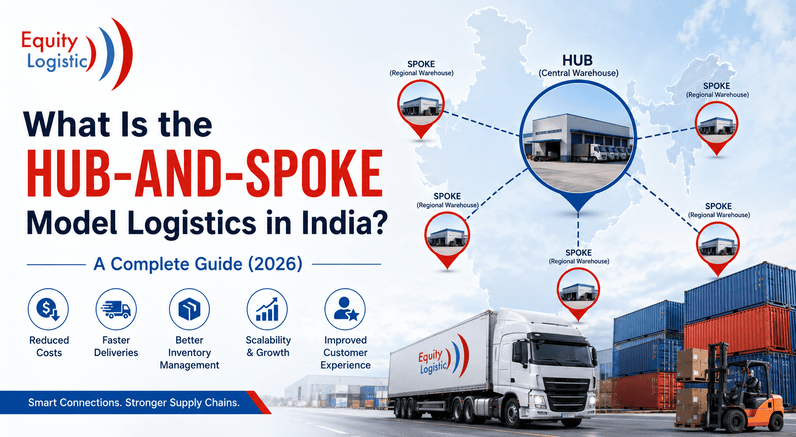
The hub-and-spoke model is a logistics and distribution network design in which goods are consolidated at central points — called hubs — and then distributed outward to smaller destinations — called spokes. Think of it like a bicycle wheel. The centre of the wheel is the hub, and the spokes radiate outward from the centre to the rim. In logistics terms, the hub is the central warehouse or distribution centre, and the spokes are the local delivery branches, regional offices, or end destinations connected to it.
Instead of transporting goods directly from every point of origin to every point of destination — which would require an enormous number of individual routes — the hub-and-spoke model consolidates shipments at the hub, sorts them efficiently, and then dispatches them to their final destinations via the spokes.
This approach dramatically reduces the number of routes required, lowers transportation costs, improves efficiency, and enables far better tracking and quality control throughout the logistics process.
At Equity Logistics, we have refined and perfected this model specifically for the unique challenges and opportunities of the Indian market, making us one of the most trusted names in logistics service India.
How the Hub-and-Spoke Model Works in India
India presents a unique set of logistics challenges that make the hub-and-spoke model not just useful but absolutely essential. With 28 states, 8 union territories, over 640 districts, and thousands of cities, towns, and villages spread across a vast and geographically diverse landscape, moving goods efficiently across this country requires careful planning and an intelligent network design.
Here is how the hub-and-spoke model works in the Indian logistics context, step by step:
Step 1 — Collection at Origin Spokes Goods are first collected from businesses, manufacturers, warehouses, or individual sellers at local collection points — the origin spokes. These are typically smaller regional offices or collection centres located across cities and towns.
Step 2 — Transportation to the Hub Once collected, goods are transported in consolidated loads from the origin spokes to the nearest regional hub. Because multiple shipments are consolidated together for this journey, transportation costs per unit drop significantly.
Step 3 — Sorting and Processing at the Hub At the hub — typically a large, strategically located central warehouse or distribution centre — goods are sorted, scanned, labelled, and reorganised by destination. Advanced technology, barcode scanning, and automated sorting systems ensure accuracy and speed at this stage.
Step 4 — Inter-Hub Transportation In large-scale logistics networks like the one operated by Equity Logistics, there may be multiple hubs across different regions of India — such as a North India hub, South India hub, East India hub, and West India hub. Goods destined for far regions are transported between these hubs via large-capacity trucks, trains, or air freight.
Step 5 — Delivery to Destination Spokes From the regional hub, sorted goods are dispatched to local delivery branches — the destination spokes — in the target area. These local branches handle the final mile delivery to businesses, retailers, or end customers.
Step 6 — Last Mile Delivery The final spoke in the chain handles the crucial last mile delivery — getting the parcel or shipment to its exact destination address. This is often the most challenging and expensive part of logistics, and the hub-and-spoke model helps optimise it by ensuring that local delivery vehicles are always operating with efficient, consolidated loads.
This end-to-end process is what makes Equity Logistics one of the most efficient and reliable logistics service India providers operating today.
Why the Hub-and-Spoke Model Is Perfect for India
India's logistics landscape is uniquely complex. Here are the specific reasons why the hub-and-spoke model is particularly well-suited to India's geography, infrastructure, and business environment:
1. India's Vast Geography India covers over 3.28 million square kilometres, making it the seventh-largest country in the world by area. Serving every corner of this vast nation through direct point-to-point delivery would be logistically impossible and financially catastrophic. The hub-and-spoke model solves this by creating a structured network that can reach even the most remote areas efficiently.
2. Diverse Infrastructure India has an incredibly diverse infrastructure landscape — from world-class expressways and modern airports in major cities to narrow roads and limited connectivity in rural areas. The hub-and-spoke model adapts to this diversity beautifully. Large vehicles handle the long-haul hub-to-hub legs on highways, while smaller, more agile vehicles handle local delivery in areas with challenging road conditions.
3. GST and Interstate Logistics Since the introduction of the Goods and Services Tax (GST) in 2017, interstate commerce in India has become significantly smoother and more cost-effective. The hub-and-spoke model is perfectly aligned with India's GST framework, as centralised hubs can serve as efficient GST-compliant warehousing and distribution points, reducing tax complexities and improving compliance.
4. The E-Commerce Explosion India's e-commerce market is among the fastest growing in the world. Millions of orders are placed every single day across platforms like Amazon, Flipkart, Meesho, and countless others. Handling this volume of shipments efficiently is only possible with a hub-and-spoke network. At Equity Logistics, our hub-and-spoke infrastructure is purpose-built to handle high-volume e-commerce logistics service India requirements with speed, accuracy, and reliability.
5. Growing Tier 2 and Tier 3 City Markets One of the most exciting trends in Indian commerce is the rapid growth of Tier 2 and Tier 3 city markets. Consumers in cities like Patna, Indore, Coimbatore, Surat, and Jaipur are ordering online and expecting fast delivery just like their counterparts in metro cities. The hub-and-spoke model makes it economically viable and operationally efficient to serve these rapidly growing markets.
6. Cost Sensitivity India is a highly cost-sensitive market. Businesses are always looking for ways to reduce logistics costs without compromising on service quality. The hub-and-spoke model delivers exactly this — by consolidating shipments and optimising routes, it dramatically reduces per-unit transportation costs, making quality logistics service India accessible and affordable for businesses of all sizes.
Key Benefits of the Hub-and-Spoke Model for Indian Businesses
Now that we understand how and why the hub-and-spoke model works in India, let's explore the specific benefits it delivers for Indian businesses using logistics service India providers like Equity Logistics.
1. Significant Cost Reduction The single biggest advantage of the hub-and-spoke model is cost reduction. By consolidating multiple shipments onto a single vehicle for the long-haul portion of the journey, transportation costs are shared across many shippers. This means each business pays a fraction of what they would pay for a dedicated direct route. For small and medium businesses in India, this cost saving can be truly transformative.
2. Faster Delivery Times Counterintuitively, the hub-and-spoke model actually enables faster delivery than many direct routing systems, especially over long distances. Because hubs operate as high-efficiency sorting and dispatch centres with goods moving in and out constantly, shipments are processed quickly and dispatched on optimal routes without delay. At Equity Logistics, our hub operations run around the clock to ensure your goods are always moving forward as quickly as possible.
3. Better Shipment Tracking and Visibility In the hub-and-spoke model, every shipment passes through clearly defined checkpoints — collection spoke, hub, destination spoke, final delivery. At each checkpoint, goods are scanned and updated in the tracking system. This gives businesses and their customers real-time visibility into exactly where their shipment is at any given moment. At Equity Logistics, our advanced tracking technology gives you complete visibility into your supply chain as part of our logistics service India offering.
4. Scalability One of the most powerful advantages of the hub-and-spoke model is its scalability. As your business grows and your shipping volumes increase, the hub-and-spoke network simply handles the additional volume without requiring a complete overhaul of your logistics setup. You can add spokes, expand hub capacity, and extend your network reach without disrupting existing operations. This makes it the ideal model for growing Indian businesses.
5. Improved Reliability and Consistency Because goods move through a structured, organised network with clearly defined processes at every stage, the hub-and-spoke model delivers a significantly higher level of reliability and consistency than ad-hoc direct delivery systems. Shipments are less likely to get lost, delayed, or damaged, and when issues do arise, they are quickly identified and resolved within the structured network. At Equity Logistics, our reliability record is one of the strongest in the logistics service India industry.
6. Optimised Last Mile Delivery Last mile delivery — the final leg of the journey from the local branch to the customer's door — is notoriously the most expensive and challenging part of logistics. The hub-and-spoke model optimises last mile delivery by ensuring that local delivery vehicles are always working with consolidated, geographically organised loads, minimising unnecessary travel and maximising delivery efficiency.
7. Better Inventory Management Centralised hub warehousing within the hub-and-spoke network gives businesses the ability to manage inventory more effectively. Instead of maintaining stock at multiple locations, businesses can store goods at strategic hub locations and distribute them as needed, reducing inventory holding costs and improving stock availability.
8. Environmental Benefits By consolidating shipments and optimising routes, the hub-and-spoke model significantly reduces the number of vehicle movements required to deliver the same volume of goods compared to point-to-point delivery. This leads to lower fuel consumption, reduced carbon emissions, and a smaller overall environmental footprint — an increasingly important consideration for responsible Indian businesses in 2024 and beyond.
Types of Hubs Used in Indian Logistics
Not all hubs are the same. In India's logistics network, different types of hubs serve different functions. At Equity Logistics, our logistics service India network incorporates multiple hub types to ensure maximum efficiency and reach:
Primary Hubs (National Hubs) These are the largest facilities in the network, typically located in India's major metro cities such as Mumbai, Delhi, Bengaluru, Chennai, Hyderabad, and Kolkata. Primary hubs handle the highest volumes and serve as the main interchange points between different regions of the country.
Secondary Hubs (Regional Hubs) Located in major state capitals and large cities, secondary hubs serve as intermediaries between primary hubs and local spokes. They handle sorting and redistribution for their specific region, enabling efficient delivery to Tier 2 and Tier 3 cities within that region.
Tertiary Hubs (Local Distribution Centres) These smaller facilities are located in district-level cities and towns, handling the final sorting before last mile delivery. Tertiary hubs are critical for reaching smaller markets efficiently.
Cross-Docking Facilities Some hubs operate as cross-docking centres, where goods are transferred directly from inbound to outbound vehicles with minimal storage time. Cross-docking is used extensively for time-sensitive shipments in our logistics service India network.
Technology Driving the Hub-and-Spoke Model in India
Modern logistics is as much about technology as it is about trucks and warehouses. The efficiency of India's hub-and-spoke networks is increasingly powered by cutting-edge technology solutions that Equity Logistics has invested in heavily:
Warehouse Management Systems (WMS) Advanced WMS software manages every aspect of hub operations — from goods receipt and storage to picking, packing, sorting, and dispatch. These systems dramatically increase throughput and accuracy at hub facilities.
Transportation Management Systems (TMS) TMS platforms optimise route planning, vehicle allocation, and load planning for both hub-to-hub and last mile delivery operations. By calculating the most efficient routes in real time, TMS solutions save time, fuel, and money in every logistics service India operation.
Barcode and RFID Scanning Every shipment in our network is tagged with a unique barcode or RFID tag that is scanned at every checkpoint. This creates a complete, real-time audit trail for every parcel, enabling accurate tracking and rapid resolution of any issues.
AI and Machine Learning Artificial intelligence is increasingly being used to predict demand patterns, optimise hub locations, forecast vehicle requirements, and improve overall network efficiency. At Equity Logistics, we are actively integrating AI-driven tools into our logistics service India operations to stay at the forefront of industry innovation.
GPS Fleet Tracking Every vehicle in our fleet is equipped with GPS tracking, enabling real-time monitoring of all transport movements across the network. This ensures on-time performance and gives our operations team complete visibility and control.
Mobile Delivery Apps Our delivery teams use sophisticated mobile applications that provide turn-by-turn navigation, digital proof of delivery, customer communication tools, and real-time status updates — ensuring a seamless last mile experience for every customer.
Challenges of Implementing Hub-and-Spoke in India
While the hub-and-spoke model offers tremendous advantages, implementing it effectively in India also comes with its own set of challenges. Understanding these challenges is key to appreciating the expertise required to run a successful logistics service India network like Equity Logistics:
Infrastructure Gaps While India's infrastructure has improved dramatically in recent years, gaps still exist — particularly in rural and semi-urban areas. Poor road quality, lack of warehousing facilities, and limited connectivity in certain regions can make hub-and-spoke operations challenging in these areas.
Regulatory Complexity India's logistics sector operates across multiple states, each with its own regulations, permit requirements, and compliance obligations. Navigating this regulatory landscape requires significant expertise and resources.
Seasonal Demand Fluctuations India experiences significant seasonal demand peaks — during festive seasons like Diwali and Dussehra, e-commerce sales and logistics volumes can spike dramatically. Hub-and-spoke networks must be designed with sufficient flexibility to handle these peaks without compromising service quality.
Skilled Workforce Requirements Running an efficient hub-and-spoke network requires a highly skilled workforce — from warehouse operations managers and technology specialists to trained drivers and customer service teams. Building and retaining this talent is an ongoing challenge in the competitive Indian logistics market.
At Equity Logistics, we have overcome these challenges through years of operational experience, strategic investment in infrastructure and technology, and an unwavering commitment to service excellence across our entire logistics service India network.
The Future of Hub-and-Spoke Logistics in India
The hub-and-spoke model is not just the present of Indian logistics — it is very much the future. Several powerful trends are set to make this model even more important and sophisticated in the years ahead:
Drone and Autonomous Delivery The integration of drones and autonomous delivery vehicles into the last mile spoke of the hub-and-spoke network will revolutionise delivery in remote and hard-to-reach areas of India, making logistics service India reach even more comprehensive and cost-effective.
Green Logistics Electric vehicles are set to transform the logistics industry across India. Hub-and-spoke networks are ideally suited to EV integration — short, predictable last mile routes are perfect for EV delivery vehicles, while long-haul hub-to-hub routes can transition to electric trucks as battery technology matures.
Hyperlocal Micro-Hubs As same-day and even same-hour delivery expectations grow, we will see the emergence of hyperlocal micro-hubs — small, strategically located distribution points within dense urban areas that enable ultra-fast last mile delivery.
Multimodal Integration The future hub-and-spoke network in India will seamlessly integrate road, rail, air, and waterway transportation, using each mode where it is most efficient and cost-effective. This multimodal approach will make logistics service India faster, cheaper, and more resilient than ever before.
PM Gati Shakti and National Logistics Policy The Indian government's PM Gati Shakti programme and National Logistics Policy are investing trillions of rupees into upgrading India's logistics infrastructure. These initiatives will dramatically improve road, rail, and port connectivity across India, making hub-and-spoke networks even more powerful and efficient in the years ahead.
At Equity Logistics, we are actively preparing for this exciting future — investing in technology, infrastructure, and talent to ensure we remain at the forefront of logistics service India for decades to come.
Why Choose Equity Logistics for Your Logistics Needs?
At Equity Logistics, we don't just move goods — we move businesses forward. Our hub-and-spoke network spans the entire length and breadth of India, giving your business access to a reliable, efficient, and cost-effective logistics service India that you can truly count on.
Here is what sets Equity Logistics apart:
- Pan-India coverage reaching over 19,000 pin codes across all states and union territories
- State-of-the-art hub facilities equipped with advanced sorting and warehousing technology
- Real-time shipment tracking with complete end-to-end visibility
- Dedicated account management for businesses of every size
- Flexible solutions for e-commerce, B2B, retail, manufacturing, and FMCG logistics
- Industry-leading on-time delivery performance across our entire network
- Competitive pricing designed to help Indian businesses grow and compete
- Commitment to sustainable, eco-friendly logistics practices
- Experienced, professional team with deep expertise in Indian logistics
Whether you are a small business shipping your first hundred parcels or a large enterprise managing complex, high-volume supply chains, Equity Logistics has the hub-and-spoke infrastructure, technology, and expertise to power your logistics operations efficiently and reliably.
Conclusion
The hub-and-spoke model is more than just a logistics strategy — it is the foundation upon which modern, efficient, and scalable logistics service India is built. By consolidating shipments at strategically located hubs, optimising transportation routes, and ensuring efficient last mile delivery through local spokes, this model delivers lower costs, faster delivery times, better tracking, and greater reliability for Indian businesses across every sector.
As India continues its journey toward becoming a global economic powerhouse, the hub-and-spoke model will only grow in importance, sophistication, and reach. And at Equity Logistics, we are proud to be at the forefront of this revolution — connecting businesses, empowering growth, and keeping India moving forward, one shipment at a time.
Ready to experience the power of a truly world-class hub-and-spoke logistics network? Partner with Equity Logistics today and discover what India's premier logistics service India provider can do for your business.
FAQ
Q1. What is the hub-and-spoke model in logistics?
It is a network where goods are collected, consolidated at a central hub, sorted, and delivered to final destinations through smaller local branches. It is the most efficient way to manage large-scale logistics across India.
Q2. Why is the hub-and-spoke model important for India?
India's vast geography and diverse infrastructure make this model essential. It helps logistics providers like Equity Logistics reach every corner of India — from metro cities to remote towns — efficiently and cost-effectively.
Q3. How does the hub-and-spoke model reduce costs?
By consolidating multiple shipments onto a single vehicle for long-haul journeys, transportation costs are shared across many shippers. This significantly reduces the per-unit delivery cost for every business.
Q4. Is it suitable for small businesses?
Absolutely! Small and medium businesses benefit the most as they get access to a pan-India delivery network at a fraction of the cost of running their own logistics operations.
Q5. Can it handle e-commerce logistics in India?
Yes! The hub-and-spoke model is the backbone of e-commerce logistics in India. Equity Logistics specialises in fast, reliable, and affordable e-commerce logistics service India for businesses of every scale.
Q6. How does Equity Logistics track shipments?
Every shipment is scanned at each checkpoint — from collection to final delivery. Our advanced tracking system gives businesses complete real-time visibility into every shipment across our network.
Q7. How do I get started with Equity Logistics?
Simply contact our team, share your logistics requirements, and we will design a customised logistics service India solution perfectly tailored to your business needs and budget.