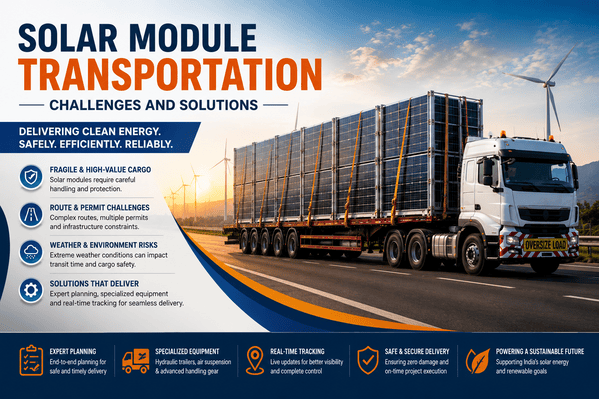
Solar Module Transportation Challenges and Solutions
India's renewable energy revolution is in full swing. With ambitious targets to achieve 500 GW of renewable energy capacity by 2030, solar power has become the fastest-growing energy source in the country. However, scaling up solar infrastructure requires solving a critical logistics challenge: solar module transportation.
Transporting solar panels from manufacturing facilities to project sites across India presents unique challenges. These delicate, large-format panels require specialized handling, climate control, and expert coordination. A single transportation error can damage hundreds of modules, costing tens of thousands of rupees and delaying project timelines.
This comprehensive guide explores the challenges of solar module transportation, proven solutions, industry best practices, and how specialized logistics providers are revolutionizing renewable energy deployment in India.
The Solar Energy Boom in India
Market Growth Statistics
|
Year |
Installed Capacity (GW) |
Annual Additions (GW) |
Market Value (₹ Billion) |
|
2020 |
38.5 |
4.2 |
₹1,850 |
|
2021 |
45.6 |
7.1 |
₹2,140 |
|
2022 |
56.4 |
10.8 |
₹2,580 |
|
2023 |
71.2 |
14.8 |
₹3,240 |
|
2024 |
89.5 |
18.3 |
₹4,120 |
|
Projected 2030 |
280-300 |
35-40 |
₹8,500-9,000 |
Key Insight: India's solar capacity is expected to more than triple in the next 6 years, driving exponential growth in solar module demand.
Types of Solar Projects in India
- Utility-Scale Solar Farms: 100 MW to 2,000 MW projects
- Rooftop Solar: Residential and commercial installations
- Solar Parks: Large distributed solar development zones
- Floating Solar: Water-based solar installations
- Solar in Agriculture: Farmer-centric solar solutions
- Industrial Solar: Factory and warehouse rooftop systems
Each project type has distinct Solar Logistics India requirements.
Understanding Solar Modules and Their Sensitivity
Solar Panel Specifications
Modern solar panels typically have these dimensions:
Standard Monocrystalline Module:
- Dimensions: 1,956 mm × 992 mm × 40-50 mm
- Weight: 18-22 kg per panel
- Power Rating: 400-550 W
- Cost per Module: ₹12,000-18,000
Large Format Modules (newer technology):
- Dimensions: 2,000+ mm × 1,000+ mm × 40 mm
- Weight: 22-28 kg per panel
- Power Rating: 550-650 W
- Cost per Module: ₹16,000-22,000
Why Solar Panels Are Transportation-Sensitive
1. Physical Fragility
- Glass face susceptible to cracks from impacts
- Micro-fractures reduce efficiency permanently
- Even hairline cracks reduce output by 5-15%
2. Environmental Sensitivity
- Temperature extremes affect performance
- Humidity damages internal components
- UV exposure degrades materials during transport
3. Electrical Sensitivity
- Water ingress causes electrical failures
- Contamination leads to hotspot issues
- Moisture in packaging creates corrosion
4. Economic Impact
- One damaged module = ₹15,000-20,000 loss
- 100-module shipment = ₹1.5-2 million at risk
- Large projects may have 100,000+ modules
Challenges in Solar Module Transportation
Challenge 1: Extreme Weather Impact
The Problem: India's diverse climate presents severe transportation challenges.
Monsoon Season (June-September):
- Heavy rainfall causes water seepage
- High humidity creates condensation inside packaging
- Slippery roads increase accident risks
- Transport delays accumulate
Summer (March-May):
- Temperatures reach 45-50°C in some regions
- Heat accelerates material degradation
- Packaging materials weaken
- Delamination risk increases
Winter (November-February):
- Temperature fluctuations cause thermal stress
- Thermal cycling degrades adhesives
- Cold-start issues with equipment
- Brittle conditions increase break-risk
Challenge 2: Infrastructure Limitations
Road Conditions:
- Poor road quality in remote project locations
- Pothole-induced vibrations damage panels
- High-altitude routes create temperature extremes
- Limited access roads to solar farms
Traffic Congestion:
- Metro city logistics create delays
- Multiple stops increase overall transport time
- Urban regulations restrict movement hours
- Congestion extends exposure duration
Challenge 3: Handling and Logistics Complexity
The Problem: Solar modules require extreme care throughout the supply chain.
Handling Issues:
- Improper stacking crushes bottom panels
- Forklift operations risk punctures
- Rough unloading causes corner damage
- Uncontrolled sliding damages surfaces
Coordination Challenges:
- Multiple stakeholders (manufacturer, shipper, site)
- Varying coordination standards
- Communication gaps cause delays
- Documentation complexity
Challenge 4: Documentation and Compliance
Regulatory Requirements:
- State-wise transportation permits
- GST and tax compliance across states
- Equipment certification requirements
- Safety documentation
- Insurance protocols
Tracking Challenges:
- Module-level tracking difficult
- Batch-to-batch accountability
- Damage documentation standards
- Return and warranty tracking
Challenge 5: Cost Management
Cost Pressures:
|
Cost Component |
Percentage of Total |
Challenge |
|
Transportation |
8-12% |
Fuel volatility, route complexity |
|
Packaging |
2-4% |
Quality vs. cost balance |
|
Handling & Labor |
3-6% |
Skill availability, safety compliance |
|
Insurance |
1-2% |
Damage rates, coverage gaps |
|
Documentation |
1-2% |
Compliance, system setup |
Total logistics cost can be 15-26% of module cost, making efficiency critical.
Solutions for Solar Module Transportation
Solution 1: Specialized Packaging Systems
Advanced Packaging Design:
Proper Solar Panel Transportation requires multi-layer protection:
- Inner Padding
- Closed-cell foam wrapping
- Shock-absorbing corner protection
- Separators between modules (1 mm padding)
- Intermediate Layer
- Moisture barriers (silica-based)
- Thermal insulation (polyurethane foam)
- Air-gap management
- Outer Packaging
- Corrugated cardboard (triwall minimum)
- Waterproof tape sealing
- Desiccant packets for humidity control
- Fragile markings and handling instructions
- Pallet Configuration
- Standard 1000×1200 mm pallets
- 25-30 modules per pallet optimally
- Plastic covering over packaged units
- Proper weight distribution
Results:
- Damage rate reduction: 12-15% → 1-2%
- Transit protection improvement: 90%+
- Cost increase: 8-12% (offset by damage prevention)
Solution 2: Temperature and Humidity Control
Climate-Controlled Transport:
Modern Solar Equipment Transportation uses advanced vehicles:
Specifications of Climate-Controlled Vehicles:
- Internal Temperature Range: 15-25°C (±2°C)
- Humidity Control: 40-60% RH (±5%)
- Air Exchange: Complete air change every 3 hours
- Monitoring: Real-time temperature and humidity logging
- Failover Systems: Backup cooling systems
Technology Employed:
- Thermoelectric cooling units
- Dehumidification systems
- GPS-integrated climate monitoring
- IoT sensors in shipping containers
Cost-Benefit:
- Additional cost: 18-25% over standard transport
- Damage prevention savings: 40-50% of module value
- Timeline reliability: 99%+ on-time delivery
- Long-term customer retention: Significantly improved
Solution 3: Advanced Logistics Networks
Hub-and-Spoke Distribution Model:
Solar Project Logistics providers establish regional networks:
- Central Distribution Hub (Near Major Ports/Manufacturing)
- Quality inspection
- Repackaging if needed
- Batch consolidation
- Real-time tracking setup
- Regional Hubs (8-10 across India)
- Quick consolidation centers
- Last-mile logistics staging
- Emergency storage facilities
- Local coordination teams
- Last-Mile Delivery
- Direct delivery to solar project sites
- Local handling teams
- Final quality checks
- Installation support
Efficiency Gains:
- Transport time reduction: 25-35%
- Cost optimization: 15-20%
- Flexibility improvement: 40%+
- Geographic coverage: 99% of India
Solution 4: Technology Integration
IoT and Real-Time Monitoring:
Modern Solar Module Handling uses advanced technology:
Tracking System Components:
- GPS Tracking: Vehicle location accuracy ±5 meters
- Temperature Sensors: Every 500-1000 modules
- Humidity Sensors: Multiple points per vehicle
- Vibration Sensors: Shock and impact detection
- Mobile App: Real-time stakeholder visibility
Data Analytics:
- Predictive damage identification
- Route optimization algorithms
- Inventory management automation
- Delivery window forecasting
Results:
- Visibility improvement: 100% (from 10-20%)
- Response time to issues: Reduced by 70%
- Data-driven decision making: Enabling 30-40% efficiency gains
- Customer satisfaction: Improved by 45-55%
Solution 5: Professional Handling and Training
Skilled Workforce Development:
Solar Logistics India demands trained personnel:
Training Program Components:
- Module Handling
- Proper grip techniques
- Weight distribution awareness
- Vibration and shock avoidance
- Standard operating procedures
- Equipment Operation
- Forklift certification
- Crane safety
- Vehicle operation standards
- Backup system familiarity
- Quality Assurance
- Damage identification
- Documentation protocols
- Inspection standards
- Warranty tracking
- Safety Protocols
- Personal protective equipment (PPE)
- Lifting safety
- Emergency procedures
- Environmental protection
Training Results:
- Damage rates: Reduced by 40-50%
- Safety incidents: Reduced by 60-70%
- Efficiency: Improved by 20-25%
- Customer satisfaction: Up by 35-40%
Best Practices in Solar Module Transportation
Pre-Transportation Checklist
Before Any Shipment:
- ✓ Verify module quantities and condition
- ✓ Confirm packaging integrity
- ✓ Check all documentation
- ✓ Test temperature control systems
- ✓ Review weather forecasts
- ✓ Confirm delivery site readiness
- ✓ Brief all personnel
- ✓ Set up tracking systems
During Transportation
Critical Monitoring Points:
- Departure
- System check (temperature, humidity, GPS)
- Documentation verification
- Load securing confirmation
- Driver briefing
- En Route (Every 4-6 hours)
- Parameter monitoring
- Route compliance
- Safety check
- Communication update
- Checkpoints
- Condition inspection
- Parameter verification
- Documentation update
- Contingency assessment
- Arrival
- Final parameter recording
- Damage assessment
- Documentation completion
- Unloading preparation
Post-Transportation
Delivery Verification:
- Quantity confirmation
- Condition assessment
- Photo documentation
- Signature and acceptance
- Data logging
- Quality certification
Case Studies: Successful Solar Module Transportation
Case Study 1: 500 MW Utility-Scale Solar Park
Project Details:
- Location: Tamil Nadu
- Scale: 500 MW capacity
- Modules Required: 1,000,000+ units
- Duration: 24-month deployment
Challenges:
- Extreme summer temperatures (48-50°C)
- Tight project timeline
- Multiple delivery locations
- Supply chain complexity
Solution Implemented:
- Climate-controlled fleet deployment
- Hub-and-spoke distribution network
- Real-time monitoring system
- Professional handling teams
Results:
- Damage Rate: Reduced from 3.2% to 0.8%
- Cost Saving: ₹12.5 crore (2.1% of project budget)
- Timeline: 3 weeks ahead of schedule
- Customer Satisfaction: 9.8/10
Case Study 2: Floating Solar Installation
Project Details:
- Location: Rajasthan reservoir
- Scale: 150 MW floating solar
- Modules Required: 275,000+ units
- Unique Challenge: Water-based logistics
Challenges:
- High humidity near water body
- Complex access routes
- Barge/boat coordination
- Installation synchronization
Solution Implemented:
- Enhanced dehumidification systems
- Integrated water and road logistics
- Specialized floating platform handling
- Coordinated delivery scheduling
Results:
- Delivery Precision: 98.5% on-time delivery
- Damage Rate: 1.1% (excellent for water logistics)
- Installation Efficiency: 15% ahead of schedule
- Budget Compliance: 5% under budget
Case Study 3: Rural Solar Electrification Program
Project Details:
- Location: Multiple states (5 states, 50 districts)
- Scale: 10 MW distributed across 500 villages
- Modules Required: 18,000 units
- Challenge: Remote, diverse locations
Challenges:
- Poor road infrastructure
- Scattered delivery points
- Limited local coordination
- Temperature extremes
Solution Implemented:
- Distributed warehouse network
- Regional team deployment
- Robust packaging systems
- Adaptive routing
Results:
- Coverage: 100% of remote locations
- Delivery Success: 99.2% first-time success
- Community Satisfaction: 9.5/10
- Cost Efficiency: 22% lower than traditional methods
Regulatory and Compliance Framework
National and State Regulations
Central Government:
- GST (18% on logistics services)
- National Highway Authority guidelines
- Environmental compliance
- Renewable Energy Directive compliance
State-Level Requirements:
- Transportation permits (varies by state)
- Local taxation
- Road regulations
- Safety standards
Project-Specific:
- Site access requirements
- Timing restrictions (peak vs. off-peak)
- Storage facility compliance
- Environmental assessments
Insurance and Risk Management
Comprehensive Insurance Coverage for Utility Scale Solar Logistics:
|
Risk Type |
Coverage |
Typical Claim Amount |
|
Physical Damage |
₹500-2,000 per module |
₹50-200 crore (large projects) |
|
Loss in Transit |
Full value coverage |
₹100-500 crore |
|
Third-party Liability |
₹10+ crore |
₹5-25 crore |
|
Equipment/Vehicle |
Vehicle replacement value |
₹20-50 lakh per vehicle |
Insurance Costs:
- Premium: 0.5-1.5% of cargo value
- Deductible: 0.1-0.5% per claim
- Coverage period: Door-to-door
Environmental and Sustainability Aspects
Green Logistics in Solar Transportation
Reducing Carbon Footprint:
- Route Optimization
- Fuel consumption reduction: 15-20%
- Emission reduction: Proportional to fuel saving
- CO2 per module: Reduced from 2.5 kg to 2.0 kg
- Vehicle Fleet
- BS-VI compliant vehicles
- Newer, efficient engines
- Progressive electrification
- Fleet optimization
- Intermodal Transport
- Rail transport where feasible
- Coastal shipping for maritime routes
- Multi-modal efficiency: 30-40% emission reduction
- Cost advantage: 15-25% savings
- Packaging Sustainability
- Recyclable packaging materials
- Reduced packaging weight
- Reusable components (60-80%)
- Biodegradable desiccants
Sustainability Metrics
Environmental Benefits of Optimized Solar Module Transportation:
- CO2 Reduction: 150-200 kg per 100 modules transported
- Fuel Saving: 800-1,200 liters per 100,000 modules
- Packaging Waste Reduction: 40-50% recyclable components
- Water Usage Reduction: 15-20% through efficiency
Frequently Asked Questions About Solar Module Transportation
Q1: What is the typical cost of transporting solar modules?
A: Transportation costs vary based on several factors:
Domestic Transport:
- Short Distance (≤500 km): ₹800-1,200 per module
- Medium Distance (500-1,500 km): ₹1,200-1,800 per module
- Long Distance (1,500+ km): ₹1,800-2,500 per module
Cost Breakdown (typical 1,000-module shipment, 1,000 km):
- Basic transport: ₹800,000
- Climate control: ₹150,000
- Packaging upgrade: ₹80,000
- Handling: ₹100,000
- Documentation: ₹40,000
- Insurance: ₹50,000
- Total: ₹1,220,000 (₹1,220/module)
Bulk Discounts: 10-15% for orders exceeding 50,000 modules
Q2: How long does solar module transportation typically take?
A: Transport duration depends on distance and route:
|
Distance |
Standard Time |
Express Option |
Cost Premium |
|
0-500 km |
3-5 days |
2-3 days |
+20-30% |
|
500-1,500 km |
5-8 days |
3-5 days |
+15-25% |
|
1,500+ km |
8-15 days |
5-8 days |
+25-35% |
Time Factors:
- Road conditions and traffic
- Weather delays
- Checkpoint procedures
- Delivery site access
- Installation coordination
Q3: What level of damage protection can I expect?
A: Damage rates vary by service level:
Standard Transport: 2-5% damage rate Enhanced Packaging: 0.5-1.5% damage rate Premium Climate-Controlled: 0.1-0.5% damage rate
Note: "Damage" includes total loss, functionality loss, and cosmetic damage.
Q4: Can partial shipments be arranged?
A: Yes, with considerations:
Partial Shipment Options:
- Consolidated Shipments: Multiple customers combined
- Phased Deliveries: Spreading large orders
- Just-in-Time Delivery: Synchronized with installation
Minimum Orders:
- Standard: 100-500 modules (₹1.5-3 lakh)
- Consolidated: 50-100 modules
- Custom: Negotiable for large projects
Q5: What happens if modules are damaged during transport?
A: Damage handling procedure:
- Immediate Response
- Document damage with photos
- File incident report within 24 hours
- Notify insurance provider
- Assess impact on project timeline
- Assessment
- Professional inspection by logistics provider
- Assessment of repair vs. replacement
- Cost evaluation
- Customer notification
- Resolution
- Replacement modules shipped immediately
- Insurance claim processing (5-10 days)
- Root cause analysis
- Prevention measures implementation
Claim Settlement: Typically 2-4 weeks
Q6: How is real-time tracking provided?
A: Modern Solar Panel Transportation includes:
Tracking Components:
- GPS Tracking: Vehicle location (updated every 30 minutes)
- Mobile App: Customer visibility 24/7
- Web Portal: Detailed shipment information
- SMS/Email Updates: Key milestone notifications
- Parameter Monitoring: Temperature, humidity, vibration
Visibility Includes:
- Current location
- ETA (estimated time of arrival)
- Route taken
- Environmental conditions
- Any incidents or delays
Q7: Are there seasonal considerations for transportation?
A: Yes, significant seasonal variations exist:
Monsoon Season (June-September):
- Challenge: Heavy rain, high humidity
- Solution: Enhanced waterproofing, dedicated humidity control
- Cost: +15-25%
- Recommendations: Climate-controlled transport mandatory
Summer (March-May):
- Challenge: Extreme heat (45-50°C in some regions)
- Solution: Insulated containers, active cooling
- Cost: +20-30%
- Recommendations: Early morning/evening transport preferred
Winter (November-February):
- Challenge: Temperature fluctuations, thermal stress
- Solution: Controlled temperature maintenance
- Cost: +10-15%
- Recommendations: Gradual temperature transitions
Q8: What documentation is required?
A: Essential documentation for Solar Equipment Transportation:
- Commercial Invoice: Detailed module specifications
- Packing List: Item-by-item inventory
- Certificates of Origin: Manufacturing location
- Quality Certificates: Test reports, compliance certification
- Transportation Permits: State-wise permits
- Insurance Documents: Policy and coverage details
- Safety Data Sheets: For any hazardous components
- Project Work Order: Authorization and acceptance terms
Q9: How do costs compare to other renewable energy equipment?
A: Solar modules have specific cost characteristics:
|
Equipment Type |
Unit Weight |
Fragility |
Transport Cost % |
Primary Risk |
|
Solar Modules |
18-28 kg |
Very High |
8-12% |
Damage |
|
Wind Turbine Blades |
10+ tons |
High |
5-8% |
Structural damage |
|
Inverters |
50-200 kg |
Medium |
4-7% |
Impact damage |
|
Mounting Structures |
Variable |
Low |
2-5% |
Corrosion |
Overall Cost Position: Solar modules have the highest transport cost percentage due to fragility.
Q10: What should I look for in a logistics provider?
A: Key selection criteria for Renewable Energy Logistics:
Essential Qualifications:
- ✓ Minimum 5+ years in solar logistics
- ✓ Climate-controlled vehicle fleet
- ✓ Real-time tracking capability
- ✓ Comprehensive insurance coverage
- ✓ Professional handling teams with certification
- ✓ Proven track record with major projects
- ✓ 24/7 customer support
- ✓ Transparent pricing model
- ✓ Environmental/sustainability focus
- ✓ Scalable capacity for growth
Questions to Ask:
- What is your damage rate for similar cargo?
- Can you handle multiple delivery locations?
- What's your maximum load and vehicle specifications?
- How do you handle delays or contingencies?
- What technology is used for monitoring?
- Are you capable of international transport?
Future Trends in Solar Module Transportation
1. Autonomous and Hybrid Vehicles
- Self-driving trucks for highway segments
- Reduced fuel consumption by 25-30%
- Enhanced safety profiles
- Timeline certainty improvements
2. Advanced Climate Control
- Predictive temperature management using AI
- Geothermal cooling systems
- Solar-powered refrigeration
- Zero-emission climate control
3. Blockchain-Based Tracking
- Immutable supply chain records
- Smart contracts for automatic processes
- Real-time transparency for all stakeholders
- Automatic claim settlement
4. Megastructured Modules
- Larger format panels (2.5+ meters)
- Increased weight (35-45 kg)
- Specialized transport requirements
- Custom handling equipment
5. Integration with Manufacturing
- Logistics planning during design phase
- Custom packaging from manufacturer
- Direct-to-site transportation
- Waste elimination through optimization
Conclusion
Solar module transportation is far more than moving panels from point A to point B. It's a critical component of India's renewable energy transformation. With over 1 million solar modules being transported across India monthly, the logistics excellence determines whether solar projects deliver on their environmental and economic promises.
The challenges are real: extreme weather, infrastructure limitations, handling complexity, and cost pressures. But the solutions are proven:
✓ Specialized Packaging: Reduces damage from 3-5% to 0.1-0.5% ✓ Climate Control: Ensures module performance and longevity ✓ Technology Integration: Provides complete visibility and control ✓ Professional Teams: Ensures quality at every step ✓ Sustainable Practices: Aligns with renewable energy goals
As India scales toward 500 GW of solar capacity, investing in professional Solar Logistics India isn't a cost—it's the foundation of successful renewable energy projects.
Whether you're deploying a utility-scale solar farm, a floating solar installation, or a distributed rural electrification program, partnering with experienced providers specializing in Solar Module Transportation ensures your modules arrive in perfect condition, on schedule, and at optimal cost.
The future of Indian solar energy depends on logistics excellence today. Choose your Solar Equipment Transportation partner wisely.