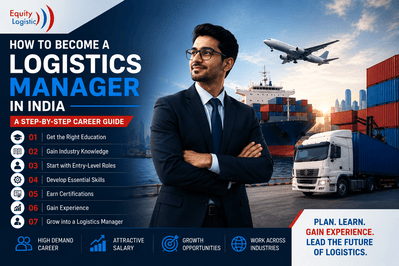
How to Become a Logistics Manager in India
India's supply chain industry is booming. With e-commerce giants, manufacturing hubs, and global trade expanding rapidly, the demand for skilled Logistics Managers has never been higher. If you are planning a career in this field, you are looking at one of the most stable, high-growth professions in the country.
In this complete guide, we will walk you through everything you need to know — from educational qualifications and essential skills to salary expectations and career growth — all from the perspective of a leading logistics service India company, Equity Logistics.
What Does a Logistics Manager Do in India?
Before jumping into the "how," it is important to understand the "what." A Logistics Manager is responsible for planning, coordinating, and overseeing the movement of goods — from the point of origin to the final destination.
In the Indian context, this means managing:
- Warehousing and inventory across multiple cities
- Transportation networks — road, rail, air, and sea
- Vendor and supplier relationships
- Import and export documentation and compliance
- Last-mile delivery operations
- Cost control and budget management
- Technology platforms like TMS (Transport Management System) and WMS (Warehouse Management System)
A Logistics Manager is essentially the backbone of any supply chain. Without efficient logistics management, businesses cannot deliver products on time, control costs, or satisfy customers.
At Equity Logistics, our managers oversee end-to-end logistics solutions India — from freight forwarding and warehousing to customs clearance and last-mile delivery across the country.
Why Choose a Career in Logistics Management in India?
India's logistics sector is one of the fastest-growing industries in Asia. Here is why it is a smart career choice:
Massive Industry Growth- The Indian logistics industry was valued at over $250 billion in 2024 and is projected to reach $380 billion by 2030. Government initiatives like PM Gati Shakti, the National Logistics Policy, and the Dedicated Freight Corridor are pumping billions into infrastructure — creating thousands of new job opportunities every year.
High Demand for Skilled Professionals- India currently faces a significant shortage of trained logistics professionals. Companies across sectors — retail, pharma, automotive, FMCG, e-commerce — are actively hiring Logistics Managers who can handle the complexity of modern supply chains.
Competitive Salary Packages- Logistics Managers in India earn between ₹5 LPA and ₹25 LPA depending on experience, company size, and specialisation. Senior roles at large logistics firms can go even higher.
Career Diversity- A career in logistics opens doors across multiple industries. Whether you want to work in e-commerce, manufacturing, pharmaceuticals, retail, or freight forwarding — your logistics skills are transferable and always in demand.
Entrepreneurship Opportunities- Many experienced logistics professionals go on to start their own logistics businesses — transportation companies, warehousing firms, freight brokers, or last-mile delivery startups. The skills you gain as a Logistics Manager give you a solid foundation for entrepreneurship.
Educational Qualifications to Become a Logistics Manager in India
There is no single fixed path to becoming a Logistics Manager in India. However, certain educational qualifications significantly improve your chances:
Bachelor's Degree (Minimum Requirement)
Most entry-level logistics roles require at least a bachelor's degree. Relevant undergraduate courses include:
- B.Com (Bachelor of Commerce)
- BBA (Bachelor of Business Administration)
- B.Sc in Supply Chain Management
- B.Tech in Industrial Engineering or Operations Management
- B.Sc in Logistics and Supply Chain Management
Several universities in India now offer specialised undergraduate programs in logistics and supply chain management, including NMIMS Mumbai, Symbiosis International University, and Amity University.
MBA or Postgraduate Degree (Preferred for Management Roles)
For management-level positions, an MBA with a specialisation in Supply Chain Management, Operations Management, or Logistics is strongly preferred. Top institutes offering relevant programs include:
- IIMs (Indian Institutes of Management) — Ahmedabad, Bangalore, Calcutta
- NITIE Mumbai (National Institute of Industrial Engineering)
- SP Jain School of Global Management
- XLRI Jamshedpur
- ISB Hyderabad
- Symbiosis Centre for Management and Human Resource Development
An MBA not only deepens your domain knowledge but also develops the leadership and analytical skills critical for senior logistics roles.
Diploma and Certificate Courses
If you want to enter the logistics field without a specialised degree, diploma and certificate programs are an excellent option:
- PG Diploma in Supply Chain Management — XLRI, NMIMS
- Certificate in Logistics and Supply Chain — Indian Institute of Materials Management (IIMM)
- Certificate in Freight Forwarding — Federation of Freight Forwarders Associations in India (FFFAI)
- Certificate in Customs and Export Management — various institutes
- Online courses on Coursera, edX, and LinkedIn Learning from MIT, Rutgers, and Rutgers University
Professional Certifications (Highly Recommended)
Global professional certifications add significant weight to your resume and are increasingly expected by top employers:
- APICS CSCP (Certified Supply Chain Professional) — globally recognised
- APICS CPIM (Certified in Planning and Inventory Management)
- CILT (Chartered Institute of Logistics and Transport) Membership
- Six Sigma Green Belt or Black Belt — for process improvement roles
- PMP (Project Management Professional) — for senior project-heavy roles
- SAP SCM Certification — for technology-focused logistics professionals
Key Skills Required to Become a Logistics Manager in India
Education alone is not enough. Employers at companies like Equity Logistics look for a combination of technical knowledge, analytical ability, and leadership skills.
Technical and Domain Skills
Supply Chain Knowledge A deep understanding of end-to-end supply chain operations — procurement, warehousing, transportation, distribution, and returns — is non-negotiable.
Transportation Management Knowledge of road, rail, air, and sea freight operations. Understanding freight rates, carrier selection, route optimisation, and load planning is essential for any logistics service India professional.
Warehouse Management Familiarity with warehouse operations — inbound, outbound, storage, picking and packing, inventory control, and WMS platforms.
Import and Export Compliance Understanding of customs procedures, EXIM policies, GST implications on logistics, and international trade documentation like Bill of Lading, Airway Bill, and Letter of Credit.
Technology Proficiency Modern logistics is heavily technology-driven. Proficiency in:
- TMS (Transport Management Systems) — like SAP TM, Oracle OTM
- WMS (Warehouse Management Systems) — like Manhattan, Blue Yonder
- ERP Systems — SAP, Oracle, Microsoft Dynamics
- Advanced Excel and data analytics tools
- GPS and real-time tracking platforms
Analytical and Problem-Solving Skills
Logistics operations generate enormous amounts of data — shipment volumes, delivery times, carrier performance, inventory turnover, and cost per shipment. A good Logistics Manager must be able to:
- Analyse key performance indicators (KPIs) like on-time delivery, order accuracy, and cost per unit
- Identify bottlenecks in the supply chain
- Make data-driven decisions to improve operational efficiency
- Forecast demand and plan inventory levels accordingly
Leadership and Communication Skills
As a manager, you will lead teams of warehouse staff, transport coordinators, customs agents, and vendor representatives. Strong leadership includes:
- Clear and effective communication — both written and verbal
- Conflict resolution and negotiation — especially with vendors and carriers
- Team motivation and performance management
- Stakeholder management — communicating with senior leadership, clients, and government authorities
Financial Acumen
Logistics is a cost-intensive function. Managers must understand:
- Budget planning and cost control
- Freight cost optimisation
- ROI analysis for logistics technology investments
- Understanding of P&L as it relates to logistics operations
Step-by-Step Roadmap to Become a Logistics Manager in India
Here is a practical step-by-step roadmap you can follow:
Step 1 — Complete Your Education
Start with a relevant bachelor's degree in commerce, business administration, or engineering. If you are serious about a management career, plan for an MBA in Supply Chain or Operations Management from a reputed institute.
Step 2 — Gain Entry-Level Experience
Fresh graduates typically start in roles like:
- Logistics Coordinator
- Warehouse Executive
- Transportation Executive
- Supply Chain Analyst
- Freight Operations Assistant
These roles give you hands-on exposure to real logistics operations — the kind of experience you cannot get from textbooks alone. Companies like Equity Logistics regularly hire entry-level candidates eager to learn and grow.
Step 3 — Earn Relevant Certifications
While working in your entry-level role, pursue professional certifications like APICS CSCP, CILT membership, or SAP SCM. These credentials signal to employers that you are serious about your career and have advanced domain knowledge.
Step 4 — Develop Technology Skills
In 2026 and beyond, logistics professionals who understand technology have a massive competitive advantage. Learn TMS and WMS platforms, get comfortable with data analytics, and understand how AI and automation are transforming supply chain operations in India.
Step 5 — Build Your Network
The logistics industry in India is relationship-driven. Join professional associations like:
- CILT India (Chartered Institute of Logistics and Transport)
- IIMM (Indian Institute of Materials Management)
- CII (Confederation of Indian Industry) — Supply Chain Council
- Logistics sector groups on LinkedIn
Attend industry events, conferences, and webinars. Networking often leads to better job opportunities than online job portals.
Step 6 — Move into a Management Role
After 3 to 5 years of experience, you will be ready to transition into an Assistant Manager or Deputy Manager role. At this stage, focus on:
- Taking ownership of a specific function — transportation, warehousing, or procurement
- Leading a small team
- Driving measurable improvements in cost, efficiency, or service quality
- Building relationships with senior stakeholders and clients
Step 7 — Advance to Senior Logistics Manager
With 7 to 10 years of experience, you can progress to Senior Logistics Manager or Head of Supply Chain roles. At this level, you are responsible for:
- Strategic supply chain planning
- Multi-location or national-level logistics operations
- Large budgets and P&L ownership
- Driving digital transformation and automation projects
Career Paths and Specialisations in Logistics Management
Logistics management is not a single career path. There are several exciting specialisations you can pursue:
Freight and Transportation Management- Specialise in managing domestic and international freight — road, rail, air, and ocean. This path is ideal for those interested in the movement side of logistics.
Warehouse and Distribution Management- Focus on warehousing operations, inventory management, fulfilment centres, and distribution network design. With e-commerce booming in India, this is one of the highest-demand specialisations.
Supply Chain Consulting- Experienced logistics professionals can transition into consulting roles — helping businesses design, optimise, and transform their supply chains. This path typically requires strong analytical skills and a strong professional reputation.
Customs and Trade Compliance- Specialise in import-export compliance, customs clearance, and international trade regulations. This is a highly specialised and well-paying niche within the logistics industry.
Logistics Technology and Digital Transformation- As AI, IoT, blockchain, and automation reshape logistics, there is huge demand for professionals who understand both logistics operations and technology. This specialisation is particularly future-proof.
Salary of a Logistics Manager in India
Salary varies significantly based on experience, location, industry, and company size:
Entry Level (0–3 years): ₹3.5 LPA to ₹6 LPA Roles: Logistics Coordinator, Supply Chain Analyst, Warehouse Executive
Mid Level (3–7 years): ₹6 LPA to ₹14 LPA Roles: Logistics Manager, Supply Chain Manager, Operations Manager
Senior Level (7–15 years): ₹14 LPA to ₹28 LPA Roles: Senior Logistics Manager, Head of Supply Chain, VP Logistics
Leadership Level (15+ years): ₹28 LPA to ₹50 LPA+ Roles: Director of Logistics, Chief Supply Chain Officer (CSCO)
Top Paying Industries for Logistics Managers in India:
- E-commerce (Amazon, Flipkart, Meesho)
- Pharmaceuticals (Sun Pharma, Cipla, Dr. Reddy's)
- Automotive (Maruti, Tata Motors, Mahindra)
- FMCG (HUL, ITC, Nestle)
- Third-Party Logistics (3PL) companies like Equity Logistics
Top Companies Hiring Logistics Managers in India
Some of the top employers of logistics professionals in India include:
- Equity Logistics — offering comprehensive logistics solutions India across freight, warehousing, and supply chain management
- Amazon India — e-commerce and fulfilment
- Flipkart — supply chain and last-mile delivery
- DHL Supply Chain India
- Blue Dart — air express and logistics
- Mahindra Logistics
- TVS Supply Chain Solutions
- Delhivery
- Ecom Express
- TCI (Transport Corporation of India)
- Allcargo Logistics
- GATI-KWE
Why Equity Logistics is the Right Partner for Your Logistics Career
Equity Logistics is one of India's most trusted logistics service India providers — delivering end-to-end supply chain solutions to clients across industries and geographies.
For professionals aspiring to build a career in logistics, joining a company like Equity Logistics provides:
Real-World Exposure- Work on live logistics operations — freight forwarding, customs clearance, warehouse management, and last-mile delivery. Every day brings new challenges and learning opportunities.
Cross-Industry Experience- Equity Logistics serves clients across multiple industries — giving you exposure to diverse supply chain environments and best practices. This cross-industry experience makes you a more versatile and valuable logistics professional.
Technology-Driven Environment- Equity Logistics invests in modern logistics technology — from real-time tracking systems to advanced warehouse management platforms. Working here gives you hands-on experience with the tools that define modern logistics.
Growth Opportunities-Equity Logistics believes in promoting from within. High performers are given increasing responsibility, leadership opportunities, and the chance to drive meaningful projects that impact the business.
Whether you are just starting out or looking to advance your logistics career, Equity Logistics offers the environment, mentorship, and logistics solutions India scale that accelerates professional growth.
Future of Logistics Management in India
The Indian logistics sector is undergoing a massive transformation. Here is what the future holds for Logistics Managers:
Technology Will Be Central- AI-powered demand forecasting, autonomous vehicles, drone delivery, IoT-enabled warehouses, and blockchain-based supply chain visibility are no longer futuristic concepts — they are being piloted and deployed right now. Future Logistics Managers must be comfortable with technology.
Green Logistics Will Gain Importance- Sustainability is becoming a key priority. Companies are under pressure to reduce their carbon footprint — electric vehicle fleets, green warehousing, optimised routing, and sustainable packaging are all creating new roles within logistics.
Government Investment Will Create Opportunities- India's PM Gati Shakti initiative, the National Logistics Policy, and the Dedicated Freight Corridor project are set to dramatically improve logistics infrastructure — reducing logistics costs from around 13–14% of GDP to the global benchmark of 8%. This will drive massive expansion in the logistics sector and create thousands of new jobs.
Skill Upgradation Will Be Continuous- The pace of change in logistics means that continuous learning is not optional — it is essential. The most successful Logistics Managers of the future will be those who commit to lifelong learning, staying ahead of technological and market changes.
Conclusion — Your Logistics Career Starts Here
Becoming a Logistics Manager in India is an achievable and rewarding career goal. The industry is growing, salaries are competitive, and the demand for skilled professionals far outstrips supply.
The roadmap is clear:
- Get the right education
- Gain hands-on experience
- Earn relevant certifications
- Build technology skills
- Grow your professional network
- Take on leadership responsibilities
And when it comes to building your career with a company that genuinely invests in its people and operates at the forefront of India's logistics transformation — Equity Logistics is the partner you need.
Explore career opportunities and learn more about how Equity Logistics delivers world-class logistics solutions India — and how you can be part of that journey.
Ready to start your logistics career? Visit Equity Logistics today.