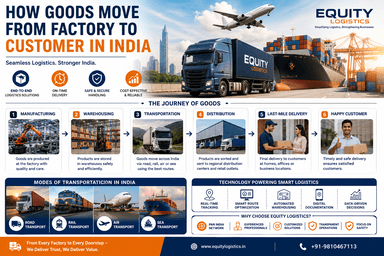
How Goods Move from Factory to Customer in India
Have you ever ordered a product online and wondered how it travelled from a factory floor in Pune or Surat all the way to your doorstep in Delhi or Chennai? The journey of goods across India is one of the most complex, fascinating, and critically important processes in the entire economy — and most people never give it a second thought.
India is a vast country. With over 1.4 billion people spread across 28 states, hundreds of cities, and thousands of towns and villages, moving goods efficiently from manufacturer to end customer is no small task. It involves warehouses, trucks, trains, ships, aeroplanes, last-mile delivery agents, and an enormous network of logistics service providers working in coordination every single day.
At Equity Logistics, we work at the heart of this system. In this guide, we are going to walk you through exactly how goods move from factory to customer in India — step by step, in plain language — so you understand the full picture of transportation in India and why every link in the supply chain matters.
Why Understanding the Supply Chain Matters
Before we trace the journey of a product, it helps to understand why this process is so important.
India's logistics sector contributes approximately 14% of GDP and employs millions of people across trucking, warehousing, rail freight, port operations, and last-mile delivery. The efficiency of logistics service in India directly affects the price of everything you buy — from medicines and electronics to groceries and clothing.
When logistics works well, goods arrive on time, prices stay competitive, businesses grow, and customers stay satisfied. When it breaks down — a delayed shipment, a missed customs clearance, an overloaded warehouse — the impact ripples across businesses and consumers alike.
Understanding how goods move through India also helps businesses make smarter decisions about their supply chain, choose better logistics partners, and build more resilient operations. Whether you are a manufacturer, an e-commerce seller, or simply a curious consumer, this guide is for you.
Step 1: Production at the Factory
Every product's journey begins at the point of manufacture. India's industrial landscape is spread across several key manufacturing hubs — Pune and Chennai for automobiles, Surat and Tiruppur for textiles, Ludhiana for machine parts, Bengaluru for electronics and technology hardware, Ahmedabad for pharmaceuticals, and dozens more.
Once a product is manufactured, it does not immediately begin moving toward the customer. The first step is quality control — inspection to ensure products meet the required standards. After that, goods are packaged for transport. How something is packaged depends heavily on what it is, how fragile it is, how far it needs to travel, and how it will be transported.
A batch of automotive components heading to a nearby assembly plant will be packaged very differently from a shipment of garments going to an overseas buyer in the United States. Packaging decisions at the factory level directly affect how safely and efficiently goods move through the rest of the supply chain.
Once packaged, goods are typically labelled with barcodes or RFID tags, which allow them to be tracked throughout their journey. Modern logistics service providers in India increasingly rely on this tracking data to manage inventory and monitor shipments in real time.
Step 2: First-Mile Logistics — Moving Goods Out of the Factory
The first leg of the journey — getting goods from the factory to the first storage or transit point — is known as first-mile logistics.
In most cases, this involves loading goods onto trucks or commercial vehicles at the factory gate. India has an enormous road network, making road transport the dominant mode of first-mile logistics across the country. The goods are loaded, the paperwork is completed — including the e-way bill, which is mandatory under India's GST framework for the movement of goods above a certain value — and the vehicle sets off.
For large manufacturers with high-volume output, this first leg might involve a fleet of dedicated trucks moving continuously between the factory and a nearby distribution centre. For smaller manufacturers, it might be a single shared truck load arranged through a third-party logistics service provider.
This is the stage where a good logistics partner makes an immediate difference. A well-organised first-mile operation ensures goods leave the factory on time, are properly documented, and arrive at the next stage in the supply chain without delay.
Step 3: Primary Warehousing — The First Resting Point
After leaving the factory, goods typically move to a primary warehouse or a mother warehouse. This is a large storage facility, usually located close to the manufacturing hub, where goods from one or more factories are consolidated before being distributed further.
Warehousing is one of the most underappreciated elements of logistics service in India. A well-run warehouse is not just a storage shed — it is a precision operation. Goods arrive, are counted and inspected against purchase orders, stored in organised locations, and tracked in a Warehouse Management System (WMS) so that their exact location and quantity is always known.
In India, major warehousing hubs have developed around cities like Mumbai, Delhi-NCR, Chennai, Hyderabad, Pune, and Bengaluru — each serving as a nodal point for goods moving across different regions of the country.
Modern warehouses in India are increasingly sophisticated. Temperature-controlled cold storage facilities serve the food and pharmaceutical sectors. Multi-level automated warehouses serve large e-commerce players. Bonded warehouses near ports serve international trade by holding imported goods before customs clearance is completed.
The rise of formalised warehousing in India has been significantly accelerated by the introduction of GST in 2017, which removed the need to maintain separate state warehouses purely for tax purposes and allowed companies to rationalise their logistics networks around efficiency rather than compliance.
Step 4: Long-Haul Transportation Across India
Once goods are consolidated at the primary warehouse, the next challenge is moving them across India's vast geography to reach the regions where they are needed. This is long-haul transportation — the backbone of transportation in India.
Road Transport
Road transport is the most widely used mode of transportation in India, accounting for roughly 65% of all freight movement by volume. India has one of the largest road networks in the world, including the National Highways, State Highways, and the rapidly expanding expressway network.
Long-haul trucks — typically 20-tonne to 40-tonne heavy commercial vehicles — carry goods between cities and states. The major freight corridors in India include Delhi to Mumbai, Delhi to Chennai, Mumbai to Kolkata, and the Golden Quadrilateral connecting the four major metros. Dedicated Freight Corridors, currently being developed and commissioned in phases by the Indian government, are set to further transform transportation in India over the coming years.
Road transport in India offers unmatched flexibility — goods can be picked up from and delivered to virtually any location. However, it also faces real challenges: congestion on major highways, variable quality of road infrastructure at the last-mile level, driver shortages, and the sheer size of the country.
Rail Freight
Indian Railways is one of the largest railway networks in the world, and rail freight plays a vital role in transportation in India — particularly for heavy, bulk commodities like coal, steel, cement, fertilisers, and grain. However, rail is increasingly being used for containerised cargo as well.
The Dedicated Freight Corridors being developed between the Western and Eastern corridors are expected to significantly increase the role of rail in India's logistics ecosystem. By separating freight traffic from passenger traffic, these corridors allow freight trains to run faster, more predictably, and at higher volumes — making rail a genuinely competitive option for long-haul transportation in India.
For large shippers moving goods regularly between fixed origin-destination pairs, rail freight offers significant cost advantages over road, particularly for distances above 500 kilometres.
Air Freight
For high-value, time-sensitive goods — electronics, pharmaceuticals, perishable food items, urgent spare parts — air freight is an important mode of transportation in India. Major cargo airports include Delhi's Indira Gandhi International Airport, Mumbai's Chhatrapati Shivaji International Airport, Chennai, Bengaluru, and Hyderabad.
India's air cargo capacity has grown substantially in recent years, driven by the expansion of e-commerce, pharmaceutical exports, and the broader growth of international trade. However, air freight comes at a significant cost premium over road and rail, making it suitable only for shipments where speed or product value justifies the expense.
Coastal Shipping and Inland Waterways
India has an extensive coastline of over 7,500 kilometres and a growing network of inland waterways. Coastal shipping moves large volumes of goods — particularly bulk commodities, petroleum products, and containers — between major Indian ports. The Sagarmala Programme, a flagship government initiative, is investing heavily in port development and coastal shipping infrastructure to increase the share of water transport in India's logistics mix.
Inland waterways are at an earlier stage of development, but hold significant potential — particularly for freight movement in states like Assam, West Bengal, and along the Ganga-Bhagirathi-Hooghly river system.
Step 5: Regional Distribution Centres
Once goods complete their long-haul journey, they arrive at a regional distribution centre — a warehouse strategically located to serve a specific geographic region, state, or cluster of cities.
Regional distribution is where the supply chain starts to narrow its focus. Goods that arrived in bulk are now broken down into smaller consignments destined for specific cities, towns, or retail locations within the region. A regional distribution centre serving South India might receive a full truckload of 10,000 units of a product, then split it into dozens of smaller deliveries heading to Chennai, Coimbatore, Madurai, Kochi, Bengaluru, and Hyderabad.
Efficient regional distribution is one of the most critical factors in the quality of logistics service in India. A well-managed regional hub allows goods to reach their next destination quickly, with minimal dwell time. A poorly run one creates backlogs, delays, and the dreaded scenario of goods sitting in a warehouse for days waiting to move.
Step 6: Last-Mile Delivery — The Final and Hardest Leg
If long-haul transportation is the backbone of logistics in India, last-mile delivery is the most complex and often most expensive part of the entire process. Last-mile refers to the final leg of a product's journey — from a local delivery hub or fulfilment centre to the end customer's door.
India's last-mile logistics challenge is unlike almost any other country in the world. The sheer diversity of the geography makes this uniquely difficult — goods may need to be delivered to a high-rise apartment in Mumbai, a narrow lane in Old Delhi, a village in rural Bihar, a tea estate in Assam, or a fishing community on the Kerala coast. Each of these environments demands a different approach.
In urban India, last-mile delivery is typically handled by two-wheelers, three-wheelers, and small delivery vans. The explosion of e-commerce over the past decade has driven massive investment in urban last-mile infrastructure — fulfilment centres located close to high-density residential areas, sophisticated route optimisation software, and large networks of delivery agents.
In rural and semi-urban India, last-mile logistics is more challenging. Road quality can be unpredictable, addresses are often non-standardised, and delivery density is lower — meaning each delivery agent covers greater distances between stops. Innovative solutions are emerging to address this, including micro-fulfilment centres in small towns, pickup-point networks, and partnerships with local kirana stores that act as collection hubs.
India Post, with its extraordinary reach into every corner of the country, plays a uniquely important role in rural last-mile delivery and is increasingly being integrated into the logistics networks of commercial players.
Step 7: The Role of Technology in Modern Logistics Service India
No discussion of how goods move through India in 2026 would be complete without acknowledging the transformative role of technology in modernising logistics service in India.
GPS Tracking and Fleet Management — Real-time GPS tracking is now standard across modern logistics fleets in India. Shippers can monitor the live location of their consignments, receive alerts on delays, and manage exceptions proactively rather than reactively. Equity Logistics provides end-to-end shipment visibility as a core component of its logistics service.
E-Way Bill System — Introduced under GST, the e-way bill is a digital document required for the movement of goods above ₹50,000 in value. The system has dramatically reduced check-post delays at state borders and brought greater transparency and accountability to transportation in India.
Warehouse Management Systems — Modern WMS software manages the complex operations of large warehouses — from inbound receiving and storage location assignment to pick-pack-ship operations and inventory reconciliation. These systems significantly reduce errors and improve throughput.
Transport Management Systems — TMS platforms help logistics service providers in India plan routes, optimize vehicle loads, manage driver assignments, automate documentation, and track performance metrics. They are increasingly cloud-based and accessible to mid-sized and small logistics players, not just large enterprises.
Artificial Intelligence and Route Optimisation — AI-powered route optimisation is reducing delivery costs and improving on-time performance for last-mile logistics across India's complex urban and rural geographies. Machine learning models predict traffic patterns, weather disruptions, and demand surges to help logistics planners make better decisions in real time.
ONDC and Open Networks — India's Open Network for Digital Commerce is reshaping how small sellers and logistics providers connect, potentially democratising access to logistics service in India for millions of small and medium businesses that previously lacked access to efficient, affordable supply chain infrastructure.
Step 8: Customs and International Trade Logistics
For goods that cross India's international borders — whether exports leaving India or imports arriving — an additional layer of logistics comes into play: customs clearance.
India's major gateway ports — Jawaharlal Nehru Port (JNPT) in Mumbai, Chennai Port, Mundra Port in Gujarat, and Krishnapatnam in Andhra Pradesh — handle enormous volumes of containerised international trade. Customs clearance involves the submission of documentation, payment of applicable duties, and inspection by customs authorities before goods are permitted to enter or exit the country.
Export logistics in India follows a typical sequence: goods are packed and consolidated at an inland container depot (ICD) or container freight station (CFS), customs export documentation is filed, goods are stuffed into shipping containers, and containers are transported to the port for loading onto a vessel.
Import logistics reverses this process: containers arrive at port, are off-loaded and held in a container yard, customs import documentation is filed and duties paid, the container is released and transported to the importer's warehouse, and goods are de-stuffed and distributed.
Customs clearance timelines in India have improved significantly in recent years, driven by government reforms including the introduction of the ICEGATE portal, pre-arrival processing, and risk-based examination systems. However, documentation accuracy remains critical — a single error on a Bill of Lading or a Packing List can trigger delays that ripple through the entire supply chain.
The Key Challenges in India's Logistics Ecosystem
India's logistics sector has made remarkable progress over the past decade, but real challenges remain.
Infrastructure gaps persist, particularly in the last-mile tier. While National Highways and major expressways have improved significantly, connectivity to smaller towns, industrial estates, and rural areas remains uneven. The speed and predictability of transportation in India at the local level is still heavily dependent on road quality.
Fragmentation is a structural challenge. India's trucking industry, in particular, is highly fragmented — dominated by small operators with one to five vehicles. This fragmentation makes it difficult to implement consistent standards, technology, and service quality at scale. Aggregator platforms and organised logistics service providers are gradually addressing this, but it remains a work in progress.
Cold chain logistics is significantly underdeveloped relative to India's size and its agricultural output. The lack of adequate cold storage and temperature-controlled transportation in India results in substantial post-harvest losses in food — a challenge that both the government and the private sector are working to address.
Skill development is needed across the logistics workforce — from truck drivers and warehouse operators to supply chain analysts and logistics technology specialists. As the sector modernises, the demand for skilled logistics professionals is growing faster than the supply.
What Makes a Good Logistics Partner in India
With so many players in the market, choosing the right logistics service provider in India can make or break your supply chain. Here is what to look for.
Network reach is fundamental. A good logistics service provider should be able to move goods to wherever your customers are — metros, tier-2 cities, and rural areas alike. Ask specifically about their last-mile capabilities in the geographies that matter to your business.
Technology is non-negotiable in 2026. Real-time tracking, digital documentation, automated alerts, and data analytics are the baseline expectations from any serious logistics service provider in India. A partner who cannot give you visibility into your shipments in real time is a partner who will cost you customers.
Reliability and on-time performance should be measured, not promised. Ask for data. A good logistics partner tracks and publishes its on-time delivery rates and is transparent about performance.
Flexibility and scalability matter because businesses grow and demand fluctuates. Your logistics partner needs to be able to scale capacity during peak seasons, accommodate new geographies as you expand, and handle the unexpected with minimal disruption.
Compliance is essential. Goods transport in India involves GST compliance, e-way bills, road permits, and a range of documentation requirements. A logistics partner who handles compliance rigorously protects your business from unnecessary fines, delays, and legal exposure.
At Equity Logistics, we have built our entire operation around these principles. Our logistics service in India covers the full spectrum from factory-gate pickup through warehousing, long-haul transportation, and last-mile delivery — giving our clients a single, accountable partner for their entire supply chain.
The Future of Transportation in India
India's logistics sector is on a genuinely exciting trajectory. Several major developments are reshaping how goods will move through the country over the next five to ten years.
The Dedicated Freight Corridors — Western and Eastern — are transforming rail freight in India. By providing dedicated, high-speed rail lines exclusively for freight, these corridors will allow faster, more reliable, and more cost-effective rail transportation in India for containerised and general cargo.
The PM Gati Shakti National Master Plan is a landmark government initiative that aims to integrate the planning of infrastructure projects across roads, rail, ports, and logistics parks. By bringing multiple ministries and agencies onto a single planning platform, it seeks to eliminate the coordination gaps that have historically slowed infrastructure development.
Electric vehicles are beginning to reshape last-mile logistics in India. The economics of EV-based delivery for urban last-mile applications are increasingly compelling, and major logistics players are rapidly electrifying their delivery fleets.
Drone delivery is moving from pilot programme to commercial reality in select geographies — particularly for medical supplies and urgent deliveries in areas where road access is difficult.
The formalisation of India's logistics sector — accelerated by GST, digital documentation, and technology adoption — continues. As the sector professionalises, the quality, reliability, and cost efficiency of logistics service in India will improve for everyone.
Conclusion
The journey of goods from factory to customer in India is a remarkable feat of coordination, infrastructure, technology, and human effort. It spans thousands of kilometres, crosses state borders, involves dozens of handoffs, and ultimately puts products into the hands of over a billion people.
Every product you buy — whether it is a smartphone assembled in Tamil Nadu, a kurta woven in Rajasthan, or a medicine manufactured in Gujarat — has completed a version of this journey. Behind it is a network of logistics professionals, truck drivers, warehouse managers, customs agents, and last-mile delivery agents who work every day to keep goods flowing.
At Equity Logistics, we are proud to be part of this ecosystem. Our mission is simple: to provide the most reliable, transparent, and efficient logistics service in India — connecting manufacturers to customers, wherever they are.
Whether you are looking for end-to-end supply chain management, first-mile pickup from your factory, long-haul transportation in India, or last-mile delivery to your customers, Equity Logistics has the network, the technology, and the expertise to deliver.