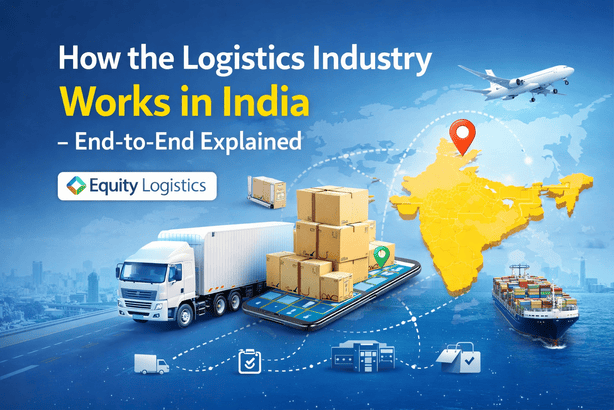
How Does A Logistics Company Work (Detailed Explanation)
India is one of the fastest-growing economies in the world, and at the heart of this growth lies the powerful engine of the Logistics Industry India. From raw materials moving from factories to finished goods reaching customers, the logistics ecosystem connects every part of the supply chain.
In 2026, the demand for advanced Logistics service India and technology-driven Logistics solutions India is higher than ever. With booming eCommerce, manufacturing expansion, government infrastructure projects, and global trade, logistics is no longer just transportation — it is strategic supply chain management.
In this comprehensive guide, we explain:
- What is the Logistics Industry India?
- How logistics works end-to-end
- Types of logistics services
- Role of technology in logistics
- Challenges and opportunities
- Future of logistics in India
- How Equity Logistics delivers optimized logistics solutions
1. What is the Logistics Industry in India?
The Logistics Industry India refers to the organized movement, storage, and management of goods from origin to final consumption. It includes:
- Transportation (road, rail, air, sea)
- Warehousing
- Inventory management
- Packaging
- Freight forwarding
- Supply chain coordination
- Last-mile delivery
India’s logistics sector contributes nearly 14% of GDP, making it one of the most important industries for economic growth.
With increasing digital transformation, modern Logistics service India providers now offer integrated supply chain visibility, automation, AI tracking, and predictive planning.
2. End-to-End Flow of Logistics in India
To understand how the Logistics Industry India works, let’s break it down step by step.
Step 1: Procurement & Supplier Movement
The journey starts when manufacturers procure raw materials. Logistics providers arrange:
- Supplier coordination
- Inbound transportation
- Customs clearance (for imports)
- Temporary storage
Efficient Logistics solutions India reduces procurement delays and improves production efficiency.
Step 2: Manufacturing & Internal Movement
Once raw materials reach factories:
- Internal logistics handles storage
- Inventory tracking systems manage stock
- Production planning integrates supply chain software
Advanced Logistics service India integrates ERP systems for real-time stock visibility.
Step 3: Warehousing & Storage
Warehousing is a critical component of the Logistics Industry India.
Types of warehouses:
- Public warehouses
- Private warehouses
- Bonded warehouses
- Cold storage facilities
- Automated smart warehouses
Modern logistics solutions include:
- Barcode scanning
- RFID tracking
- AI-powered demand forecasting
- Warehouse Management Systems (WMS)
Companies like Equity Logistics offer smart warehousing integrated with transport networks.
Step 4: Transportation & Freight Movement
Transportation is the backbone of Logistics service India.
India uses a multimodal transport system:
- Road Transport (60%+ of freight movement)
- Rail Freight
- Air Cargo
- Sea Freight
Logistics companies plan:
- Route optimization
- Fuel efficiency
- Cost management
- Real-time vehicle tracking
Technology-driven Logistics solutions India ensure faster and safer goods movement.
Step 5: Distribution & Last-Mile Delivery
This is the final stage where goods reach:
- Retailers
- Distributors
- eCommerce customers
- Direct-to-consumer buyers
Last-mile delivery is one of the most complex parts of the Logistics Industry India, especially in urban and rural regions.
AI-based route planning, delivery tracking apps, and automated notifications have transformed modern Logistics service India.
3. Types of Logistics Services in India
The Logistics Industry India is divided into multiple service categories:
-
1PL (First Party Logistics)- The manufacturer handles its own logistics.
-
2PL (Second Party Logistics)- Transportation providers (truck operators, shipping companies).
-
3PL (Third Party Logistics)- End-to-end logistics services including warehousing and transport.
-
4PL (Fourth Party Logistics)- Full supply chain management, technology integration, optimization.
-
5PL (Fifth Party Logistics)- AI-driven, automated logistics networks.
Modern Logistics solutions India increasingly rely on 3PL and 4PL models.
4. Key Components of Logistics Service India
A. Transportation Management
- Fleet management
- GPS tracking
- Fuel monitoring
- Route optimization
B. Warehouse Management
- Inventory control
- Order processing
- Automation
- Robotics
C. Freight Forwarding
- International shipping
- Customs clearance
- Documentation management
D. Supply Chain Consulting
- Cost reduction strategies
- Demand forecasting
- Network design
Companies like Equity Logistics integrate these services under one platform for seamless logistics operations.
5. Technology Transforming the Logistics Industry India
The modern Logistics Industry India is powered by advanced technologies:
Artificial Intelligence
- Demand forecasting
- Route optimization
- Risk prediction
IoT (Internet of Things)
- Real-time vehicle tracking
- Temperature monitoring for cold chains
Blockchain
- Secure documentation
- Transparent transactions
Cloud-based Logistics Platforms
- Centralized data
- Real-time tracking dashboards
Automation & Robotics
- Automated warehouses
- Sorting systems
Technology-enabled Logistics solutions India significantly reduce operational costs and improve delivery speed.
6. Major Challenges in Logistics Industry India
Despite growth, the industry faces challenges:
- High fuel costs
- Infrastructure gaps
- Traffic congestion
- Regulatory compliance
- Fragmented transport sector
However, initiatives like:
- National Logistics Policy
- Dedicated Freight Corridors
- Digital India
are transforming the future of Logistics service India.
7. Role of Equity Logistics in Modern Logistics Solutions India
Equity Logistics is emerging as a trusted name in the Logistics Industry India by offering:
- End-to-end logistics services
- Technology-integrated supply chain management
- Real-time shipment tracking
- Customized logistics solutions
- Cost-efficient transport networks
The company focuses on providing scalable Logistics solutions India for:
- Manufacturing
- eCommerce
- FMCG
- Retail
- Pharmaceuticals
By combining operational expertise with digital innovation, Equity Logistics ensures seamless supply chain execution.
8. Industries Served by Logistics Service India
The Logistics Industry India supports nearly every major industry:
- eCommerce
- Retail
- Automobile
- Pharmaceuticals
- Agriculture
- FMCG
- Manufacturing
- Construction
Each industry requires customized Logistics solutions India based on speed, temperature control, safety, and compliance needs.
9. Future of Logistics Industry India in 2026 and Beyond
The future of Logistics service India is driven by:
- AI-powered automation
- Green logistics (EV fleets)
- Drone delivery trials
- Hyperlocal delivery networks
- Smart warehouses
- Data-driven supply chains
By 2030, India aims to reduce logistics costs from 14% to 8% of GDP, making the country globally competitive.
Companies investing in advanced Logistics solutions India will dominate the market.
10. Why Businesses Need Professional Logistics Solutions India
Businesses today cannot afford delays, inventory loss, or inefficient transportation.
Professional Logistics service India provides:
- Faster delivery cycles
- Reduced operational costs
- Improved customer satisfaction
- Better inventory control
- Scalability during demand spikes
Partnering with reliable logistics providers like Equity Logistics ensures long-term operational success
Conclusion
The Logistics Industry India is not just about transporting goods — it is about managing complex supply chains efficiently.
From procurement to last-mile delivery, modern Logistics service India combines transportation, warehousing, technology, and strategic planning.
With digital transformation and government initiatives accelerating growth, the future of Logistics solutions India looks stronger than ever.
Businesses that adopt advanced logistics strategies and partner with trusted providers like Equity Logistics will gain a competitive advantage in 2026 and beyond.
Frequently Asked Questions (FAQ)
What is the Logistics Industry India?
The Logistics Industry India refers to the complete system of transportation, warehousing, inventory management, freight forwarding, and last-mile delivery that enables goods to move from manufacturers to consumers. It plays a crucial role in supporting manufacturing, eCommerce, retail, agriculture, and global trade across the country.
What are the main components of Logistics service India?
A professional Logistics service India typically includes transportation (road, rail, air, and sea), warehousing, order fulfillment, inventory management, supply chain coordination, and real-time tracking. Advanced logistics providers also offer AI-based route optimization and digital supply chain solutions.
How do Logistics solutions India help businesses grow?
Modern Logistics solutions India help businesses reduce operational costs, improve delivery speed, enhance inventory control, and increase customer satisfaction. By optimizing supply chain processes, companies can scale operations efficiently and maintain competitive advantages.
What is the difference between 3PL and 4PL in the Logistics Industry India?
In the Logistics Industry India, 3PL (Third-Party Logistics) providers handle transportation, warehousing, and distribution services. 4PL (Fourth-Party Logistics) providers manage the entire supply chain strategy, including technology integration, optimization, and coordination of multiple logistics partners.
Why is technology important in Logistics service India?
Technology is transforming Logistics service India through AI, IoT tracking, automation, and cloud-based platforms. These technologies enable real-time shipment tracking, demand forecasting, route optimization, and warehouse automation, resulting in faster and more cost-effective logistics operations.
Which industries depend heavily on Logistics solutions India?
Industries such as eCommerce, retail, manufacturing, pharmaceuticals, FMCG, agriculture, and automotive rely heavily on efficient Logistics solutions India to ensure timely delivery, inventory accuracy, and supply chain stability.
What challenges does the Logistics Industry India face?
The Logistics Industry India faces challenges like high transportation costs, fuel price fluctuations, infrastructure gaps, traffic congestion, and regulatory complexities. However, digital transformation and government initiatives are helping overcome these issues.
How does last-mile delivery impact Logistics service India?
Last-mile delivery is one of the most critical and complex parts of Logistics service India. It directly impacts customer satisfaction, delivery speed, and operational costs. Advanced route planning and hyperlocal delivery networks are improving last-mile efficiency in India.
How can a company choose the right Logistics solutions India provider?
Businesses should evaluate a logistics provider based on service coverage, technology integration, industry expertise, scalability, real-time tracking capability, and customer support. Choosing an experienced company like Equity Logistics ensures reliable and optimized logistics services.
What is the future of the Logistics Industry India?
The future of the Logistics Industry India is driven by automation, AI-powered supply chains, electric vehicle fleets, smart warehouses, and digital logistics platforms. These advancements will reduce costs and improve delivery efficiency across India.